
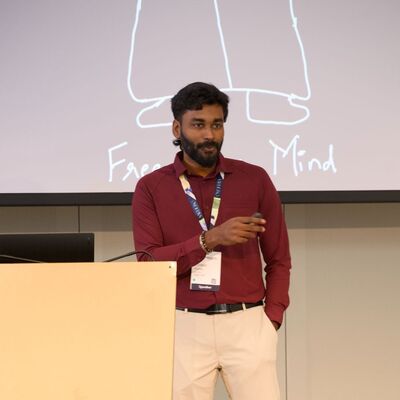
Divakar Kumar
Technical Architect @FlyersSoft | Microsoft MVP | MCT
Chennai, India
Actions
Divakar Kumar is a Microsoft MVP in AI and a Microsoft Certified Trainer (MCT), working as a Technical Architect at Flyerssoft. He actively shares his knowledge through blogs, talks, and training sessions, empowering developers to harness the potential of AI in real-world applications.
Badges

Area of Expertise
Topics
Unlocking Multi-Hop Reasoning with GraphRAG
Retrieval-Augmented Generation (RAG) has become a standard pattern for grounding large language models—but most implementations rely solely on vector similarity search. While useful, this approach often misses the most important aspect of knowledge: relationships.
In this session, we explore how to build a GraphRAG system using Neo4j, where context is not just retrieved—but connected. We’ll design a graph-native architecture that combines a domain graph (events, speakers, sessions) with a lexical graph (documents, chunks, embeddings), and show how linking them unlocks richer, explainable AI responses.
Using real-world scenarios, you’ll see how graph traversal strategies—such as breadth-first and depth-first search—enable multi-hop reasoning that traditional vector RAG cannot achieve. Instead of returning isolated chunks, GraphRAG traverses relationships to surface deeper insights, including attribution, context, and cross-document connections.
We’ll also dive into how Cypher-powered retrieval complements vector search, allowing you to move from “similar text” to precise graph queries. You’ll learn when to rely on embeddings, when to traverse the graph, and how to combine both effectively within Neo4j.
Finally, we extend the architecture using an agentic AI layer, where intelligent agents dynamically decide:
When to use vector similarity vs graph traversal
How to decompose complex, multi-part questions
How to generate and execute Cypher queries for structured retrieval
This results in a flexible, production-ready system capable of handling both exploratory and deterministic queries.
By the end of this session, you will learn:
How to model and connect lexical + domain graphs in Neo4j
How to implement GraphRAG with traversal strategies
How to leverage Cypher for structured, explainable retrieval
How to orchestrate retrieval using agent-based patterns
Real-Time Fraud Detection at Scale
This session demonstrates three architectural patterns for building real-time decision systems with Azure Cosmos DB: Event Sourcing with hierarchical partition keys for immutable audit trails, temporal queries, and scalable event storage ; Change Feed pattern for push-based event notifications that trigger instant materialized view updates without polling; and Event-Driven Integration for capturing domain events from existing databases (PostgreSQL, Oracle, MongoDB) through Azure Service Bus while keeping source systems authoritative. Through a live fraud detection demo that combines traditional ML for clear-cut cases and Agentic AI for uncertain scenarios, you'll see how these patterns enable fast decisioning, complete auditability, and seamless integration across heterogeneous data sources.
Secure DevOps with managed identites
In this session you will learn how to deploy and run your solutions securely in Azure using the Microsoft Identity Platform, ARM, service principals and Managed Identities.
Understanding the power of WebSockets
We will cover how WebSockets helps us to develop real-time medium web applications. We will achieve this using Azure Functions (WebPubSub trigger) and Azure WebPubSub Service.
OpenTelemetry Tracing with Azure Cosmos DB
Traces are relatively new to many of us and connecting different components in a distributed system is even harder. But to understand the behavior of any architecture we would need traces.
In this session we will see how to implement tracing and will deep dive into some of the metrics that could help us in debugging Azure Cosmos DB in your entire flow.
OpenTelemetry for Generative AI applications
The rise of Generative AI and agentic workflows has introduced new challenges in monitoring and observability. Applications powered by large language models (LLMs) involve dynamic interactions across multiple agents, tools, and APIs, creating complex workflows that demand robust monitoring. This session demonstrates how to implement OpenTelemetry in .NET for Generative AI applications, focusing on multi-agent systems and their unique requirements.
Through the lens of a real-world travel agency application, we’ll explore how agents interact to handle flight queries, weather updates, and ticket bookings in a seamless workflow. The session will cover:
- Instrumenting OpenTelemetry in LLM workflows to trace interactions across agents.
- Monitoring iterative loops in agentic workflows to identify bottlenecks and optimize performance.
- Addressing common observability challenges, such as distributed tracing, metrics collection, and logging in generative AI applications.
Implementing Aggregator pattern in Multi-Agent workflows
As GPT-powered applications and copilot tools become integral to modern solutions, the creation of semantic layers over databases has become essential. This session explores how semantic layers can enhance GPT models' understanding of complex datasets by incorporating business context using Aggregator pattern, thereby improving the accuracy and relevance of generated responses.
We will demonstrate how to mirror databases into Microsoft Fabric's analytics zones, enabling seamless integration of diverse data sources for advanced analytics and insights. In microservice-based architectures, teams often leverage varied databases such as Azure SQL and Azure Cosmos DB. While the copilot application might primarily interact with Cosmos DB, we will showcase how Microsoft Fabric’s OneLake can unify these data silos by creating combined views across disparate sources, facilitating real-time analytics and robust BI reporting.
Attendees will gain practical insights into building real-time semantic layers on Azure Cosmos DB using the change feed, ensuring GPT models remain context-aware and updated. Additionally, we will illustrate methods to integrate supplementary data sources into Microsoft Fabric, creating enriched datasets tailored for copilot applications and business intelligence needs.
Mapping the Invisible: Graph-Powered Archaeology with Neo4j, LiDAR, and LLMs
Archaeology often begins with clues hidden in terrain: a raised mound here, a linear depression there — the silent traces of a vanished world. This talk introduces Archaios, a graph-driven platform that uses Neo4j to represent, reason about, and orchestrate the discovery of archaeological features from LiDAR and historical data.
The system combines a semantic graph model of terrain features, place-names, and historic references with a multi-agent framework powered by Autogen. Agents coordinate tasks like terrain segmentation, image analysis via GPT-4 Vision, and classification of possible man-made features. When candidates are found, they’re logged in Neo4j as hypotheses and routed to archaeologists via a notification system for final confirmation.
You’ll learn how Neo4j serves as a central semantic hub — encoding spatial relationships, human feedback, and interpretive hypotheses — while agentic LLMs act as flexible analysts. We’ll explore how to combine structured and unstructured reasoning in a graph-native architecture, and how feedback loops improve both discovery and trust in AI-supported domains.
Exploring Hidden Worlds with Cloud-Native AI and Multi-Agent Systems
Archaeological research today struggles with siloed LiDAR data, satellite imagery, and scattered historical records. Archaios demonstrates how a cloud-native, AI-powered knowledge graph can unify these sources and enable discovery at scale.
Built on Neo4j and Azure Cosmos DB, Archaios constructs a semantic layer that links terrain models, spectral imagery, and historical documents into an interconnected knowledge graph. This foundation powers multi-agent reasoning with Microsoft’s Semantic Kernel, where AI experts — Archaeology Analyst, Terrain Specialist, and Environmental Expert — collaborate across graph relationships to surface hidden patterns, anomalies, and candidate sites.
In this session, Divakar Kumar shows how event-driven Azure Durable Functions orchestrate LiDAR and spectral processing pipelines, while graph-based representations unlock semantic search, historical context retrieval, and explainable insights. You’ll also see how gamified collaboration enables archaeologists and explorers to contribute knowledge back into the graph, creating a living, evolving map of human history.
Whether you’re building intelligent applications, scaling knowledge-centric systems, or exploring how Neo4j + multi-agent AI can transform real-world domains, this session will inspire you to think beyond data pipelines and into knowledge-driven discovery.
EventKernel: Multi-Hop Reasoning and GraphRAG for AI-Powered Event Intelligence
Vector search has revolutionized semantic retrieval, letting systems surface relevant results from natural language input. But when users ask nuanced, open-ended questions—like “Which sessions match my interests and are presented by speakers I haven’t seen before?”—semantic similarity alone falls short. It retrieves results, but can’t reason over relationships, enforce constraints, or explain why something was chosen.
In this session, we explore how combining vector search, knowledge graphs, and multi-hop reasoning creates a more intelligent and trustworthy retrieval experience. Using examples from EventKernel, an event intelligence platform built on Neo4j, we demonstrate how dynamic user queries are interpreted into hybrid retrieval flows:
- Vector-only: fast, flexible, but opaque
- GraphRAG: vector search anchored in Neo4j for semantically grounded and structurally accurate answers
- Graph Reasoning: deterministic Cypher-based lookups where logic, depth, and context matter
Attendees will learn how to structure queries dynamically, blend embeddings with graph traversals, and enforce explainability in AI assistants—all while keeping performance and safety in check.
Agentic Event-Driven Systems: When Events Talk Back
Fraud detection has always been a race against time. In traditional event-sourced systems, every transaction, login, or transfer is captured as a sequence of immutable events. These events tell a clear story — but only after the fact. What if events could do more than just record history? What if they could talk back?
In this talk, we’ll explore how agentic event-driven systems transform fraud detection. Imagine every PaymentInitiated, LoginAttempt, or DeviceChanged event not just being logged, but immediately consumed by an autonomous Fraud Detection Agent. This agent correlates events across accounts, reasons over historical event streams, and generates new events like SuspiciousActivityFlagged or TransactionHeldForReview.
Through a real-world inspired use case in banking and digital payments, we’ll show:
- How event sourcing provides the perfect memory layer for fraud detection agents
- Patterns for agents to safely inject new domain events without violating invariants
- How to avoid runaway feedback loops when multiple agents interact (e.g., fraud + compliance + customer service agents)
- Governance, auditing, and explainability challenges when autonomous agents take part in mission-critical workflows
By the end of this session, you’ll see how event-driven DDD systems evolve when agents stop being passive consumers and start actively shaping the event stream — turning fraud detection from a reactive process into a proactive, adaptive defense.
Azure Cosmos DB as a Time Machine: Event Sourcing for Real-Time Intelligence
What if your database was a time machine? With Cosmos DB and event sourcing, every change is immutable and replayable. Add agents on the change feed, and events don’t just record history — they detect fraud, flag anomalies, and shape the future in real time.
Azure Cosmos DB Snap
In this session, we'll explore how Azure Cosmos DB empowers cutting-edge AI workflows by seamlessly integrating diverse functionalities, including vector storage, semantic layering, and mirroring capabilities with Microsoft Fabric for enhanced data analytics and visualization.
Learn how Durable Multi-Agents, built with .NET's Semantic Kernel and Azure Durable Functions, utilize Azure Cosmos DB to orchestrate complex, scalable, and reliable AI-powered operations. We'll discuss how Azure Cosmos DB serves as:
1. A vector store to enable efficient similarity search and knowledge retrieval.
2. A semantic layer for generating better results in RAG scenarios with natural language-to-SQL conversion.
3. A mirroring solution with Microsoft Fabric, enabling automated data synchronization for actionable insights and analytics.
This session will showcase real-world examples of multi-agent setups managing dynamic, large-scale datasets while maintaining high availability and performance. Whether you're building intelligent agents, crafting actionable analytics, or optimizing your AI pipelines, you'll gain actionable strategies to leverage Azure Cosmos DB’s versatility in your projects.
Bounded Contexts in Action: Designing Durable Multi-Agent Workflows
In complex systems, bounded contexts help define clear boundaries for distinct functionalities, making it easier to manage domain complexity. When applied to multi-agent workflows, bounded contexts ensure each agent operates independently while collaborating seamlessly within the larger system. This session explores how to design durable workflows by assigning specific responsibilities to agents within their bounded contexts. Attendees will learn to implement fault-tolerant, stateful, and long-running workflows using Azure Durable Functions, ensuring agents communicate effectively while maintaining their autonomy.
Azure Function extension library to handle Cross-cutting concerns
In the talk we will see how the library that I developed in .NET will help us in solving the middleware access within Azure Function ( In-process mode)
It helps us to handle cross-cutting concerns in both HTTP and non-HTTP triggers.
Building Durable Multi-Agents with Semantic Kernel and Azure Durable Functions
This session introduces a cutting-edge approach to developing Durable Multi-Agents using the powerful combination of .NET, Azure Durable Functions, and the Semantic Kernel.
We'll dive deep into how Semantic kernel with .NET helps us in building complex multi-agent workflows, enabling advanced patterns like Fan-Out/Fan-In and Function Chaining. Learn how the Semantic Kernel and Azure Cosmos DB come together to create a powerful NL2SQL layer, enhancing data-driven decision-making with vectorization for similarity-based queries.
This talk will showcase the high scalability and reliability that Azure Durable Functions brings to multi-agent systems, along with secure, managed identity connectivity to Azure OpenAI and Cosmos DB.
C# Notebooks with Azure Cosmos DB
Built-in Jupyter notebooks in Azure Cosmos DB enable you to analyze and visualize your data from the Azure portal.
In the demo I will be covering :
1. How to Run C# code interactively
2. Ways to Visualize your data
3. How to Use built-in magic commands
4. Steps to Connect your notebooks workspace to GitHub
Distributed tracing in .NET using OpenTelemetry shim
OpenTelemetry for .NET provides an API shim on top of the System. Diagnostics- based implementation. This shim is helpful if you’re working with other languages and OpenTelemetry in the same codebase, or if you prefer to use terminology consistent with the OpenTelemetry spec.
Over the talk we will take a real world scenario that comprises of different microservices that uses Kafka as a message broker. We will see how to use the shim library to perform manual instrumentation and In order to visualize and analyze our traces, we will export them to a backend such as Jaeger.
Enterprise-GPT: Harnessing the Power of Azure OpenAI on your data
In the session I will cover, how to leverage the cutting-edge capabilities of Azure OpenAI to build and deploy intelligent applications tailored to your organization's unique needs
Event-Driven Multi-Agent AI at scale
Learn how to architect production-grade AI systems that combine event-driven serverless patterns with multi-agent orchestration. This talk walks through a real archaeological research platform processing terabyte-scale LiDAR terrain data, demonstrating critical design patterns: durable workflows for long-running AI operations, fan-out/fan-in for parallel agent execution, external event correlation for human-in-the-loop approval, and state management across distributed agent conversations. See how Microsoft's Agent Framework (Semantic Kernel + AutoGen) simulates realistic expert collaboration, archaeologists debating terrain features, environmental analysts cross-referencing satellite data, and historians validating findings through natural multi-turn dialogue.
What attendees will learn:
- Implementing Durable Functions patterns: fan-out/fan-in, external events, human approval gates, and long-polling for async container workloads
- Managing conversational state across multi-agent systems using Microsoft Agent Framework orchestration
- Designing event-driven pipelines that trigger on blob storage events and coordinate distributed AI processing
- Simulating domain-expert collaboration: building agents that maintain context, debate conclusions, and reach consensus like real archaeologists
- Combining DiskANN vector search (Cosmos DB) with graph relationships (Neo4j) for stateful knowledge retrieval
CosmicTalent: Workforce Efficiency with AI-Driven Vector Search
By leveraging the native vector search feature in Azure Cosmos DB for MongoDB vCore, we will develop a intelligent application that allows organization to do resource mapping and talent optimization in a better and efficient way.
We will start by uploading the resume of all employees via API/batch processing , which is then used by AI Document Intelligence to extract semantic chunks and stored in our vector database. Now, Manager/Business/HR users, queries with relevant JD or custom queries. Query is then vectorized, and then uses it in a vector query against the data stored in Azure Cosmos DB for MongoDB vCore. The results are then passed to Azure OpenAI Service which will then helps in listing all relevant candidates who are currently in bench.
Bracing for Tsunamis with OpenAI Autoscaler
Join me to learn how to harness the power of prompt engineering to transform language models into intelligent autoscalers. We will learn how to fine-tune these models for specific tasks and walk through the process step by step.
At the end of the session I will do a live demonstration, where we will showcase how the sentiment analysis of the ongoing game can dynamically influence the scaling of a virtual machine cluster.
Transactional outbox pattern with Azure Cosmos DB
In a distributed system we might typically involve publishing events/messages via a message broker to other services, where we might face challenges in the reliability and guaranteed delivery of those events. In this session we will learn how to overcome it using Transactional Outbox pattern with Azure Cosmos DB
From Data to Insights : Azure Cosmos DB in IoT workloads
In the session we will see how to use Raspberry Pi with PM sensor and GPS sensor to measure air quality.
Takeaways
- How to setup Azure Cosmos DB as a custom routing endpoint
- When to use Synthetic Partition Key
- Integration of Synapse analytic + Azure Cosmos Db
- Visualizing data in Power BI
Microservices: Saga orchestration using outbox pattern
This session aims at displaying what a practical implementation of an Event-Driven Architecture (using Event Streaming) would look like in the context of a Microservice system that uses the Saga-Choreography pattern for communication.
We would also be touching upon the associated design concepts including Async APIs for Events and implementation of observability in such a system that relies on events for communication between the components (traces/spans and dependency graphs )
Build Serverless Web Pub Sub using Azure Functions
In the Demo we will see how to develop real time speech translator Web Pub Sub using Functions App
Demo is based on a tool that allows you to host a session and listen to it, in any preferred languages .
Speech are transcribed and translated using Azure cognitive services . It is then pushed to Web Pub sub with the help of Azure Functions , by which all the listeners who are subscribed to this session can see the translations with their preferences.
What happens when PubSub meets Azure Static Web App ?
In the Demo we will see how to develop real time speech translator Web Pub Sub using Functions App
Demo is based on a tool that allows you to host a session and listen
to it, in any preferred language .
Speech is transcribed and translated using Azure cognitive services .It is then pushed to Web Pub sub with the help of Azure Functions , by which all the listeners who are subscribed to this session can see the translations with their preferences
Build integrated workflows with Event Grid and Logic Apps
In the Demo
- We will discuss on the use case that we are trying to solve.
- Create Custom CloudEvent v1.0 event types.
- Challenges that we face in Logic Apps for the CloudEvent support.
- Workaround for implementing it , to support CloudEvent.
- Will trigger approval-based automations based on the model.
Build Serverless Web Pub Sub using Azure Functions
In the Demo we will see how to develop real time speech translator Web Pub Sub using Functions App
Demo is based on a tool that allows you to host a session and listen to it, in any preferred languages .
Speech are transcribed and translated using Azure cognitive services . It is then pushed to Web Pub sub with the help of Azure Functions , by which all the listeners who are subscribed to this session can see the translations with their preferences.
Continuous Performance testing
We will learn about how to implement continuous performance testing using Azure Load testing and GitHub Actions.
Middleware pattern for Azure Functions
We all are aware that from .NET 5 release we have two modes in which we can run Azure Functions
- Out-Of-Process
- In-Process
Out-of-process or Isolated mode have ability to define middleware as on out-of-box feature. But we will see how to achieve the same in the traditional Azure Functions using my open-source library AzureFunctions.Extensions.Middleware
Introduction to Azure Load Testing for developers
we will cover everything that you need to kickstart your performance testing with Azure Load Test service
Real-time cosmic chat
In the demo we will cover how to built a Cosmic chat application in real time using Azure cosmos Db + Azure Functions + Azure Web PubSub
Secretless in Serverless
In this workshop we will learn about how to manage secrets built on .NET 6 function app.
Real-world Event sourcing with Redis as Read model and Azure SQL as Write model
As part of this demo , I will be providing a brief introduction on Event sourcing in distributed systems and how to chose the right model for your application.
We will develop an application with an use case to cover all below points
- CQRS
- Azure Function to build REST API
- Azure Service Bus
- Azure Redis
- Design patterns
Build everything on Serverless !
In the Demo
* We will see how to develop Angular SPA and host it on Azure Static Web app and will use integrated API ( Azure Function ) to develop our translator modules , authentication .
* We will see how to use workflows using Azure Logic Apps to trigger invite mail once a user login to our application
* Finally we will also cover Serverless Cosmos DB which is used as our persistence layer.
Serverless Middleware in Azure Functions
When it comes to microservice architecture , sometimes all you wanted is to perform cross cutting concerns ( logging, authentication , caching, CORS, Routing, load balancing , exception handling , tracing, resiliency etc..) and also there might be a scenario where you wanted to perform certain manipulations on your request payload before hitting into your actual handler. And this should not be a repetitive code in each of the services , so all you might need is a single place to orchestrate all these concerns and that is where Middleware comes into the picture. In the demo I will be covering how to orchestrate these cross cutting concerns by using Azure functions as a Serverless model both in current runtime and as well in out-of-process model which is still in preview stage
Serverless Middleware in Azure Functions
When it comes to microservice architecture , sometimes all you wanted is to perform cross cutting concerns ( logging, authentication , caching, CORS, Routing, load balancing , exception handling , tracing, resiliency etc..) and also there might be a scenario where you wanted to perform certain manipulations on your request payload before hitting into your actual handler. And this should not be a repetitive code in each of the services , so all you might need is a single place to orchestrate all these concerns and that is where Middleware comes into the picture. In the demo I will be covering how to orchestrate these cross cutting concerns by using Azure functions as a Serverless model.
Microsoft Azure Skillup Tamilnadu Session 2025 User group Sessionize Event Upcoming
AI Engineer World's Fair 2026 Sessionize Event
Domain-Driven Design Europe and Data Mesh Live 2026 Sessionize Event
Azure Cosmos DB Conf 2026 Sessionize Event
NODES AI 2026 Sessionize Event
FABCON 2026 & SQLCON 2026 - SESSIONS Sessionize Event
NODES 2025 Sessionize Event
Global Azure 2025-Chennai Sessionize Event
KCD Chennai 2025 Sessionize Event
Azure Cosmos DB Conf 2025 Sessionize Event
Microsoft Fabric Community Conference Sessionize Event
Azure AI Connect Sessionize Event
Azure Cosmos DB Conf 2024 Sessionize Event
Global AI Bootcamp 2024 - Chennai Sessionize Event
Global Azure 2023-Chennai Sessionize Event
Global Azure 2022-Chennai Sessionize Event
Global Azure 2022 Sessionize Event
DeveloperWeek Europe 2022 Sessionize Event
Azure Cosmos DB Conf 2022 Sessionize Event
DeveloperWeek Global (Management, Cloud, Enterprise) 2021 Sessionize Event
Azure Community Conference 2021 Sessionize Event
Virtual NetCoreConf 2021 - 2 Sessionize Event
Azure Serverless Conf Sessionize Event
Azure Back to School 2021 Sessionize Event
Global Azure 2021-India Sessionize Event
Global Azure 2021 Sessionize Event
Please note that Sessionize is not responsible for the accuracy or validity of the data provided by speakers. If you suspect this profile to be fake or spam, please let us know.
Jump to top