

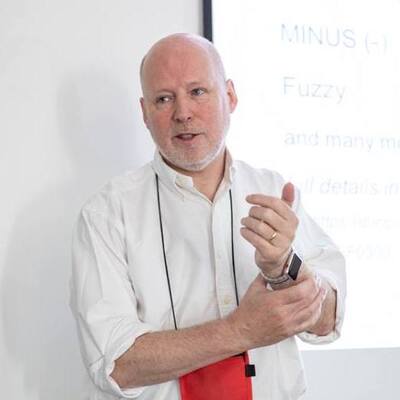
Niall McPhillips
♠︎ Oracle ACE Director. PL/SQL devt. ORDS. APEX. Data Models. REST + Web Services. Multimedia. Text. Int'l Organisations. Energy.
Genève, Switzerland
Actions
Niall McPhillips is an Oracle ACE Director and a member of Symposium 42. He has presented many times at international conferences on different subjects including the use of Oracle technologies including APEX, ORDS, PL/SQL, REST, JSON, Oracle Text, SODA, Multimedia as well as on his experiences with the implementation of large APEX projects.
He has been using Oracle since 1989, has been using Oracle PL/SQL Web technologies since 1995 and Oracle APEX since 2005.
Niall has developed many large, multilingual applications for multinational companies and organisations all over the world. He is a strong believer in PL/SQL and APEX solutions because of their stability, scalability, and rapid development speed.
Links
Area of Expertise
Topics
Quien busca, encuentra: explorando las nuevas opciones de búsqueda en Oracle 26ai
Esta presentación abordará AI Vector Search y la nueva AI Vector Hybrid Search, junto con otras técnicas de búsqueda más clásicas.
Con las recientes incorporaciones de 26ai - AI Vector Search, Hybrid Vector/Text Search y Ubiquitous Search - junto con las búsquedas clásicas, como Text Search y Simple Search, comprender estas opciones de búsqueda es fundamental para elegir el enfoque adecuado al desarrollar aplicaciones en PL/SQL y otras tecnologías de Oracle.
Esta sesión explorará las características de cada técnica de búsqueda, destacando sus ventajas y desventajas a través de ejemplos del mundo real, demostraciones en vivo y debates. Los asistentes obtendrán información clave sobre los factores a tener en cuenta al seleccionar e implementar la estrategia de búsqueda que mejor se adapte a sus necesidades.
Declarative Search in APEX: Harnessing the Power of Search Configurations
Search is at the heart of many APEX applications, but implementing it well has often required custom code, clever SQL, or workarounds.
With the first introduction of Search Configurations in APEX 22.2, the APEX team has delivered a declarative way to define how users can search across your applications.
Since then, the feature has expanded rapidly, incorporating support for Progressive Query Relaxation, as well as Ubiquitous Database Search (APEX 23.2) and AI Vector Search (APEX 24.2).
In this session, we will:
- Explore how to declaratively define search sources (local tables, REST Data Sources, Ubiquitous Search, vector embeddings).
- Demonstrate how to build intuitive search pages and regions without writing custom PL/SQL or JavaScript.
- Show real-world examples of combining full-text, metadata, and semantic AI search in an APEX application.
- Take a peek "under the hood" to see what is happening at the database query level
Búsqueda declarativa en APEX: el poder de las configuraciones de búsqueda
La búsqueda está en el corazón de muchas aplicaciones APEX, pero implementarla correctamente suele haber requerido código a medida, SQL ingenioso o distintos tipos de soluciones alternativas.
Con la introducción inicial de las configuraciones de búsqueda en APEX 22.2, el equipo de APEX incorporó una forma declarativa de definir cómo los usuarios pueden buscar dentro de las aplicaciones.
Desde entonces, esta funcionalidad se ha expandido rápidamente, incorporando soporte para Progressive Query Relaxation, así como para Ubiquitous Database Search (APEX 23.2) y AI Vector Search (APEX 24.2).
En esta sesión vamos a:
- Explorar cómo definir de forma declarativa las fuentes de búsqueda (tablas locales, REST Data Sources, Ubiquitous Search y embeddings vectoriales).
- Demostrar cómo construir páginas y regiones de búsqueda intuitivas sin escribir código PL/SQL ni JavaScript a medida.
- Mostrar ejemplos reales de cómo combinar búsqueda de texto completo, metadatos y búsqueda semántica basada en IA dentro de una aplicación APEX.
- Dar un vistazo “debajo del capó” para entender qué está ocurriendo a nivel de consultas en la base de datos.
AI Vector Search en acción: desarrollando una API REST con 26ai, ORDS, PL/SQL
AI Vector Search es un nuevo y potente conjunto de herramientas de IA que ya forma parte integral de Oracle 23ai.
ORDS es la herramienta insignia de Oracle para la implementación de servicios web RESTful en PL/SQL.
En esta presentación, a través de ejemplos prácticos en vivo, los asistentes aprenderán cómo construir una API REST para integrar la nueva funcionalidad de AI Vector Search de Oracle 26ai en sus aplicaciones.
En conjunto, desarrollaremos una API REST independiente de la tecnología, que podrá ser utilizada tanto desde entornos Oracle como desde entornos no Oracle.
Los temas que se abordarán incluyen:
- introducción a la búsqueda vectorial y a AI Vector Search de Oracle 26ai
- una breve introducción a la creación de servicios web con ORDS en PL/SQL
- definición de una API de búsqueda vectorial
- desarrollo de una API de búsqueda vectorial utilizando ORDS, PL/SQL
- protección OAuth2 de la nueva API
Building an AI Vector Search API using 23ai, ORDS, REST webservices, PL/SQL
AI Vector Search is an exciting, powerful new set of AI tools that are already an integral part of Oracle 23ai.
ORDS is Oracle's flagship tool for implementing RESTful web services in PL/SQL.
In this presentation, through live, practical examples, attendees will learn how to build a REST API to incorporate Oracle 23ai's AI Vector Search into their applications.
We'll develop a technology-independent REST API that will be usable from both Oracle and by non-Oracle environments alike.
Topics to be covered include:
- introducing vector search and Oracle 23ai's AI Vector Search
- a brief intro to building ORDS web services in PL/SQL
- defining a vector search API
- developing vector search APIs using ORDS and PL/SQL
- securing the new API using OAuth2
Search and you shall find. A walk through the Oracle 23ai search landscape
This presentation will discuss AI Vector Search and the new AI Vector Hybrid Search, along with a few other more classic search techniques.
With recent 23ai additions — AI Vector Search, Hybrid Vector/Text Search and Ubiquitous Search — alongside the classic Text Search and Simple Search, understanding these search options is essential for choosing the right approach when building PL/SQL, APEX, and other Oracle applications.
This session explores the characteristics of each search technique, highlighting their advantages and disadvantages through real-world examples, live demonstrations, and discussions. Attendees will gain insights into the factors to consider when selecting and implementing the search approach that best meets their needs.
So, you've been asked to write an ORDS REST API ...
Designing and creating APIs with PL/SQL and ORDS
Oracle REST Data Services (ORDS) offers a powerful way to expose Oracle DB functionality over RESTful APIs. During this session, we’ll explore how developers can quickly build secure, high-performance, and scalable APIs using SQL and PL/SQL.
The presentation will include:
- creating ORDS modules, templates and handlers,
- practical patterns for defining REST endpoints,
- use of HTTP methods for CRUD operations,
- JSON design principles and working with JSON payloads,
- using HTTP response codes,
- pagination and filtering,
- adding OAuth2 security, and
- documenting your API with OpenAPI
What's Our Vector, Victor? Navigating AI Vector Searches in Oracle 23ai
In a fast changing environment, Oracle 23ai introduces an exciting new feature with its AI Vector Search capabilities.
We'll start with the essentials — demystifying the concept of AI Vector Search in the Oracle database. What are vectors, and how can they change our approach to search queries?
The presentation progresses to discuss real examples of how to prepare and generate your vectors for embedding in your database. It also covers the new search operators and functions introduced with this feature.
Moving beyond basics, we will delve into practical applications. Learn how to embed your vectors, transforming raw data into a rich, searchable landscape. We’ll explore the new search operators and functions that Oracle 23ai brings to the table through real-world examples.
We'll take a look at vector distances and measurement methods. Through illustrative examples, understand how similarity searches can be performed using AI Vector Search.
Bringing it all together, we will integrate it with PL/SQL and APEX applications. This will be a synthesis of theory and practice, showcasing the incorporation of AI Vector Search into database environments.
Building an AI Agent with PL/SQL, Oracle Text and APEX
What actually happens inside an AI agent? In this session we build an AI agent entirely in PL/SQL using Oracle Database 26ai and Oracle APEX, with no external framework. The agent's job is to answer plain-language questions using Oracle Text.
The idea is that the LLM never needs to know about Oracle Text CONTAINS syntax. It simply completes a structured request (must-have terms, alternatives, exclusions) which PL/SQL then validates, escapes and uses to build an Oracle Text query. If a search finds no results, the code broadens it automatically using fuzzy matching, stemming, query relaxation, and similar techniques .
We walk through the search tools exposed to the model, the REST call and agent loop that bring everything together, and the guardrails that help keep an agent behaving as we want it to. We also look at swapping a hosted model for a local one.
By the end, participants should have a better understanding of how agents work and have a simple pattern they can use to experiment with their own data.
Niall McPhillips
♠︎ Oracle ACE Director. PL/SQL devt. ORDS. APEX. Data Models. REST + Web Services. Multimedia. Text. Int'l Organisations. Energy.
Genève, Switzerland
Links
Actions
Please note that Sessionize is not responsible for the accuracy or validity of the data provided by speakers. If you suspect this profile to be fake or spam, please let us know.
Jump to top