
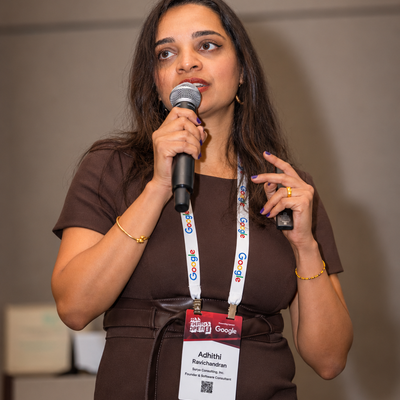
Adhithi Ravichandran
Software Consultant, Author, Speaker
Kansas City, Missouri, United States
Actions
Adhithi Ravichandran is a Software Consultant, Author, and Speaker based in Kansas City, and the founder of Surya Consulting, Inc. Through her consulting practice, she partners with organizations to build modern, scalable software systems while helping teams evolve their engineering practices in an AI-driven world.
With a passion for both technology and education, Adhithi has authored several highly rated Pluralsight courses, reaching over 140,000 students worldwide. Her teaching spans modern web development, including React, React Native, Next.js, GraphQL, and Cypress, as well as AI-focused topics such as Applied AI-Assisted Coding, with a strong emphasis on practical, real-world application.
Through Surya Consulting, Inc., Adhithi combines her deep expertise in modern frontend technologies with a strong focus on helping teams effectively adopt AI in the software development lifecycle. Her consulting work spans designing scalable architectures, guiding teams as they integrate AI into their workflows, and evolving engineering practices to support faster, higher-quality delivery. She works closely with developers to ensure AI is used thoughtfully enhancing productivity while maintaining high standards for code quality, security, and long-term system reliability.
Adhithi is also an active voice in the tech community, writing on Medium for an audience of over 20,000 monthly readers and speaking at conferences across the country. Her work is driven by a commitment to helping teams think more effectively, collaborate better, and build high-quality software in the age of AI.
Links
Area of Expertise
Topics
Thriving Beyond Code: Adaptability, Growth, and the Entrepreneurial Mindset in Tech
In a field where change is constant and new technologies appear almost daily, it can be challenging to know how to grow your career with confidence.
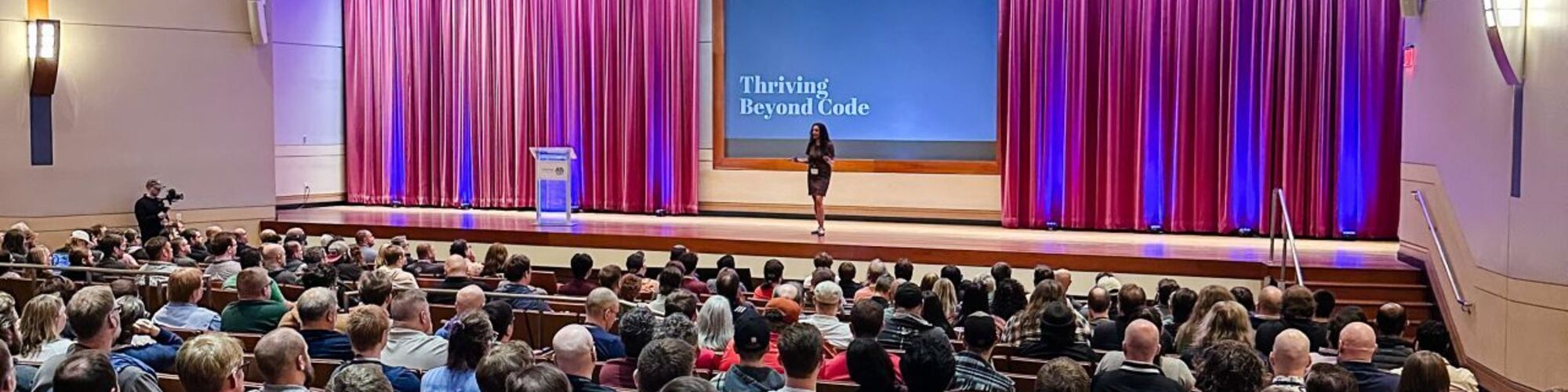
In this talk, I will share my personal journey of adapting and thriving in the ever-evolving landscape of software development. Starting as a C++ developer, transitioning to JavaScript and React, and ultimately becoming an entrepreneur, tech author and speaker, my career has been a testament to the power of adaptability.
Along the way, I learned that great engineers don’t stand out because of code quality alone; they stand out because they communicate clearly, collaborate effectively, and lead with empathy and confidence. These “beyond code” skills amplify our technical abilities and open doors to growth, influence, and new opportunities.
This talk will offer practical strategies for navigating change, deciding what to learn next, and cultivating an entrepreneurial mindset, no matter your role or career stage. You’ll leave with a refreshed perspective on your journey in tech and a roadmap for growing both your capabilities and your impact.
The Most Valuable Thing I Do Isn’t Writing Code
After years of building software, one realization stands out: the most valuable contributions rarely come from writing code.
This talk reflects on where real impact happens; defining the right problems, making decisions under uncertainty, and helping teams move in the same direction. As AI takes on more of the coding, these contributions become even more important.
This talk focuses on my personal look at how the role of an engineer evolves over time and why the work that matters most often isn’t the most visible.
Scaling End-to-End Testing with Cypress: Best Practices for Modern Web Apps
Modern web applications demand a robust end-to-end (E2E) testing strategy to ensure reliability, scalability, and seamless user experiences. Cypress has become a favorite among developers due to its speed, ease of use, and powerful debugging capabilities. However, as applications grow, so do the challenges in writing and maintaining efficient test suites. Flaky tests, slow execution times, and unreliable test environments can quickly become bottlenecks in a development workflow.
This talk explores how to scale Cypress effectively in modern web applications. We’ll dive into best practices for structuring test suites, handling flaky tests, and leveraging API stubbing for fast, reliable tests. Authentication, network requests, and session management can often introduce complexity in testing workflows. We will learn practical approaches to managing these challenges with Cypress’s built-in tools.
Beyond writing tests, we will also discuss strategies for running Cypress in CI/CD pipelines, optimizing test execution times, and parallelizing tests for improved efficiency. Whether you are testing a React, Vue, Angular, or traditional server-rendered application, this session will provide actionable insights on making Cypress a seamless part of your development and deployment process. Through real-world examples and live demonstrations, attendees will gain a deeper understanding of how to build scalable, maintainable test automation with Cypress.
React and Next.js: Building Future-Ready Web Applications
Join us for a half-day workshop dedicated to exploring the essentials of Next.js. This 4-hour session is designed to provide a solid understanding of Next.js for developers. We'll start with the basics of the framework, covering key concepts such as the app router and different rendering methods like server-side rendering (SSR) and static site generation (SSG). A special focus will be given to React Server Components (RSC), discussing their role and advantages in building modern web applications.
As we progress, the workshop will also include practical aspects of routing, data fetching, and strategies for optimizing your Next.js applications. The session concludes with a hands-on deployment experience using Vercel, where participants will apply what they've learned to deploy a functional Next.js application. This workshop is ideal for those looking to gain a comprehensive yet concise understanding of Next.js in a collaborative and hands-on environment.
Optimizing Next.js Applications with React Server Components and Server Actions
Your React app built with Next.js works, but is it truly optimized for performance? Slow load times and inefficient data handling can impact user experience and scalability, leading to frustrated users and higher infrastructure costs.
In this hands-on workshop, we will start with a Next.js application that lacks modern performance optimizations and gradually enhance it by implementing React Server Components (RSC) and Server Actions step by step. You will see how RSC reduces JavaScript bundle sizes, improves interactivity, and enables progressive rendering, while Server Actions make data updates more efficient by minimizing client-server communication.
Through guided demonstrations, we will transform the app from a traditional Next.js setup into an optimized, fast, and scalable application. By the end of the session, you will have a clear understanding of how to apply these techniques in your own projects to build faster, more responsive, and efficient Next.js applications.
AI Wrote the Code - Is It Secure?
AI-assisted development tools can generate code, tests, and even architectural patterns in seconds, dramatically accelerating how software is built. However, this speed also introduces new security challenges that many teams are not yet prepared to address. AI-generated code can include insecure patterns, outdated dependencies, improper authentication logic, or subtle vulnerabilities that may go unnoticed during rapid development cycles. As organizations increasingly rely on AI-assisted coding, ensuring that AI-generated software remains secure becomes a critical responsibility for developers and engineering teams.
In this session, we explore the security implications of AI-assisted development and the risks that emerge when developers rely too heavily on AI-generated code. Through practical examples, we will examine common vulnerabilities introduced by AI tools and demonstrate how insecure patterns can unintentionally make their way into production systems. The session will also walk through practical techniques for reviewing and validating AI-generated code, including dependency and supply chain checks, secret management, and integrating security scanning into CI/CD workflows.
By the end of this talk, attendees will gain a clearer understanding of how to balance the productivity benefits of AI-assisted development with the security practices required for modern applications. Developers will leave with practical strategies for reviewing AI-generated code, identifying potential vulnerabilities early, and implementing guardrails that allow teams to safely integrate AI into their development workflow without compromising application security.
From Prompt to Production: Lessons from Building an AI-Driven Design-to-Code Pipeline with Figma
AI tools promise to accelerate UI development by generating code directly from designs, but many teams quickly encounter real-world challenges: inconsistent components, high token usage, and unreliable outputs. Without a structured design system and a clear connection between design and engineering, AI-generated UI often fails to produce production-ready code.
In this session, I will share lessons from implementing an AI-driven design-to-code pipeline for an enterprise client using Figma. The team started with no established design system, component library, or theme tokens, making it difficult for AI tools to generate accurate UI components.
By combining Figma Make to bootstrap UI components, Model Context Protocol (MCP) optimization to improve how AI models understand design context, and Code Connect to link design components with real code components, we built a workflow that significantly improved the reliability of AI-generated UI.
The result was a streamlined pipeline that reduced token usage, increased component generation accuracy, and enabled developers to move from design to production-ready code much faster.
Attendees will learn practical strategies for structuring design systems and development workflows so AI-assisted UI generation can work reliably in real-world environments.
Learning Outcomes
• Understand why AI-generated UI code often fails without structured design systems
• Use Figma Make to bootstrap a component system when starting from scratch
• Structure design tokens and components so AI tools can interpret them effectively
• Optimize Model Context Protocol (MCP) to reduce token usage and improve code generation accuracy
• Use Code Connect to bridge design components with production code components
• Apply a practical framework for implementing an AI-driven design-to-code pipeline in enterprise environments
KCDC 2026 Sessionize Event
CommunityDays KC 2026 Sessionize Event
CodeStock 2026 Sessionize Event
KCDC 2025 Sessionize Event
KCDC 2024 Sessionize Event
CodeStock 2022 Sessionize Event
TechBash 2019 Sessionize Event
Music City Tech 2019 Sessionize Event
KCDC 2019 Sessionize Event
Chain React 2019 Sessionize Event
ByteConf React Native 2018
10 Lessons I Learned Using React Native
All Things Open
Using Redux for your react native application wisely.
Heartland Developers Conference
10 Lessons I learned using React Native
KCDC 2018 Sessionize Event
Lecturer - The University of Kansas
Lecturer at the Electrical Engineering and Computer Science Department.
Taught IT 416 - Software Architecture and Integration for the BS IT program.
The course introduces key concepts of Software architecture, requirements, middle-ware platforms, design patterns, quality assurance, agile methodologies, DevOps and system integration.
Google sponsored two day workshop - Computer Science for High School (CS4HS)
Conducted a two day Google sponsored workshop at the University of Kansas for teachers - Computer Science for High School (CS4HS).
The workshop provided hands on experience with the various apps that could assist teachers in the classroom.
The session provided exposure to Android apps that could help teachers in the classroom.
I developed simple Android programs and exercises that the teachers could use and get some practice on during the sessions.
Adhithi Ravichandran
Software Consultant, Author, Speaker
Kansas City, Missouri, United States
Links
Actions
Please note that Sessionize is not responsible for the accuracy or validity of the data provided by speakers. If you suspect this profile to be fake or spam, please let us know.
Jump to top