
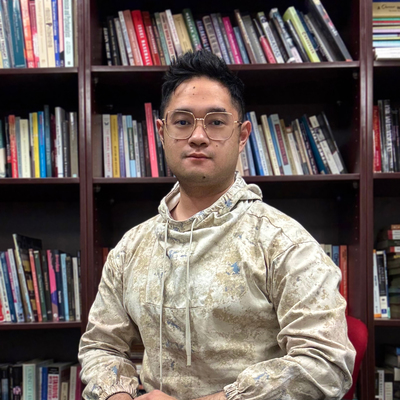
Allen Baylosis
Research Affiliate, A/P/A Institute at NYU
Actions
Allen Baylosis is a PhD candidate and has taught at the University of British Columbia in Asian Canadian & Asian Migration Studies and the Institute for Gender, Race, Sexuality & Social Justice. He holds an MA in Performance Studies from New York University and a BA in Speech Communication from the University of the Philippines Diliman. His writing has appeared in the Canadian Theatre Review and BC Studies. His current appointment is at New York University's Asian/Pacific/American Institute as a Research Affiliate to complete his doctoral dissertation, Filipino Brown Erotics: Racial Affect and Queer Performances of Excess, which examines how contemporary performances shape transnational and transformative conversations about queer, racial, cultural, and sexual politics in the Filipino Canadian diaspora and beyond.
Eroticizing Asian/America: Performing Unruly Bodies with/in Hopeful Commons
Both as and beyond sex, the erotics manifest as styles, as giftgiving, as care work, and as ritual. This panel tends to how feminist and queer diasporic artists conjure erotics’s unruly and disidentificatory capacity to imagine pleasurable and livable futures rooted in the present.
Diasporic Entanglements: Confronting Colonial Erasure through Diasporic Cultural Practices
This roundtable bridges artist-scholars based in Canada, the continental U.S., and Hawaiʻi to confront contradictions across Asian/Pacific American research, artistic work, and activism by offering situated knowledges and artistic practices. We interrogate our entanglements with histories of colonial occupation, displacement, and genocide, thus reimagining what it means to “be in diaspora.”
Beginning the roundtable, Gupit presents "sculptural copying" as decolonial practice, transforming objects from the motherland into imperfect “bad copies” that echo histories of erasure and displacement. gonzales proposes "baliktad" as analytic to sit with the contradictions of Philippine diasporic subjectivity. Mijares situates the "balikbayan" box as "choreopolitical object" to understand the migrant body as subject to the same policing, controls, and racialized uncertainties brown bodies endure in mobility. Agustin presents "Woven Memories," highlighting Linda Tuhiwai Smith’s “remembering” as decolonial approach to arts-based projects/research. Lattig complicates diasporic Hawaiian identity through off-island hula, as it facilitates cultural memory and commodifies Hawaiianness. Park offers a "decolonial juxtaposition of spam-ness" to explore the relationship between Korean dish "budae jjigae," Filipino dish "spamsilog," and Hawaiian "Spam musubi." Lastly, through "tula" (poetry), Añonuevo interrogates diasporic settlers’ ethics and actions as they grapple with their relationships to Indigenous communities in so-called Canada.
Our roundtable underscores the necessity of relating our work to the conference site. Extending beyond an acknowledgment of our position as guests to Kānaka Maoli ancestral lands, our roundtable critically engages this year’s theme by addressing how our practices re-create and transform culture while grappling with our positionality on occupied lands.
Performing “Kálat:” Striptease as Disassembling in Viktoria Court’s Burlesque Performance of “Waray-
This paper presentation thinks through the Tagalog term “kálat” and its multiple forms of multiplicity— litter or mess, state of disorder, and diffusion— as performed in the Filipinx diaspora. I look at how “kálat” could serve as an analytic in comprehending transnational Filipinx experience and diasporic encounters. In doing so, I turn to Filipinx Canadian burlesque performer Viktoria Court’s “Waray-Waray” performance in Vancouver, where I argue that her performance could serve as a rumination on the status of diasporic Filipinxs in what it means to be in the constant in-between valuing of those deemed disposable, indentured, and indispensable. By looking at this performance as a form of cultural production situated in the diaspora, I frame “kálat” towards a queer orientation on how the global order can produce remaindered lives based on the necessary fiction and fantasy productions of a livable present. I also frame the burlesque performance under the notion of “disassembling” vis-à-vis striptease, where I extend a queer way of rupturing the metrics of aesthetic order, harmony, and beauty through creative ways of disassembling and reassembling self, life, time, art, family, and community so that one can begin to imagine and perform quotidian survival in the global elsewhere. In conversation with Martin Manalansan’s “queer mess,” Neferti Tadiar’s “remaindered life,” and José Esteban Muñoz’s “brown commons,” I situate the burlesque performance—through “kálat”— as an attempt to extensively reflect and refract how Filipinxs make do with the afterlives of colonial modernity and global capitalism that render diasporic lives as mess, remaindered, brown, and minor—collateral damages of urbanization, economic liberalization, political aggression, and globalization of culture.
Choreographic Orientations of “Performing Back” From/To Canada and the Philippines
In this panel, we bring together six Filipino/a/x artists and scholars in the global north to discuss their aesthetic practices in dance, theatre, and performance studies. The curated discussion aims to focus on exploring our respective aesthetic practices as choreographing our orientations in examining our diasporic cultural identities as first- and second-generation artists. Using interdisciplinary lenses from dance studies, performance studies, cultural studies, and critical Filipinx studies, we aim to address the proximity of performance-making and meaning-making from/to the Philippines and Canada. In so doing, we aim to touch on diasporic intimacy, belonging, and representation as geopolitical concerns confronted by performing bodies who have treated Canada as a new stage for cultural identity formation and expression. In light of this, paraphrasing Filipinx American historian Catherine Choy, we critically reflect: to what extent can we imagine Canada as an extension of the Philippines? Without attempting to reify its colonial forms, this panel reflects “performing back” from and on Canada as a space of resistance and ambiguity, situating the artists of varying commitment in performing our “mixing-and-matching” identities (Tiatco).
This panel argues that these worldly encounters of identities captivate, cultivate, and emancipate us as artists in our queer feminist anticolonial creative strategies in performance-making. With the rising awareness of equity, inclusivity, diversity, and social justice as the theoretical framework for artistic inquiry, this panel engages with new methods of decolonial performance research that gesture critical, embodied, and autoethnographic inquiry. For the first paper, Gupa fleshes out his self-reflexivity in the pedagogical and ethical implications of appropriation when teaching a Philippine performance form folk dance to white-dominated non-Filipinx/a/o university students. Next, Escamillan looks at his contemporary dance piece as a liminal toggle between the Philippines and Canada, using the piña fabric not just as a metaphor but as a form of dancing with the colonial and cultural encounters imposed on the second-generation immigrant body. Third is Gamboa’s examination of her exploratory dance piece "dama," where she treats the cultural body as an archive of a fluid, affective, and empowered diasporic identity after feeling spatially torn by existing between two homes: Manila and Vancouver. In the final paper, Mijares looks at how dancing bodies from the Victoria Filipino Canadian Association’s Sampaguita Dance Group reconcile the idea of multiple homes in one performing body. In closing, Burns synthesizes and interweaves the four papers not just as mere aesthetic case studies but as “worldly encounters,” where this panel serves as an invitation “to participate in a new order of creative collaboration, moving the Filipinx body from spaces of familiar trespass to the stages of intercultural movement” (Burns 332). Hence, this panel is invested in the notion of dancing through the emerging intersections and entanglements of queer racialized identity, sexuality, geopolitical, historical, and cultural contexts in the world of art-making in the colonial white performing liminal stages between Canada and the Philippines.
Queer Aesthetics on Violence In Asia/America
This panel responds to the problematic of liberal Asian American attachments towards the state, law, and citizenship by bringing to the fore alternative histories, geographies, and encounters in Asian North America. The renewal of anti-Asian violence activated by the Covid-19 pandemic, alongside the resurgence of Asian North American community organizing, present new opportunities to interrogate the disavowal of anti-Asian racism by the liberal, multicultural settler state. This panel departs from the understanding that anti-Asian violence is both a site of foreclosure and unknown possibility. We posit anti-Asian violence as a category of knowledge that shifts and transforms. Drawing from Simeon Man’s articulation of anti-Asian violence as a function of settler colonialism and racial capitalism (2020, p. 25), our panel interrogates and responds to liberal formations of anti-Asian organizing that demand exceptionalism and recognition of anti-Asian racism as separate from imperialism. Our aim is to bring contestation and dissensus to what we readily name as anti-Asian violence. The art objects and performance-based works examined in this panel investigate how Asian North American art and cultural production can disrupt liberal framings of anti-Asian hate that continue to reinforce carceral, antiblack, and settler colonial violences. Our assembling of cultural texts and topics draws from Gayatri Gopinath’s method of queer curation, which aims to disrupt normative ways of seeing and make sensible submerged affiliations and embodiments by juxtaposing seemingly unrelated objects, histories, and geographies. In queer of colour media arts collective Love Intersections works, The Haunting of Hulijing and Yellow Peril: Queer Futures, the artists draw on different Chinese art and medicine traditions, alongside the aesthetics of horror and macabre to explore the notion of transgressing homonationalism, and the enforcement of biopolitics and racial capitalism by the nation-state. Alternately, the documentary film All Our Father’s Relations challenges framings of anti-Asian violence as separate from settler colonialism by recuperating Indigenous and Asian intimacies on unceded Musqueam land. For a protest rally in New Jersey, we turn to the sonic as we present a song Piglas—curated from chants, speeches, and performances—as a creative-critical reflection that resonates with the call for social justice on Anti-Asian violence. Lastly, a queer Asian archive of performance and poetry borne out of the HIV/AIDS epidemic offers to bring the past into the present in order to complicate the present and work towards alternative futures. Our panel seeks to highlight the ways that artists offer us frameworks that recalibrate and gesture towards different modes of seeing, feeling, and naming intersectional workings of power in Asia North America that ultimately aim to transform and reinvigorate diasporic Asian commitments to racial justice.
Allen Baylosis
Research Affiliate, A/P/A Institute at NYU
Actions
Please note that Sessionize is not responsible for the accuracy or validity of the data provided by speakers. If you suspect this profile to be fake or spam, please let us know.
Jump to top