
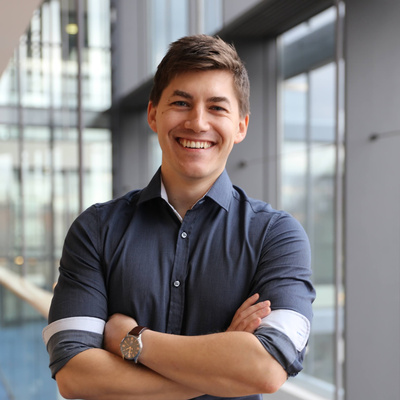
Anatoli Kalysch
CISO at Lindenhofgruppe | Swiss CISO of the Year 2026 | AI security and cyber risk
Bern, Switzerland
Actions
Dr. Anatoli Kalysch is CISO at Lindenhofgruppe in Bern, Switzerland. He was named Swiss CISO of the Year 2026. His work connects technical security with decisions about risk, investment and patient care.
Before joining Lindenhofgruppe, he served as CISO at Deutsche Bahn Connect and as Senior Information Security Officer and Deputy CSO at Taurus. His background includes penetration testing and research in mobile security and reverse engineering. He holds a doctorate in computer science from Friedrich-Alexander University Erlangen-Nürnberg and teaches cybersecurity at Fernfachhochschule Schweiz (FFHS).
Anatoli speaks about AI accountability and the security of systems that can act autonomously. He also covers supplier risk and the communication of cyber risk to executive teams and boards. His sessions examine the decisions organisations face when putting security into practice, including who can authorise an action and what evidence is needed to trust its outcome.
Area of Expertise
Topics
Who is accountable when AI acts?
An AI system that can use tools or change records creates decisions about authority long before anything goes wrong. This session examines how to assign responsibility when software can take action on an organisation's behalf. It covers approval thresholds and access limits. It also examines the evidence needed to reconstruct a decision. Attendees will learn how to distinguish actions that can be delegated from those that need human approval, and how reversibility can guide that boundary. The discussion draws on the demands of healthcare, where an operational failure can affect patient care.
Audience: CISOs, executives, governance and risk leaders.
Format: 30 to 45 minutes with Q&A. A 15-minute version can be agreed.
Languages: English and German.
Your supplier's AI is now your AI
AI capabilities can arrive through a routine software update. A product that once offered suggestions may gain the ability to make changes or call other services, leaving the original supplier assessment out of date. This session shows how to review the actions the product can take and the data it can access. It examines when human approval is needed and what evidence to request from suppliers. Attendees will leave with questions to use in procurement and change reviews, including when an existing approval needs to be revisited.
Audience: Security leaders, procurement, third-party risk and technology teams.
Format: 30 to 45 minutes with Q&A. A 15-minute version can be agreed.
Languages: English and German.
Running an AI-assisted red team in a hospital
AI can help a security team test more attack paths. Each action still needs a defined scope and a way to stop it. This session examines how to design an authorised testing programme around the operational constraints of a hospital. It covers isolation, human approval and stop conditions, then follows findings through validation and remediation. Attendees will learn how to separate plausible output from evidence of a weakness and how to judge whether their organisation is ready for recurring AI-assisted testing.
Audience: Security practitioners, CISOs and healthcare technology leaders.
Format: 30 to 45 minutes with Q&A. A 15-minute version can be agreed.
Languages: English and German.
Cyber risks a board can make decisions about
A board needs a decision it can act on. This session follows a technical security finding through to its business consequences and the choices available to management. It examines how to describe uncertainty, explain what an investment would change and make the remaining risk visible. Attendees will learn a practical structure for presenting cyber risk with a clear owner and decision, using healthcare as an example of the connection between information security and continuity of essential services.
Audience: CISOs, executives, board members and risk leaders.
Format: 30 to 45 minutes with Q&A. A 15-minute version can be agreed.
Languages: English and German.
When the Disassembler Lies: Can AI Reverse Engineers Recover?
AI-assisted reverse engineering depends on the evidence produced by its tools. When a disassembler returns a plausible but incorrect listing, an agent can build a confident explanation on the wrong foundation. This session examines how obfuscation affects the loader, disassembler and decompiler, and how those failures differ from prompt injection in strings or tool output.
Using controlled binary-analysis examples, we examine how an agent can recognise an unsupported assumption and seek independent evidence. We compare explicit tool errors with misleading output that arrives without a warning, then consider recovery through another analysis view or runtime observation. A successful tool call and a correct explanation of the program are separate outcomes.
Attendees learn how to assess evidence in an agent's analysis trace, choose useful cross-checks and set limits on repeated or inconclusive analysis. The session is intended for practitioners evaluating AI-assisted reverse engineering and malware triage.
Audience: Reverse engineers, security researchers and teams building AI-assisted analysis tools. Binary-analysis basics are helpful.
Format: 60 minutes including demonstrations and Q&A. A focused 30-minute version is available.
Languages: English and German.
The evolution of binary obfuscation
Binary obfuscation changes what an analyst can see without necessarily changing what a program does. This session traces the development of software protection from packing and instruction substitution through control-flow flattening, mixed Boolean-arithmetic expressions and virtual machines, to code reconstructed only when it is needed. These techniques coexist and are often combined.
For each family, we examine the assumption it disrupts in a disassembler, decompiler or human analyst, and the evidence that can still reveal program behaviour. We connect protection techniques with the analysis methods developed in response, including execution traces and symbolic reasoning, and consider their costs and limits.
Drawing on published work in virtualization-based protection and deobfuscation, the session gives practitioners a way to recognise common protection patterns and choose a suitable next analysis step. It also helps software owners judge what obfuscation can protect and what an executable must expose to run.
Audience: Reverse engineers, security researchers and software engineers evaluating code protection. Basic assembly and program-analysis knowledge are helpful.
Format: 45 to 60 minutes with Q&A.
Languages: English and German.
H-CSC Conference 2026 Upcoming
Upcoming lightning talk: Breach and attack simulation in the health care sector.
Cloudflare Immerse Zurich 2026
Upcoming panel: Swiss Leaders Unfiltered: Industry, Healthcare, Media & Operations.
GOhack26 (EDU Program)
Talk: Mehr Sicht auf Drittparteien: Supply Chain Security mit OSINT und KI.
Delivered on 30 October 2026 at FFHS Gleisarena.
ISC2 Chapter Switzerland Annual Assembly 2026
Talk: From AI-Scan to Agentic Red Team.
Building AI-assisted attack simulations you can absorb in the age of AI.
Global Cyber Conference 2026
Keynote: Humans vs. AI
Delivered on 2 September 2026 in Zurich.
ARES 2026 / CUING
Research talk: Towards Environment-derived Bytecode Generation for Virtualization-Based Obfuscation.
H-CSC Webinar: Supply Chain Security
Webinar talk: The transparent supplier: OSINT as a cyber security tool.
ISSS Zürcher Tagung 2026
Talk: The evolving role of the CISO in an era of technological supremacy.
H-CSC Webinar: Cloud and AI in Hospitals
Webinar talk: Internationale Cloud-Lösungen im Bereich KI der Spitäler, Aktivitäten im Kanton Bern.
With Urs Meier, CISO Inselgruppe Bern.
Eraneos Healthcare C-Level Roundtable 2026
Talk: Der gläserne Lieferant: OSINT-Research als Cyber-Security-Tool.
Almato DevCon 2025
Talk: Modern security strategies for protecting digital and traditional assets.
Safeguarding Crypto & Traditional Assets.
Agoria Webinar: Navigating DORA Regulations
Webinar: Aligning DORA with ISO 27001 and NIS2.
Mapping DORA compliance requirements onto ISO 27001 and NIS2, with Arnaud Martin and Markus Vervier.
Almato DevCon 2023
Talk: Security Testing in the Age of AI.
Opportunities and risks of using AI for security testing.
IFIP SEC 2022
Research talk: Usability of Antivirus Tools in a Threat Detection Scenario.
ACNS 2020 (virtual)
Research talk: A Study on Vulnerability Reuse in Android Development Studios.
Virtual conference.
ARES 2020 (virtual)
Research talk: Template-based Android Inter-Process Communication Fuzzing.
Virtual conference.
Zollhof AI & Machine Learning Workshop
Workshop: Introduction to AI and machine learning in an industrial setting.
ARES 2019
Research talk: The internet banking [in]security spiral: past, present, and future of online banking protection.
DeepSec / ROOTS 2018
Research talk: How Android's UI Security is Undermined by Accessibility.
ISC 2018
Research talk: Lumus: Dynamically Uncovering Evasive Android Applications.
ARES 2018
Research talk: Tackling Android's Native Library Malware with Robust, Efficient and Accurate Similarity Measures.
ARES 2017
Research talk: VMAttack: Deobfuscating Virtualization-Based Packed Binaries.
Anatoli Kalysch
CISO at Lindenhofgruppe | Swiss CISO of the Year 2026 | AI security and cyber risk
Bern, Switzerland
Actions
Please note that Sessionize is not responsible for the accuracy or validity of the data provided by speakers. If you suspect this profile to be fake or spam, please let us know.
Jump to top