
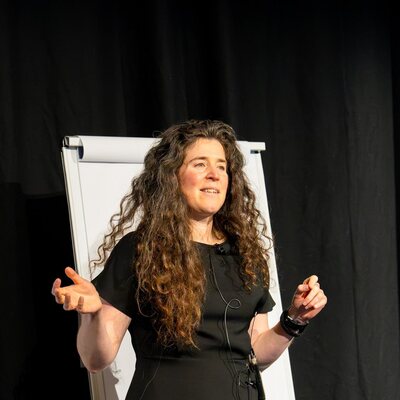
Andrea Magnorsky
Programmer and creator of "Bytesize Architecture Sessions"
Auckland, New Zealand
Actions
Andrea Magnorsky is a programmer and entrepreneur currently based in New Zealand. She is well-known in the programming community for her contributions to functional programming and software architecture. Magnorsky has over 20 years of experience in the software industry and has spoken at many international conferences and events on topics such as game development, functional programming, and software architecture. She is the creator or Bytesize Architecture Sessions
Area of Expertise
Topics
Thinking about Systems with Bytesize Architecture Sessions
People building a system need to have a high level of shared knowledge.
They need to know not just what to build today, but what the system should look like in the near future.
Generally, the goal of the system is a bit of mirage, with blurry edges. Each of us have an idea of what it is we are building, is it the same idea?
Sharing knowledge effectively is hard, in this talk I will present a technique called **Bytesize Architecture Sessions**. It is a workshop format that improves knowledge sharing of systems.
Some of the benefits of Bytesize Architecture Sessions are:
* Improved systems thinking.
* Enriching collaboration within the team.
* Understanding architecture practices and tools in a safe environment.
* A feedback loop controlled by the team that produces better documentation across sessions.
* Revealing the Bermuda Triangles!
Preferred session duration : 1 hour
Residuality: Real World Comparative Case Studies
Residuality Theory has disrupted the Software Architecture scene, presenting a new approach to architecture based on the complexity sciences and random simulation. It aims to help architects to design an architecture that is statistically more resilient to a broader range of possible futures.
In parallel, practices like the Architecture Advice Process and the application of Systems Thinking consider architecture through the lens of how organisations practically make and execute architectural decisions.
Are these approaches compatible?
We aim to understand how using Residuality fits into our toolbox, by reporting our findings in using it in two different settings. As practitioners, we have been wondering: How do we take this architecture and use it to deliver business value? How do we communicate the decisions that led to it, when the design process is so new and unfamiliar to the broader organisation? How do we wrestle with the inevitable trade-offs that must be made when building real operational systems based on this vision of a more adaptive capacity?
Drawing on two comparative experiences applying Residuality in the design and modernisation of systems in two separate businesses, we will share lessons learnt and thoughts on how to practically make use of this new approach.
The Certainty of Uncertainty: How did we get here, where do we go?
Solving problems through systems requires knowledge, creativity, and hard work. Yet, the cold truth of reality often derails our best plans: current technical constraints limits valuable options and collide with shifting expectations. Communication gaps waste irrecoverable time, and data we relied on proves incorrect. How do we break free from the paralysis of uncertainty to navigate this?
This talk is a tour of real-world situations, examining the mindset needed to move forward when your signals tell you the system shouldn't be in this state, and yet here we are. How to learn to understand the system of software and people, find the leverage points, even when the path ahead is unclear.
The Making of a Decision
We often stumble over the invisible webs that drive decision making. Reflecting upon past decisions, we wonder "How did we come to this?". Why do others not see the obvious flaws in their decision making? Have you been forced to make a bad decision, hoping the future will provide a path to recovery?
This talk is about the anatomy of a decision. We'll examine its parts and their relationships. We'll learn about the context of a decision in a socio-technical system, and how we can create and distribute knowledge to effectively drive decision making. Ultimately, we'll better understand how influence and power affect us all.
Analysis, Design & Architecture Conference 2026 Sessionize Event Upcoming
KanDDDinsky 2026 Sessionize Event
GOTO Copenhagen
The Making of a Decision
Convex
The Making of a decision
Residuality: Real World Comparative Case Studies
Domain-Driven Design Europe and Data Mesh Live 2026 Sessionize Event
LAST Conference Melbourne 2025
Understanding your systems with Bytesize Sessions - Workshop
Knowledge is spread in ways that might seem chaotic. How can cross-functional teams have a more cohesive understanding about the systems they work on? What works best in the long run is to make it a practice. That practice needs to be short so that it happens often. Little and often.
Bytesize Architecture Sessions originated from iterating on solutions to this problem across organisations of all sizes and within diverse teams. Seeing how valuable the format had become, Andrea formalised it so that others could try it with their own groups. Put simply, Bytesize Architecture Sessions are a series of short meetings, each concentrating on a narrow slice of a system. A session runs for 45‑90 minutes and follows four clearly defined stages: Session Goal, Alone Together, Consensus and Summary. You may model your systems with whichever tools you prefer.
In this workshop we will review a few guiding principles and then work together through two brief sessions, demonstrating how useful this format can be and the various contexts in which it can be applied.
Analysis, Design & Architecture Conference 2025 Sessionize Event
Web Directions Code Leaders
The making of a decision
We often stumble over the invisible webs that drive decision making. Reflecting upon past decisions, we wonder "How did we come to this?". Why do others not see the obvious flaws in their decision making? Have you been forced to make a bad decision, hoping the future will provide a path to recovery?
This talk is about the anatomy of a decision. We'll examine its parts and their relationships. We'll learn about the context of a decision in a socio-technical system, and how we can create and distribute knowledge to effectively drive decision making. Ultimately, we'll better understand how influence and power affect us all.
Oredev 2023
Thinking about your systems using Bytesize Architecture Sessions
Analysis, Design & Architecture Conference 2024 Sessionize Event
GSAS (Global Software Architecture Summit)
Learning consistently with Bytesize Architecture Sessions by Andrea Magnorsky
Does your team suffer from: Inconsistent views of your systems? Producing incohesive solutions? Ineffective architecture practices and tools? Introducing Bytesize Architecture Sessions! Bytesize Sessions are a workshop format that enable collaborative and iterative knowledge sharing. This talk will inform you about how to run Bytesize Sessions resulting in the following benefits: improved systems thinking, enriching collaboration within the team, understanding architecture practices and tools in a safe environment, a feedback loop controlled by the team that produces better documentation across sessions, revealing the Bermuda Triangles!
New Crafts
Knowledge Sharing is Systems Building https://www.youtube.com/watch?v=Xu_-eKhgzu8&list=PLIYFkjdIWfVxEKvmXrh7f6mmBdbXp5NgO&index=15
Virtual November 2021 NE Bytes
The best life hack, but for your software 18:30 - 20:00 UTC
As programmers we make architectural decisions all the time. Being deliberate about understanding and improving the architecture helps to make better decisions. In this talk we are going to take a look at some tools that you can use to do just that: understand better the existing systems you currently work with.
Typelevel Summit
Keynote: Inviting everyone to the party Andrea Magnorsky Most of today's popular general-purpose programming languages incorporate various aspects of the imperative, object and functional programming paradigms. In some cases, these languages provide clear guidelines as to what style is preferred, and why. As programmers, we have a choice to make about which paradigm(s) to use and to what extent, even if the language provides clear guidelines. How should we think about those choices? Where are the sweet spots to make trade-offs, and what do they depend on? Let's wear the hats of history and science, thinking about the past and looking to the future, examining these apparent conflicts. Paradigm change is not a new thing - perhaps we can learn something from the history books? Wear Some(hat) and party like it's a hat party. With hats.
Curry On
Abstract
Why do programming languages look the way they do today? How did it all started? In this talk we will go over a brief history of programming languages, from the very early days. We will go over greatest hits from Hilbert, Turing, Church, Hopper and more.
Andrea Magnorsky
Programmer and creator of "Bytesize Architecture Sessions"
Auckland, New Zealand
Actions
Please note that Sessionize is not responsible for the accuracy or validity of the data provided by speakers. If you suspect this profile to be fake or spam, please let us know.
Jump to top