
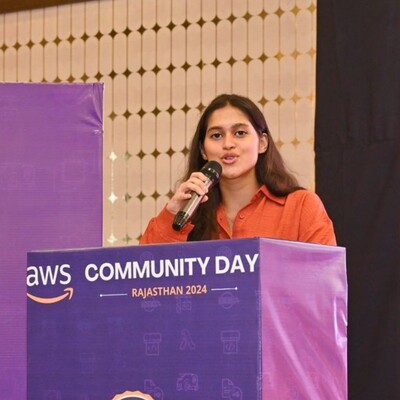
Anshika Tiwari
DevOps Engineer | AWS | CI/CD | Docker | Kubernetes | Prometheus
Delhi, India
Actions
Anshika is a passionate DevOps/SRE Engineer who is always eager to learn & implement cloud-native solutions, she has contributed to streamlining deployment processes and enhancing system reliability. She is eager to share her experiences and insights at conferences, contributing to the open-source community through talks, mentorship, and collaboration.
Badges

Area of Expertise
Topics
Agentic AI Meets Search: Real-World Use Cases with OpenSearch MCP Support
Agentic AI systems operate autonomously to plan, execute, and adapt across diverse domains, but their power multiplies when connected to live, rich data sources. OpenSearch 3.0’s experimental MCP support enables AI agents to seamlessly interact with search indexes and observability data as tools, unlocking new possibilities for autonomous decision-making.
Join this session to explore real-world use cases where OpenSearch-powered AI agents enhance healthcare diagnostics, e-commerce personalization, security analytics, and market intelligence. Learn how MCP standardizes communication between AI models and OpenSearch, enabling dynamic, context-aware AI workflows that improve accuracy, responsiveness, and business impact.
Through demos and case studies, see how agentic AI combined with OpenSearch’s search and analytics capabilities drives smarter, faster, and more adaptable solutions.
AI Agents in Action: Harnessing MCP and OpenSearch for Modern Use Cases
Agentic AI systems operate autonomously to plan, execute, and adapt across diverse domains, but their power multiplies when connected to live, rich data sources. OpenSearch 3.0’s experimental MCP support enables AI agents to seamlessly interact with search indexes and observability data as tools, unlocking new possibilities for autonomous decision-making.
Join this session to explore real-world use cases where OpenSearch-powered AI agents enhance healthcare diagnostics, e-commerce personalization, security analytics, and market intelligence. Learn how MCP standardizes communication between AI models and OpenSearch, enabling dynamic, context-aware AI workflows that improve accuracy, responsiveness, and business impact.
Through demos and case studies, see how agentic AI combined with OpenSearch’s search and analytics capabilities drives smarter, faster, and more adaptable solutions.
Faster Than the Model: GPU-Accelerated Vector Search for Production AI
A client deploying an AI retrieval system quickly learned that the model wasn’t the slow part; vector search was. As embeddings and traffic increased, CPU-bound retrieval made indexing slow and latency unpredictable, breaking the “real-time” experience that semantic search and RAG workloads needed.
In this talk, we’ll show how GPU-accelerated vector search in OpenSearch closed that gap. We’ll compare CPU vs GPU behavior for ingestion and queries, explain where GPUs make the biggest difference, and share the deployment lessons that made performance stable enough for production.
You’ll learn how to:
1. Identify when vector search becomes the bottleneck
2. Benchmark CPU vs GPU retrieval performance
3. Use GPU offloading to speed up hybrid semantic search workflows
If you’re building semantic search or RAG pipelines, this talk gives you practical performance lessons instead of theory.
Flag-tastic and Fearless: Feature Flags Meet Kubernetes for Deployments That Sing
Are your deployments stuck in the past? Fear no more! Feature Flags are here to bring agility, control, and creativity to your Kubernetes workloads. In this fun and insightful talk, we’ll explore how feature flags can enable dynamic, fearless experiments and scalable deployments in modern applications.
This talk will show you the path to smoother, smarter deployments.
We'll cover how to:
1. Dive into OpenFeature, and see how it pairs perfectly with Kubernetes to orchestrate deployments.
2. Integrate feature flags in Kubernetes to leverage tools like ArgoCD, Flagger, and Prometheus,
3. Real-world stories of flagging triumphs (and a few hiccups)
From Traces to Action: Auto-Instrumenting LLMs for Observability with OpenTelemetry & OpenSearch
Large Language Models (LLMs) power some of today’s most advanced AI applications-from chatbots to intelligent copilots-yet monitoring their complex behavior remains a major challenge. This session demonstrates how OpenTelemetry’s auto-instrumentation capabilities, combined with OpenSearch’s powerful analytics, provide end-to-end observability for LLM-based systems.
You’ll learn how to automatically collect rich telemetry data-traces, metrics, and logs-from your LLM applications with minimal manual effort using OpenTelemetry and libraries like OpenLIT. See how this data flows into OpenSearch, enabling real-time analysis, anomaly detection, and performance monitoring tailored specifically for AI workloads.
By the end of this talk, you will get the tools and best practices to build scalable, AI-driven observability pipelines that keep your LLM applications reliable and performant.
Ready, Set, Go: WASM-Powered Containers Taking Your AI to New Heights
With the rise of containerization and edge computing, the demand for portable, efficient, and low-latency solutions is growing. WebAssembly (WASM), known for its small size and fast loading, is expanding beyond the browser into containerized and edge environments. When combined with CNCF projects like Kraken, WasmEdge Runtime, and containerd, WASM can unlock hardware accelerators (GPU, TPU, FPGA) to revolutionize AI/ML workloads across both containerized and edge deployments.
In this talk, we’ll explore:
1. How Kraken and WasmEdge Runtime enable seamless integration of WASM into containerized environments for enhanced performance.
2. Live demos showcasing WASM-powered containers running AI workloads across various hardware platforms.
By the end of this talk, you'll know how to take your containerized and edge AI/ML workloads to the next level with speed, portability, and hardware acceleration.
What We Learned Scaling Vector Search for AI on OpenSearch 3.x
A client building an AI retrieval system hit a wall when their vector search pipeline moved beyond prototype. As embedding volume and user traffic increased, queries slowed down, memory pressure spiked, and filtering became a bottleneck. The stack worked in the lab, but production revealed latency issues and throughput ceilings that blocked scale.
In this talk, we’ll walk through how we benchmarked and tuned OpenSearch 3.x for vector workloads, comparing index configurations (HNSW vs IVF), adjusting parameters for recall vs latency, and optimizing filtering, hybrid scoring, and indexing strategies. We’ll share what worked, what didn’t, and the OpenSearch features that made scaling possible.
You’ll learn how to:
1. Choose and tune vector index types for real AI workloads
2. Handle filtering, recall, and latency trade-offs at scale
3. Stabilize performance with 3.x features like segment replication and async indexing
If you’re running semantic search, RAG pipelines, embeddings, or vector databases, this talk gives you field-tested lessons instead of theory or marketing slides.
Why Vector Search Without GPUs Hurts (and How to Fix It with OpenSearch 3.x)
Most teams working with AI eventually learn that the model isn’t the thing slowing them down, the vector search layer is. RAG systems, semantic search, and recommendation engines all rely on fast embedding lookups, but CPU-based vector search makes indexing slow, filtering expensive, and query latency unpredictable. Throwing more CPUs at the problem only helps a little, and it still doesn’t feel “real-time,” especially for interactive AI apps.
With OpenSearch 3.x, GPU support changes that dynamic. By pushing index builds and vector scoring to the GPU, teams can finally speed up the heaviest parts of retrieval. In this talk, we’ll share how one production workload went from sluggish, CPU-bound vector queries to fast semantic retrieval by enabling GPU acceleration and tuning hybrid sparse+dense search.
By the end of the session, you’ll have a clear picture of where vector search becomes the bottleneck, how GPUs actually fix it, and what it takes to benchmark and deploy GPU-accelerated retrieval with OpenSearch for real AI use cases.
Observe Smarter, Not Harder: Scaling AI-Powered Observability with OpenSearch
If you’re still manually sifting through logs to spot issues, it’s time to rethink your observability strategy. This session will show how AI-driven OpenSearch transforms your observability practices by turning logs, metrics, and traces into actionable insights.
Using vector and neural search, how AI models can detect patterns, anomalies, and trends in real time. Learn how to reduce troubleshooting time, predict potential issues before they become critical, and empower data-driven decisions, all while scaling your observability pipeline with OpenSearch’s powerful capabilities.
One Click to Observe Them All: Auto-Instrumenting LLMs with OpenTelemetry and OpenSearch
Large Language Models (LLMs) power some of today’s most advanced AI applications-from chatbots to intelligent copilots-yet monitoring their complex behavior remains a major challenge. This session demonstrates how OpenTelemetry’s auto-instrumentation capabilities, combined with OpenSearch’s powerful analytics, provide end-to-end observability for LLM-based systems.
You’ll learn how to automatically collect rich telemetry data-traces, metrics, and logs-from your LLM applications with minimal manual effort using OpenTelemetry and libraries like OpenLIT. See how this data flows into OpenSearch, enabling real-time analysis, anomaly detection, and performance monitoring tailored specifically for AI workloads.
By the end of this talk, you will get the tools and best practices to build scalable, AI-driven observability pipelines that keep your LLM applications reliable and performant.
KubeCon + CloudNativeCon India 2026 Sessionize Event
OpenSearchCon India 2026 Sessionize Event
OpenSearchCon Europe 2026 Sessionize Event
OpenSearchCon China 2026 Sessionize Event
OpenSearchCon Japan 2025 Sessionize Event
OpenSSF Community Day Korea 2025 Sessionize Event
OpenSearchCon North America 2025 Sessionize Event
AI_dev: Open Source GenAI & ML Summit Europe 2025 Sessionize Event
OpenSSF Community Day India 2025 Sessionize Event
PlatformCon 2025 Sessionize Event
OpenSearchCon India 2025 Sessionize Event
CNCF-hosted Co-located Events Europe 2025 Sessionize Event
Please note that Sessionize is not responsible for the accuracy or validity of the data provided by speakers. If you suspect this profile to be fake or spam, please let us know.
Jump to top