
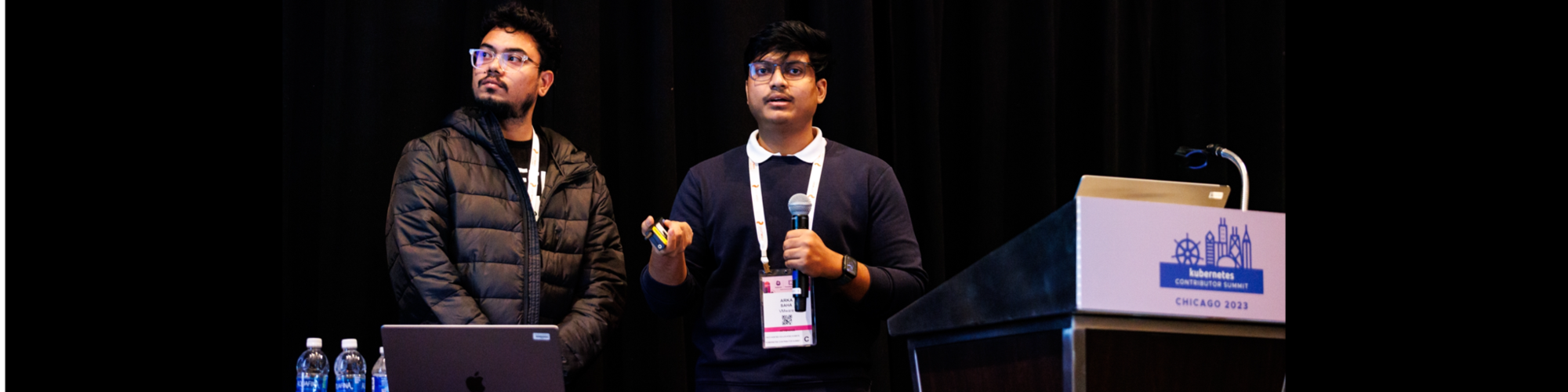

Arka Saha
Software Engineer at Broadcom, Kubernetes Contributor
Actions
Arka Saha, a Broadcom Software Engineer, leads Kubernetes releases & maintenance for VMware Cloud Foundation (VCF). He manages Broadcom's Prow infrastructure, ensuring long-term support for k8s, etcd, containers, Golang & related components. Previously, he managed Red Hat OpenShift clusters & developed Golang operators for Tekton at IBM CIO. He has been contributing to k8s and etcd since early last year and actively supports the community by improving pipelines by contributing to test-infra.
Area of Expertise
etcd v3.6 and beyond + etcd-operator updates
The recently released etcd 3.6 marks a significant milestone, bringing crucial advancements that directly impact the stability, performance, and operational efficiency of Kubernetes.
This session will delve into the key features of etcd 3.6, and provide an upgrade checklist and highlight changes users need to make before upgrading to the 3.6 release. We will also discuss the extended support of 3.4, and roadmap for 3.7.
We will also bring you the latest updates of the etcd-operator. Come join us and raise your etcd questions with the on-site etcd maintainers.
Even though etcd 3.6 was announce in KubeCon London, due to its importance, we want to advocate again to make sure Kubernetes are aware of the changes and well-prepared for the upgrade by providing comprehensive guidance and support. We also would like to encourage contributions to the etcd and etcd-operator projects for further enhancements.
Scaling and Safeguarding the Heart of Kubernetes: Deep Dive into etcd
SIG-etcd are hard at work on scaling & safeguarding etcd, but we need your help and feedback! This deep dive session will explore current & future etcd development efforts to share with both etcd & Kubernetes users & contributors.
In particular we’ll focus on:
Feature gates:
- Reviewing recent KEPs for server & cluster level etcd feature gates.
- How feature gates enable gradual rollouts, minimizing risk and breaking changes.
etcd Operator Working Group:
- Discuss progress and next steps for the official etcd Operator release.
Tackling compaction correctness
- A post-mortem of the recent etcd watch correctness issue & resolution.
Github Actions migration:
- Prowjob Adoption
- Consistent e2e tests across minor versions
Community Update:
- Update on the growth of the etcd community and project news.
Join our etcd maintainers and contributors to learn about these recent developments & future plans, including how you can contribute to them.
SIG etcd maintainer track talk
Etcd v3.6, released earlier this year, brings significant features compelling enough to upgrade. This session will provide a detailed overview of the new features and performance improvement over v3.5. We will also discuss known issues and workarounds for upgrading and how it will benefit you.
Next, we will present the long-awaited community-supported etcd-operator which will become the standard way to deploy your etcd clusters on Kubernetes for your bespoke use cases.
Finally, we will share how our in-house robustness test framework has improved etcd's reliability.
This talk will give you a chance to be excited about the future of etcd, and connect you with opportunities to contribute to the project.
Kubernetes and etcd: Common pitfalls and how to avoid them
Have you ever experienced a Kubernetes cluster that suddenly stops responding? As basic debugging steps, you run kubectl commands, but all of them result in a request timeout. So what is happening? Most likely, etcd is failing.
Etcd, as we know, is the sole distributed key-value store for Kubernetes, responsible for continuously and consistently storing the state of the entire cluster. Every configuration, workload information, node registration is stored in etcd. So, a degraded etcd cluster can cause stale reads and a possible cluster-wide outage since Kubernetes cannot reconcile or serve API requests.
In this session, we’ll explore common causes of etcd failures that affect Kubernetes stability and performance. We’ll also discuss debugging methods and introduce tools like etcd-diagnosis to analyse the health of etcd in a running cluster. Finally, we’ll share the best practices for operating etcd - upgrades, backups, recovery, and key workarounds to ensure a resilient control plane.
etcd v3.6.0 and etcd-operator v0.1.0
etcd v3.6.0 has been released, almost 4 years after 3.5.0. It’s a big step forward. etcd-operator v0.1.0 is also now available and promises to greatly improve the usability and operability of etcd.
We will dive into all the new exciting features in 3.6, like downgrade support, v2store deprecation and performance improvement. We’ll also provide an upgrade checklist and highlight changes users need to make before upgrading to the 3.6 release. We will also show you how the etcd-operator works, how it can greatly simplify the operation of the etcd cluster. Come join us and raise your etcd questions with the on-site etcd maintainers.
Don't Let Your Kubernetes Cluster Go Wild: Ensuring etcd Reliability
Have you ever encountered a perplexing Kubernetes issue that left you no choice but to recreate your cluster?As the backbone of Kubernetes, etcd stores the state and configuration at any given moment.Since any changes to this critical component can introduce instability, how can we continuously ensure that new features, improvements, or bug fixes don’t introduce data inconsistency and regression?
Join us for a deep dive into the etcd test framework and discover how we safeguard your Kubernetes clusters from catastrophic bugs. We will share the rigorous processes to guarantee correctness, consistency, and reliability with every code change for the etcd v3.6 release.
We'll share the challenges in our journey of developing, leveraging, and debugging issues caught by the robustness test framework. Whether you’re building Kubernetes or complex distributed systems, this session will equip you with invaluable knowledge and practical tools to create a more reliable and resilient infrastructure
Bug hunting in distributed systems: using robustness tests to test your code better
Traditional testing methods like unit and integration tests are great for functional validation in isolation, but are they enough for distributed systems? Distributed systems need to deal with real-world failures such as network issues, hardware errors, and race conditions. One of the proven ways to test these systems is to inject failures during testing and see if the system still works as expected. This is called robustness testing, where you run the system like it would be used in real life.
Jespen is one of the first frameworks to test distributed systems by simulating such real-world scenarios and validating the operational history. Inspired by Jespen, etcd, the backbone of Kubernetes, built its own testing framework. This framework is written in Golang and for Golang projects, allowing even more failure types on the fly and verifying if the data stays consistent using Porcupine.
As etcd contributors, we will share our challenges in writing tests to force failure via gofail and our journey of developing, leveraging, and debugging issues caught by this ever-evolving framework, so that you can apply the findings to your projects with minimal tweaks.
KubeCon + CloudNativeCon North America 2025 Sessionize Event
KubeCon + CloudNativeCon Europe 2025 Sessionize Event
Project Lightning Talk + Maintainer Track + Contribfest: KubeCon + CloudNativeCon Europe 2025 Sessionize Event
Open Source Summit + AI_dev: Open Source GenAI & ML Summit Japan 2024 Sessionize Event
Please note that Sessionize is not responsible for the accuracy or validity of the data provided by speakers. If you suspect this profile to be fake or spam, please let us know.
Jump to top