
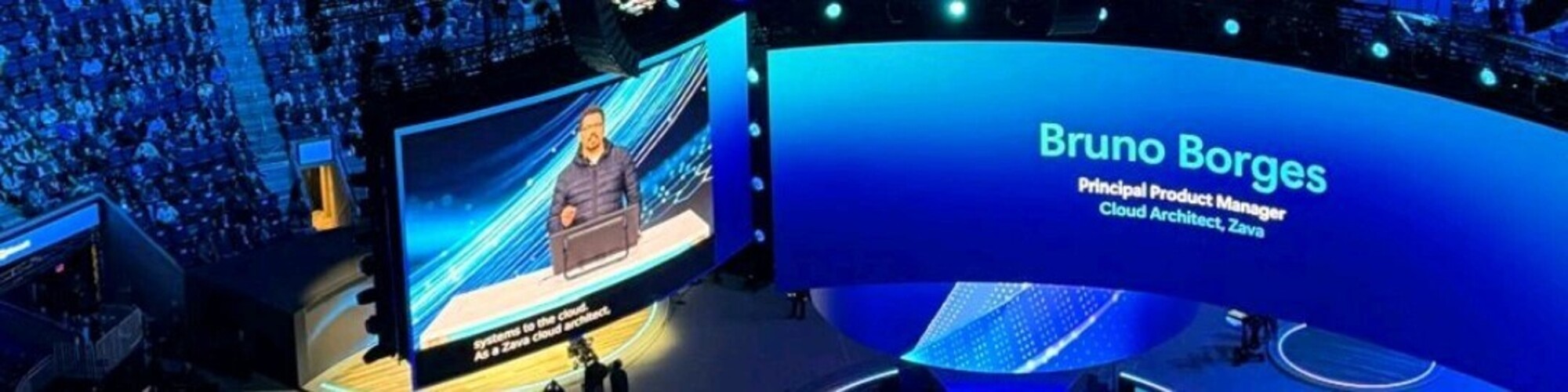

Bruno Borges
Product Manager at Microsoft
Montréal, Canada
Actions
Bruno Borges is a Principal Product Manager at Microsoft, where he has led global initiatives in software development, AI, and cloud innovation. He has driven the strategy and adoption of flagship products used worldwide, helping organizations modernize critical systems and embrace new technologies responsibly. With an Executive MBA from Simon Fraser University, Bruno combines technical depth with business acumen to deliver impact at scale. A frequent keynote speaker and advisor, he is recognized for advancing innovation, shaping product strategy, and guiding leaders through the future of technology.
Links
Area of Expertise
Topics
Secrets of Performance Tuning Java on Kubernetes
Initially, getting Java to run on Kubernetes may seem complicated, but after a few lines of YAML and a bit of work with Docker, you will wonder what all that fuss was. It is easy! Then you start looking at the performance of your Java app in one core, one GB of memory container, and this is when it all very quickly gets murky. Ops, SREs, and Java developers need to be aware of the JVM's inner works when deciding on how to resource their applications. Without this knowledge, it isn't easy to know whether it is best to scale vertically or horizontally for performance and costs. This talk will explore JVM ergonomics, CPU throttling, Garbage Collectors, and how using this knowledge can help you increase performance while reducing costs in the cloud.
Beyond Code: The Intent-Driven IDE for the Agentic Age
For decades IDEs have organized software development around files, plugins, code completion, and automation. But what happens when the dev’s primary input is no longer code, but intent?
In this demo-driven session, we’ll examine the emerging shape of intent-driven development environments: specifications as executable context, agents working concurrently in isolated worktrees, and developers shifting from authoring code to directing, reviewing, and integrating agentic work.
We’ll take a task from specs to PRs, delegate tasks to specialized agents, and build a custom workflow the environment did not previously support. We’ll explore agent harnesses, model selection, automation, context management, and human approval boundaries.
Building Custom Agents with the GitHub Copilot SDK
In this slide-free, code and agent heavy walkthrough, we will build an agentic app with the GitHub Copilot SDK.
We will begin by understanding with the Copilot Agent Runtime harness and then progressively build a museum exhibit curator agent. Attendees will create and manage sessions, stream events, expose application-owned data through a custom tool, connect an MCP server, and produce a structured, evidence-based report.
GitHub Copilot SDKs include Java, Node.js, Python, .NET, Rust, and Go support. Although each uses its language conventions and type systems, they all implement the same concepts.
Attendees will see with a working application, a practical understanding of the agent and tool-execution loop, and reusable patterns for building secure, testable Copilot-powered apps.
Optimizing Kubernetes Autoscaling for Performance and Cost
At some point in every Kubernetes journey, teams realize their clusters keep scaling even when utilization is low. Costs rise, workloads become unreliable, and performance issues persist despite more nodes and replicas. Horizontal Pod Autoscalers (HPA) and Cluster Autoscaler help, but not always will solve everything.
This session dives into the critical role of autoscaling configuration through real-world examples and performance benchmarks. We will look at advantages of Vertical Pod Autoscaling as well, and draw on experience from thousands of production environments. And we will demonstrate how small tuning changes can dramatically improve both efficiency, reliability, and cost.
Through comparisons of different scaling strategies across workload types and language runtime configurations, attendees will see how thoughtful A/B Performance Testing and tuning can achieve business goals without over-provisioning or guesswork.
Java on Kubernetes Without Container Images: The WebAssembly Way
Every time you ship a Java service to Kubernetes, you ship a base image: dependencies, a JDK and an OS layer. None of which you wrote besides your code, but all of which you must monitor and patch. The real artifact you care about, your application JAR and its dependencies, are buried inside 250 MB of packaging you never wanted to own. WebAssembly already solved this. With KWasm, the Wasm runtime lives on the node, the developer ships only a .wasm module as an OCI artifact, a RuntimeClass tells Kubernetes to execute. No Dockerfile, no container images involved at all.
In this talk we walk through how the SpinKube analogy actually maps cleanly to Java; what containerd shims, node provisioners, and CRDs can do: build your own Kubernetes-based platform, and quite easily with agentic AI.
Bruno Borges
Product Manager at Microsoft
Montréal, Canada
Links
Actions
Please note that Sessionize is not responsible for the accuracy or validity of the data provided by speakers. If you suspect this profile to be fake or spam, please let us know.
Jump to top