

Cat Morris
Staff Product Manager at Syntasso
London, United Kingdom
Actions
Cat is a Staff Product Manager at Syntasso, where she works at the intersection of developer experience, infrastructure strategy, and product design. With a background in enterprise platform tooling and developer productivity, she focuses on helping teams treat platforms as products that deliver measurable value. Cat brings experience from both engineering and product management roles in fast-scaling tech environments.
Badges

Area of Expertise
Topics
The Day 2 Hangover: What to Do After the Platform Party Ends
When the platform party ends, the hangover begins. Nitish and Cat share how focussing on platform as a product, fleet management, and orchestration, they cured their day 2 hangover!
Enter The Flow: Platform Product Management in the Era of Agentic Engineering
For years, Platform Product Managers have focused on building tools to reduce cognitive load and accelerate flow across a (usually) manageable number of teams. But the “AI Exponential” has shifted the ground beneath us. The challenge is no longer just supporting a handful of teams, but keeping pace as each one moves 10, 100 or 1000 times faster with increasingly complex needs.
In this session, we explore how to apply "Platform Thinking" to the Agentic Engineering era. Drawing on the principles of Team Topologies and the concept of being "Intentionally Human," we will discuss why the role of the Platform PM is moving away from managing backlogs and toward managing uncertainty. We will cover:
* The Cognitive Load Paradox: does AI-assisted coding help or hinder flow? (The PM’s role in balancing this).
* How to build "Thinnest Viable Platforms" (TVP) that support agentic engineering workflows without exploding the platform’s Total Cost of Ownership.
* The shift from deterministic to probabilistic (agentic) platform features: how to trust your Platform if the output isn't always the same.
* Why "Intentionally Human" design is the only way to prevent AI-driven platforms from becoming "black boxes" that stall engineering velocity.
Scaling Platform Engineering: Lessons from Europe’s Largest Enterprises
Platform engineering is no longer new. Most large organisations now have a platform team to help product and application teams deliver faster and more reliably. But as demand grows, a key question emerges: who helps the platform team scale its own impact?
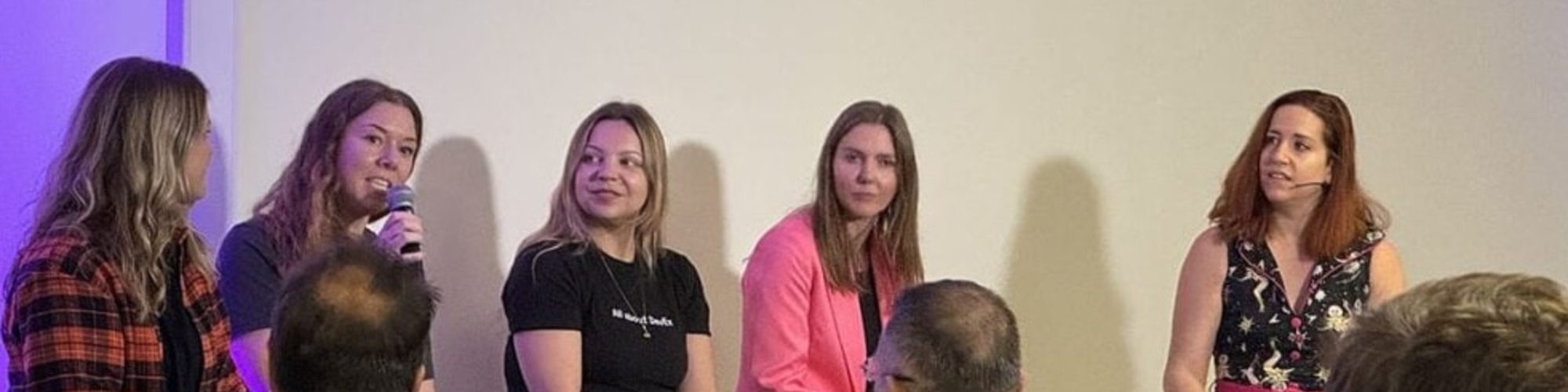
In this panel, platform leaders from some of Europe’s largest enterprises will share real-world stories of how they built, structured, and grew their internal platform organisations. You’ll hear what worked (and what didn’t!) when it came to getting internal buy-in, evangelising platform thinking across the business, and hiring and evolving the team.
Whether you’re starting a platform team from scratch or trying to take your current one to the next level, this session will leave you with actionable insights, hard-earned lessons, and inspiration from those who’ve done it at enterprise scale.
Product Thinking for Cloud Native Engineers
Want to level up your engineering career? Product management and ownership skills will help you showcase the business value of IT investments and align technical solutions with company goals. Learn how modern engineering teams—regardless of size or industry—can thrive by adopting a product thinking mindset.
Join Stéphane (Cloud Engineer applying product thinking) and Cat (once engineer, now Product Manager) as they share actionable insights from their journey. You'll discover how embracing product management principles can help your team deliver more impactful results and gain greater ownership of what you build.
What you'll learn:
- How to use product discovery techniques to better understand user needs
- Which metrics matter most when measuring product success
- Practical frameworks for identifying real problems before jumping to solutions
- Tips for bringing product thinking to your engineering role
From panic to peace: Making the observability of an eventually consistent system suck less
Your distributed systems hum along happily, everything is consistent. Until they aren’t. One tiny change later and… UH OH. Logs explode into chaos, dashboards blink like disco lights, and you’re neck-deep in debugging an issue that seems to make no sense. The data looks wrong, the system disagrees with itself, and you’re stuck wondering: how did this even happen?
We learnt this the hard way while building Kratix, a platform framework that sits on top of Kubernetes.
When Sid, one of our favourite users at a bank, did a demo for his org and showed the number steps he took to find the root cause of a problem in our software,, we were ashamed at ourselves for not doing anything sooner.
Our customers build complex, distributed platforms, and for a long time felt the same pains as Sid while using our product. When they kept coming running to us asking for solutions, we knew we had to do something about it - because learning how to observe eventually consistent, distributed systems is HARD. Correctness is a journey, not a guarantee.
In this talk, we will walk you through proven strategies for making eventually consistent systems less mysterious and more observable, and how these strategies were applied in the Kratix framework. You’ll learn how to:
- Add meaningful, traceable errors that actually help humans
- Turn events and state transitions into your best debugging tools
- Build dashboards that explain system health, not just CPU usage
- Set up alerts that reflect business impact, not just technical noise
By the end, you’ll be ready to turn your system’s logs, metrics, and states from a source of confusion into a source of clarity, no matter what part of the stack you work on.
Balancing Developer Freedom and Security
Kubernetes and containers turned out to be great for developer freedom -- they could quickly build containers running the software needed with their preferred tooling, and it would run happily next to a container running a completely different stack. But unless care is taken, this flexibility comes at a cost; a proliferation of containers, all running different base images and different software. Or the same software but at different versions. Or the same versions but with different base images and extra dependencies. Along with this proliferation comes the perils of CVEs from out-of-date or bloated software.
So what can you do to get this under control? Come listen to a panel of speakers who have seen this before and learned how to deal with the problem.
Agile On The Beach 2026 Sessionize Event
KubeCon + CloudNativeCon Europe 2026 Sessionize Event
CNCF-Hosted Co-located Events Europe 2026 Sessionize Event
Please note that Sessionize is not responsible for the accuracy or validity of the data provided by speakers. If you suspect this profile to be fake or spam, please let us know.
Jump to top