

Devika Toprani
Pre-AI Sense-making Before Scale | Global Learning Strategist | Somagraphic Learning™ | Map Before Machine™ 🌟
Dubai, United Arab Emirates
Actions
💃 Devika Toprani is a human-AI researcher, global learning strategist and founder of Somagraphic Learning™ and Substack publication, Soulful Learning with AI (800+ subscribers)
🌍 Niche?
→ 5+ years experience in the US, UAE, and India
→ Pre-AI cognitive frameworks, built to mitigate EdTech/Enterprise automation bias + boost AI safety
→ Create DEI-driven UX systems where user sense-making leads AI execution
🧠 10 research-led Pre-AI Sensemaking constructs
🚀 Scales across 5+ industries
🇴🇲 Oman-Born | 🇦🇪 UAE Golden Visa | 🇮🇳 Indian | 🇺🇸 EB2 National Interest Waiver in process
🏢 Career
Coordinated US national accreditation at UIUC, School of Social Work, supported HR at George Mason University | K-12 Educator | EdTech Program Ops
🎓 MS Management (STEM) | Dual BS/BA Psychology | UK & India-certified L&D diplomas | Google UX Design certified
🔥 Trajectory
- Book chapter “Pre-AI Sensemaking Before Scale”, AI Everywhere Vol. 3 (Nov 2026)
- Independent Consultant, MENA Speakers
- Global Classroom Educator Fellow, World Affairs Council of Seattle
- Research contributor, Oxford AIEOU Human Flourishing
- Nominated Top 100 Changemaker, MIT AI-Powered Women Conference
🎤 Invited Speaker
- CognitionX Emirates 2026
- Global Data AI Virtual Tech Con 2026
🌟 Speaker:
UIUC WebCon, Northwestern TEACHx, Microsoft Data Group, Power Platform Classmates Dubai, Google NextGen DevCon 2026
💃 On March 6, 2026, Devika pioneered pre-AI embodied sense-making through Somagraphic Learning™ framework (SLF) introducing a structured 3-stage sequence (Attempt → Map → Refine). Anchors user's own reasoning before AI
Soma = Body, Nervous system
Graphic = Expressing written original ideas
❌ Not an AI literacy framework
✅ Pre-AI human thinking guardrail to build AI literacy
🗺️ Map Before Machine™
World’s 1st analog-first, deployable AI literacy mechanism requiring users to generate a timestamped cognitive artifact before AI (Toprani, 2026)
♻️ API Cost Governance. Consumer trust. Less tokens/user. Specific prompts. Policy neutral
🤖 Pre-AI layer in AI/LMS before chatbot. Timestamped. Verifiable. 5-10 min. No curriculum redesign. AI safety. Faster workflows/teams
🏦 Pen/paper: AI-restricted/developing countries
Accessible: Neurodiverse, multilingual & non-linear users
✍️ Defined Somatic AI Literacy™ Capacity to establish embodied conceptual orientation before AI interaction (April 2026) Not in AI literacy frameworks UNESCO, ISTE, etc (Post-AI)
🌎 For Global Advisory, Industry-specific Pre-AI B2B Licensing, Pilots:
https://soulfullearningwithai.carrd.co/
📚 Substack (Soulful Learning with AI): https://substack.com/@devikatoprani
✍️ Gumroad: Map Before Machine™ Pre-AI Thinking Card (Custom e-copies): https://mapbeforemachine.gumroad.com/l/mapbeforemachinegumroadcomlcareer-pivot-edition
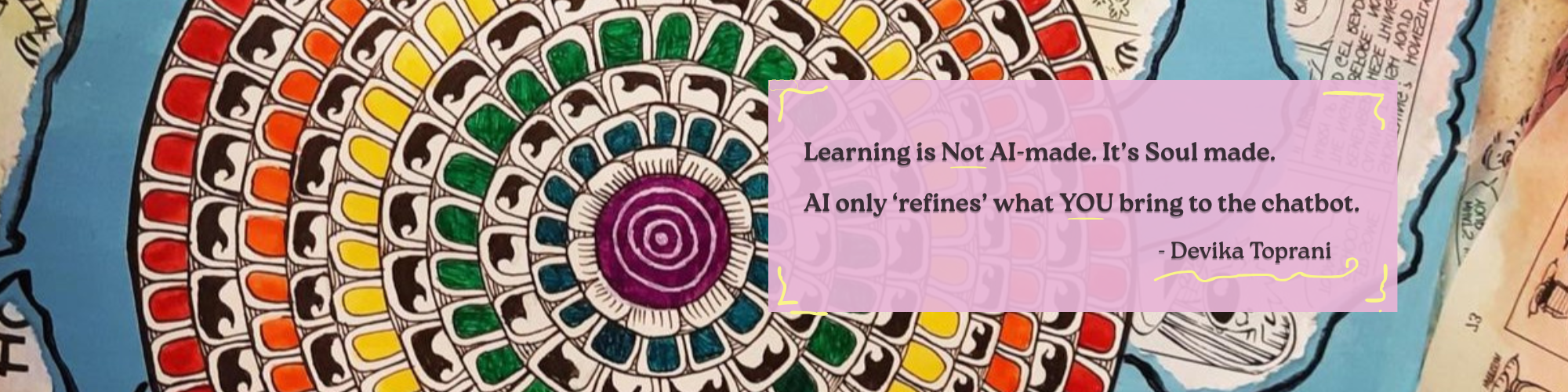
Learning is Not AI-made. It’s Soul-made.
AI only refines, what YOU bring to the chatbot. 🌟🤖
© Patent-Pending IP | Timestamped DOI | CC BY-NC-ND 4.0
Area of Expertise
Topics
Map Before Machine: A Human-First Thinking Protocol for AI-Ready Learners
When learners open AI before forming a single thought of their own, the cognitive work of understanding gets skipped entirely. What follows feels like learning. It is not. Research across seven preregistered experiments shows that learners who receive LLM-generated summaries develop shallower knowledge than those who engage in active construction first. The mechanism is not the AI tool. It is the sequence.
This session introduces the Map Before Machine™ Card, the deployable tool of the Somagraphic Learning™ Framework, a human-first, AI-supported approach grounded in embodied cognition, cognitive load theory, and human-AI interaction research. The framework's three-stage cycle, Attempt → Map → Refine, positions visual reasoning as a structured interface between human thinking and AI output.
Prototype interviews with STEM graduate learners show a clear delta. Both participants produced more specific, gap-based AI prompts after completing the card compared to their unstructured baselines. Both independently identified the Map stage as the highest point of cognitive friction and the strongest pull toward opening AI. Neither was prompted to say this. Both described the logic of the intervention before being told what it was.
The visual orientation stage is pre-verbal by design. Shapes, spatial arrangements, and motion cues do not require English language proficiency to produce or interpret.
For learners navigating complex concepts in a second or third language, AI-first instruction risks building understanding entirely on someone else's conceptual language. This is a structural problem that plays out daily across MENA classrooms. Somagraphic Learning™ addresses it before the AI interaction begins.
The card requires no special tools. It fits inside any existing course workflow in under five minutes. It is printable or LMS-ready for Canvas, Moodle, and equivalent platforms.
Attendees leave with a deployable tool, a clear evidence-based rationale, and a facilitation model ready to test in their next session.
Toprani, D. (2026, April 22). Somagraphic Learning™ Framework: A human-first, AI-supported visual cognitive approach. OSF Preprints. https://doi.org/10.35542/osf.io/fnk7z_v2
Map Before Machine™: A Pre-AI Checkpoint for Agentic Systems
Automation bias is usually framed as a trust problem. Deferring to a model’s first output over your own judgment.
For teams scaling agentic systems, it’s actually a sequencing problem. Most teams optimize the output. Almost none touch the window before a prompt hits an LLM. That gap shows up downstream as correction loops and wasted tokens.
The deployable protocol, Map Before Machine™ closes that gap. It’s an embeddable, zero-dependency protocol that enforces one checkpoint, Attempt → Map → Refine, before an agent executes a prompt. I’ll walk through the system design.
I’ll share early signal from a three-participant prototype linking structured pre-AI reasoning to more specific prompting.
US AI server deployment alone is projected to emit 24 to 44 million metric tons of CO2-equivalent annually by 2030 (Xiao et al., 2025). I’ll share a testable hypothesis for how better sequencing could cut that load.
The formal pilot hasn’t run yet. That’s the point. I want this room’s help pressure-testing the architecture before the data collection starts.
Key Takeaways
• Automation bias is a sequencing bottleneck, not just a trust deficit
• An embeddable pre-AI protocol, independent of any LLM provider or cloud stack
• Early signal on upstream reasoning and downstream prompt specificity, and what’s still unproven
• A testable hypothesis for cutting compute overhead through human-reasoning checkpoints
Map Before Machine™: Smarter Copilot & Flow Design in Power Platform
Building with Copilot in Power Platform speeds up delivery, but opening a blank prompt without structural clarity triggers automation bias.
This leads to broken flows, syntax errors, and iterative prompt churn. AI only refines what the user brings to the chatbot.
Establishing clarity BEFORE prompting ensures low-code solutions remain robust, scalable, and error-free.
This session introduces Map Before Machine™, a deployable pre-AI thinking protocol from the research-backed Somagraphic Learning™ sequence (Attempt → Map → Refine).
1) The Pre-AI Thinking Layer:
Generating a timestamped cognitive artifact that forces directional commitment:
(Concept 1) affects (Concept 2) because (Reason), before opening Copilot Studio or Power Apps.
2) Gap-Based Prompting:
How asking specific, targeted questions instead of broad prompts helps Copilot generate accurate Power Fx formulas and working flow filters on the first attempt.
3) Architecture Breakdown:
A live look at what happens when you build with a map versus without one, showing how pre-mapping eliminates flow errors and saves build time.
4) Users as Evaluators:
Practical habits to ensure YOU stay in command as the "real" builder while turning Copilot into a reliable thinking partner.
Key Takeaways
Attendees will leave with the pre-AI Map Before Machine™ protocol to eliminate prompt guessing, evaluate Copilot outputs with clarity, and build resilient Power Platform solutions faster.
When AI Enters Matters: A Behavioral Case for Human-First Reasoning in the Age of Generative AI
As generative AI accelerates across every industry, organizations face a problem that model-level improvements cannot fix: humans are outsourcing their thinking before forming any conceptual structure of their own. This is automation bias operating at the workflow level. It is quiet, habitual, and measurable.
This session introduces the Somagraphic Learning™ Framework (SLF), a research-backed, IP-protected visual-cognitive approach that sequences human reasoning before AI engagement. Its three-stage cycle, Attempt, Map, and Refine, creates a structured orientation layer that preserves independent thinking and produces a traceable artifact of original reasoning before any AI output enters the process.
The primary deployable tool is the Map Before Machine card, a 10-minute structured pre-AI prompt. Prototype testing with STEM graduate learners and faculty indicates it shifts interaction from generation-based prompting to gap-based refinement prompting. That shift is observable, structurally consistent, and directly relevant to any organization designing human-AI workflows at scale.
The card requires no curriculum redesign and embeds directly into existing LMS platforms including Canvas and Moodle.
Scaling pathways include medical education, organizational strategy, and leadership sense-making contexts where structured pre-AI reasoning has direct application.
Key takeaways:
- Why sequencing human reasoning before AI is a responsible deployment variable, not a workflow preference
- How automation bias operates behaviorally and what a structural intervention looks like in practice
- A concrete, deployable pre-AI reasoning tool applicable across enterprise and professional contexts
Framework reference: doi.org/10.35542/osf.io/fnk7z_v1
This sits at the center of the Future of Work challenge: as AI reshapes how professionals think, decide, and produce, the question is no longer whether to use AI but how to ensure human reasoning stays in the loop before it does.
Before the Prompt: Why AI Keeps Skipping Neurodivergent Thinkers (And the 10-Minute Fix)
AI workflows in data and tech were built around ONE kind of mind: text-first, language-first, prompt-first. For neurodivergent professionals, that is exactly where documented cognitive friction lives.
Research confirms that enhanced visual perception, spatial memory, and divergent thinking are genuine strengths across ADHD, autism, and dyslexia profiles (Maw, Beattie, and Burns, 2024).
Current AI entry points don't engage those strengths. They demand a neurotypical sequence before the tool will cooperate.
The harm compounds. AI detection tools now flag neurodivergent writing styles as machine-generated (Fesler et al., 2026). A different communication pattern gets read as cheating. That is an equity failure dressed as an integrity measure.
This session introduces Somagraphic Learning™, a pre-AI visual cognitive framework grounded in embodied cognition and cognitive load theory (Toprani, 2026).
Before any AI tool opens, the learner externalizes their reasoning using simple shapes and spatial relationships. No drawing skill. No software. No language fluency required to begin.
The Map Before Machine™ card produces a timestamped record of original human thinking before any AI output exists.
The Map Before Machine™ card takes under 10 minutes and produces a timestamped record of original human thinking before any AI output exists.
Attendees leave with something immediately deployable and a harder question: If the AI tools we build assume one kind of mind, what are we quietly asking everyone else to perform?
Attendees will leave knowing:
1) The research and language to name why current AI workflows structurally exclude neurodivergent thinkers inside their teams.
2) The Map Before Machine™ card: a pre-AI thinking tool that takes under 10 minutes and works across learning differences and languages.
3) A reframe for AI integrity that verifies original human reasoning before AI output appears, instead of penalizing difference after the fact.
Map Before Machine™: Engineering Pre-AI Sense-Making in Copilot Systems
Every major AI interface (from ChatGPT to Microsoft 365 Copilot) opens to a blank prompt field with no structure, no warm-up, and no invitation to THINK first.
When teams reach for generative AI before establishing internal clarity, automation bias is immediately triggered.
The brain stops reasoning, resulting in faster output, shallower thinking, and accumulating enterprise cognitive debt.
AI does not create clarity; it only refines what the HUMAN brings to it.
This session delivers an architectural and workflow blueprint for Map Before Machine™, a deployable pre-AI interaction protocol grounded in the peer-reviewed framework, Somagraphic Learning™ and it's (Attempt → Map → Refine) sequence.
Attendees will learn how to engineer an upstream pre-AI cognitive onboarding layer into Copilot and developer workflows:
1. The Pre-AI Prompt Gateway:
How forcing users to build a timestamped, visual-spatial artifact and claiming directional relationships: ([Concept A] affects [Concept B] because [Reason] ), transforms users from passive output receivers into critical evaluators.
2) From Generation-Based to Gap-Based Prompting:
How pre-AI mapping eliminates prompt drift, reduces excessive prompting, and optimizes token consumption.
3) Architecture:
Practical patterns for integrating pre-AI visual canvases into Microsoft Copilot extensions, internal developer portals, and enterprise LMS platforms to capture verifiable human intent before model invocation.
4) Governance & Verification:
Concrete metrics to audit human-in-the-loop validation, protect domain competence, and maintain compliance in high-stakes environments.
Key Takeaway
Attendees will leave with a production-ready pre-AI framework to transition enterprise Copilot implementations from passive generation engines into structured, human-grounded thinking partners.
Website: https://soulfullearningwithai.carrd.co/
Substack (Soulful Learning with AI): https://substack.com/@devikatoprani
Not AI-made. Soul-made: Reimagining Learning in a Human-First Era
AI now produces information faster than most learners can absorb it. This makes clarity one of the biggest challenges in digital education. Somagraphic Learning™ introduces a visual grammar that uses simple shapes and motion cues to explain ideas. These visuals give learners a quick sense of meaning before they encounter text, formulas, or technical detail. This session will show how a visual grammar can add a clarity-first layer to online and web-based learning. It reduces overwhelm, supports neurodiverse learners, and makes complex topics easier to understand. Participants will learn practical ways to include these visuals in slides, LMS modules, and AI-supported lessons. They will also see how this approach makes digital learning feel more human, accessible, and emotionally engaging.
● Event: Conference (University of Illinois WebCON 2026)
● Mode: 60 min Zoom session
● Link to conference page: https://soulfullearningwithai.substack.com/p/not-ai-made-soul-made
● Video link to Devika's WebCon 2026 session: https://soulfullearningwithai.substack.com/p/not-ai-made-soul-made
● Audience: Web designers, developers, social media marketers, content managers, and tech enthusiasts from higher education and EdTech interested in the latest digital trends and technologies.
AISW #104: Devika Toprani, USA-based founder of Somagraphic Learning
➡️ Devika's multi-cultural background and influences on her views about AI and feedback
➡️ Using AI for research, drafting, summarizing, and checking for errors, but not writing or developing her Somagraphic Learning Framework
➡️ Why AI tools are only used in the third phase of Somagraphic Learning (Refine) and not in the first two (Attempt and Map)
➡️ The time an AI summary omitted “Soul” when summarizing her works in “Soulful Learning With AI”, along with other misinterpretations
➡️ Training an AI image generator tool on her own Doodles by Devika artworks
➡️ Thoughts on the feedback loop of students using of AI tools for writing, which helps to train the tools, which in turn shape students’ future writing
➡️ How bots on Instagram are confounding her ability to understand what resonates most with her audience
● Mode: 60 audio interview with Karen Smiley, the founder of SheWritesAI.
● Audience: Professionals, educators, and creators interested in the ethical and practical intersections of human cognition ("wetware") and AI-based software.
Links
● Co-authored audio interview on Substack: https://sixpeas.substack.com/p/aisw-104-ai-software-wetware-devika-toprani-usa?
● Apple Podcast: https://podcasts.apple.com/us/podcast/6-ps-in-ai-pods-ai6p/id1757212178
Introducing Somagraphic Learning to the Women Who Rule community at Gies College of Business UIUC
Explored Somagraphic Learning, a human-first framework for thinking and learning in an AI-rich world.
The conversation focused on the idea that learning doesn’t start with prompts or tools, it starts with how we sense, interpret, and make meaning. Shape, motion, emotion, and meaning were offered as precursors to language and AI output, inviting us to pause before jumping to answers.
What stood out most was the discussion that followed. Many of us found ourselves asking practical questions about application, especially what this kind of embodied, exploratory learning could look like in K-12 environments, where movement, drawing, and experimentation are already part of how students learn.
Link to session insights: https://www.linkedin.com/posts/lauren-irving-nc_tonight-in-women-who-rule-at-gies-college-activity-7424288577045315584-5aRO/
● Mode: 45 min Zoom session
● Audience: Forward-thinking women leaders, alumnae, and business students at UIUC who are interested in leveraging somatic intelligence and Somagraphic techniques to enhance leadership, professional resilience, and holistic career development.
What AI Can't Replace: Why Human-Led Learning Still Wins with Devika Toprani
What happens when learners reach for AI before they reach for understanding?
In this episode of Empowered by AI, Michelle sits down with Devika Toprani, creator of the IP-protected Sonographic Learning framework, to explore what might be missing in today’s AI-integrated education landscape.
With a background in psychology and quantitative sciences from the University of Illinois, and global academic experience across Oman, Dubai, India, and the United States, Devika brings both data and lived insight to a pressing question:
Are we moving too fast for real learning to happen?
Together, they unpack what it means to slow down thinking before refining with AI — and why that sequence matters more than ever.
● Mode: 60 min Zoom session/Podcast featured on Spotify, Apple Podcasts, YouTube and shared on LinkedIn.
● Audience: Educators, lifelong learners, and academic professionals seeking to balance the speed of AI integration with the preservation of deep cognitive understanding and human-centered learning frameworks.
Link to Podcast:
YouTube: https://youtu.be/tnvKipYrOI0?si=ybxjNPK9PB16mVNG
Spotify: https://open.spotify.com/episode/6CN3iW798yj5RX4bWHsf53
Apple Podcasts: https://podcasts.apple.com/us/podcast/learning-is-not-ai-made-its-soul-made-with-devika-toprani/id1786474112?i=1000750496896
The “Soul-Made” Learner: Deepening Insight through the Somagraphic Framework
A session centered on Devika's core idea that learning is soul-made, not AI-made. Demonstrate how AI can support deeper reflection, creative expression, and human agency while keeping discernment and critical thinking at the center.
Session info and community reviews: https://sheleadsai.ai/social-saturday-may-2-2026/
● Event: She Leads AI, Invited Speaker (weekly Social Saturdays) May 2, 2026
● Mode: 45 min Zoom session
● Audience: Women professionals and aspiring leaders within the She Leads AI community who are focused on mastering AI tools and strategies for career advancement and technological empowerment.
Soul-Made Learning: Bridging the Clarity Gap Between AI and Human Sense-Making
As generative AI increasingly automates the "final product," higher education faces a crisis of cognitive atrophy. When AI provides solutions instantly, it skips the "earned struggle" essential for long-term retention. This session introduces Somagraphic Learning™: a human-first visual cognitive framework designed to bridge the Clarity Gap between AI data volume and human sense-making capacity.
Moving beyond traditional "AI-first" workflows, this interactive presentation demonstrates how to reposition AI as a "Follower" rather than a "Leader". Participants will engage with the Shape-Emotion Grammar™, a pre-verbal language that uses perceptual cues like circles for safety, boxes for structure, and arrows for movement to anchor understanding before a single prompt is typed.
We will workshop a virtual "Attempt → Map → Refine" process, where learners externalize ideas through hand-drawn motion (on paper or digital whiteboards) before utilizing AI for optimization. By the end of this session, educators will possess a replicable strategy to protect the "Human Edge", ensure academic integrity through somatic principles, and foster a "soul-made" environment where technology supports, rather than replaces, the human mind.
View Devika's TEACHx session profile: https://sched.co/2LDn7
Video session stream: https://northwestern.hosted.panopto.com/Panopto/Pages/Viewer.aspx?id=8a16ee5f-87f0-49dc-acf7-b44901492f86
● Event: Conference (TEACHx 2026, Northwestern University)
● Mode: 45 min Online Interactive Presentation
● Audience: Instructors, students, learning designers, and technology specialists from higher education institutions interested in showcasing innovative experiments and collaborations in teaching and learning with technology.
Doodles, Difficulty, and Deep Learning with Devika Toprani
Michael Wish sits down with Devika Toprani, creator of the Somagraphic Learning Method, to explore how doodling, shape-emotion grammar, and embodied learning can serve as a visual scaffold before AI enters the classroom. They discuss desirable difficulty, why learners are prioritizing speed over understanding, and how the Attempt-Map-Refine cycle works in both higher education and corporate teams.
● Mode: 25 min audio interview with Michael Wish, co-founder of White Feather AI
● Link to podcast session (includes links to Apple Podcasts, YouTube, Spotify, Amazon Music)
https://teachcoachmentor.org/episodes/devika-toprani
Somagraphic Learning™ Framework | Global Citizenship Education Series with Emiliano Bosio
The Global Citizenship Education Interview Series is a podcast/interview series focused on transformative education and sustainability.
We are delighted to welcome Devika Toprani, creator of the Somagraphic Learning™ Framework, a structured pre-AI, human-first thinking model designed to reduce automation bias in learning environments through the reflective process of Attempt → Map → Refine.
Host: Dr. Emiliano Bosio
YouTube Session Link: https://youtu.be/_CaHKkcd98A
Somagraphic Learning™ Framework: Visual Thinking First, AI Second
This month we're going hands-on with the Somagraphic Learning™ Framework (SLF), a human-first approach to AI-assisted learning that tackles the cognitive offloading problem through a unique neurologically-informed hands-on approach: Visual thinking comes first, AI comes second.
Some things we'll get into in the session:
A quick intro to the research behind the framework, including what studies on AI summarization and cognitive debt are telling us about the impacts of timing and sequence.
A live, interactive Attempt > Map > Refine exercise using a shared concept: “How AI changes the way people learn”. (A bit meta, and a rich example for us to work with!)
A debrief to discuss what parts of the SLF technique landed, what surprised you, and whether and how you might bring this approach into your own work or research.
A chance to compare SLF with other emerging approaches addressing cognitive offloading concerns in educational and workplace learning settings.
No drawing skill needed. No prep required. Just bring a pen, paper (or a digital notepad), and perhaps a concept you're currently working with to try the technique with.
The full preprint is here:
Toprani, D. (2026). Somagraphic Learning™ Framework: A Human-First, AI-Supported visual cognitive approach. OSF Preprints. https://doi.org/10.35542/osf.io/fnk7z_v4
Link to session roadmap: https://community.humansplus.ai/c/premium-events/campfire-our-monthly-ai-in-learning-education-meetup-839816
Mode: Featured Speaker, 60-minute live premium session hosted by Dan Bashaw (Founder, LXD Integral) for the Humans + AI Explorers Community.
Audience: Learning experience designers, educators, instructional researchers, and AI practitioners interested in cognitive offloading, embodied learning, and human-first frameworks for AI integration.
Session Title: Somagraphic Learning™ Framework: Visual Thinking First, AI Second
Event Details:
Date: Monday, June 1, 2026
Time: 3:00 PM to 4:00 PM PDT
Format: Virtual (premium members-only session, Humans + AI Explorers Community)
Host: Dan Bashaw, Founder, LXD Integral
Community: humansplus.ai (co-founded by Rawn Shah)
Event page: https://community.humansplus.ai/c/premium-events/campfire-our-monthly-ai-in-learning-education-meetup-839816
Preprint (cited in session): https://doi.org/10.35542/osf.io/fnk7z_v4
CognitionX Emirates 2026 Sessionize Event
Power Platform Classmates Dubai 2026 User group Sessionize Event
Celebrating Diversity, Equity & Inclusion - Because Happiness Happens When Everyone Belongs Sessionize Event
Google Next-Gen DevCon 2026 Sessionize Event
TEACHx 2026
Session: Soul-Made Learning: Bridging the Clarity Gap Between AI and Human Sense-Making
As generative AI increasingly automates the "final product," higher education faces a crisis of cognitive atrophy. When AI provides solutions instantly, it skips the "earned struggle" essential for long-term retention. This session introduces Somagraphic Learning™: a human-first visual cognitive framework designed to bridge the Clarity Gap between AI data volume and human sense-making capacity.
Moving beyond traditional "AI-first" workflows, this interactive presentation demonstrates how to reposition AI as a "Follower" rather than a "Leader". Participants will engage with the Shape-Emotion Grammar™, a pre-verbal language that uses perceptual cues like circles for safety, boxes for structure, and arrows for movement to anchor understanding before a single prompt is typed.
We will workshop a virtual "Attempt → Map → Refine" process, where learners externalize ideas through hand-drawn motion (on paper or digital whiteboards) before utilizing AI for optimization. By the end of this session, educators will possess a replicable strategy to protect the "Human Edge", ensure academic integrity through somatic principles, and foster a "soul-made" environment where technology supports, rather than replaces, the human mind.
Please note that Sessionize is not responsible for the accuracy or validity of the data provided by speakers. If you suspect this profile to be fake or spam, please let us know.
Jump to top