
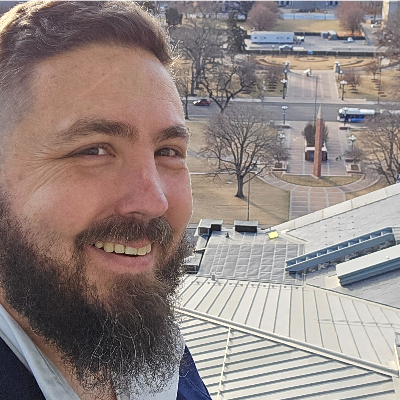
Evan Kirstein
Founder, Airspace Collective | Co-Founder & Security Lead, Study GRC
Actions
Evan Kirstein works in financial-sector information security, running a day-to-day security program under federal examination: governance, risk and compliance, identity, data protection, and the AI-assessment work that now comes attached to all of it. They research passive RF systems alongside that. Their MARVIN project uses receive-only Wi-Fi and Bluetooth observation to study networked license-plate-reader infrastructure, with no probing, no association, and no credential capture by design.
At Wild West Hackin' Fest Deadwood 2026 they are scheduled to teach a two-hour MARVIN workshop and co-host the RF Village. Evan also teaches access governance for SaaS, guest and AI-agent identities, affordable cybersecurity practice, and emergency communications built on drones and LoRa mesh networks, most recently in a July 2026 Antisyphon Anti-Cast with Luke Canfield. They have briefed state legislators at the Colorado State Capitol on AI risk, data privacy and cybercrime.
Evan holds an M.S. in Cybersecurity and Information Assurance from Western Governors University, writes for The Cybersleuth Chronicles, and co-founded Study GRC, a nonprofit offering free governance, risk and compliance training, where they serve as security lead and a board member. They are an FCC-licensed amateur radio operator, KJ5MCN, and an ARES emergency communications volunteer. Outside all of that: homelabs, tabletop and video games, cars, motorcycles, and karaoke.
Links
Area of Expertise
Cyber on a Shoestring: Building Wagyu Career Skills and Experience on a Ramen Budget
Landing a cybersecurity job requires experience but getting that experience can feel impossible when you are trying to break in, switch specialties, or stretch out a tight budget. This presentation shows you how to build real, demonstrable skills without needing expensive gear or paid programs.
We will explore free and affordable ways to create meaningful hands-on experience through home labs, GitHub repositories, blog posts, certifications, and practical projects. You will learn how to build both broad cybersecurity fundamentals and specialty-focused skills for Offensive, Defensive, OSINT, and GRC paths, including key tools to prioritize as you grow.
We will also cover how to market your skills more effectively. From strengthening your resume and LinkedIn profile to improving your personal brand and networking strategy, you will walk away with a clear roadmap for showcasing your work and building a community that helps you keep learning over time.
The Drone Renaissance 2: #DronesForGood
When disasters knock out internet, cellular, and power, disaster responders and small businesses need comms that are fast, cheap, and independent. This talk proposes a practical, Off-Grid, open-source approach that marries two accessible technologies: 3D-printable, payload-capable FPV drones carrying small, ruggedized payloads that can deploy GPS-enabled, text-based LoRa mesh nodes and solar-backed repeaters to restore basic situational awareness, triage, and coordination within hours, not days.
Why now? Rapid innovation in hobbyist drones and proven wartime/off-grid adaptations have dropped costs and expanded capabilities; meanwhile, Meshtastic’s open ecosystem makes low-bit-rate messaging and GPS location sharing viable for community groups. Attendees will learn how to choose frames/components, navigate high-level legal/ethical boundaries, design resilient meshes, and deliver waterproof/fire-resistant handheld nodes to victims and responders. We’ll cover antenna elevation strategies (balloon, arborist lines, tall structures, perch-and-stare) and pre-incident solar repeater placements in high-risk regions.
Old-School RBAC, New-School Risk: JML for SaaS, Guests, and AI
Access control didn’t disappear with cloud, it fractured. This hands-on workshop turns old-school RBAC and joiner/mover/leaver philosophies and processes into a modern exercise leaders can run Monday morning. Participants map three exemplar roles, spot segregation-of-duties conflicts, and design time-bound exceptions and guest controls that work across SaaS, collaboration suites, and AI add-ons without relying on any specific vendor. A timed tabletop tests urgent transfers, external auditors, and AI plugin surprises, forcing practical decisions under constraints. Attendees leave with a one-page role catalog, a JML workflow, and a “first five moves” checklist tied to audit-ready outcomes. The result is immediate, durable access hygiene: fewer foot-guns, smaller blast radius, and a cadence for quarterly reviews that executives understand and teams can sustain at scale, everywhere.
The S.E.P. Field on Every Corner: Watching the Watchers - (2hr Workshop)
Flock Safety automated license plate reader cameras are being installed at the entrances to neighborhoods, apartment complexes, schools, and municipal roads across America at an extraordinary rate -- and most people who drive past them every day have no idea they are being logged. This workshop teaches participants to find them.
The detection methodology relies on the cameras' own wireless management interfaces. Flock Safety cameras are networked devices, networked devices have MAC addresses, and MAC addresses have organizationally unique identifiers that are publicly resolvable. Participants learn how to build MARVIN -- a MAC Address Recon for Vehicle Infrastructure Nodes war-driving kit -- around accessible hardware (a compute module such as a Raspberry Pi or laptop, a USB GPS dongle, and a set of ESP32S3 WiFi+BLE radios), then learn how to use it to passively enumerate Flock-associated hardware on every block they pass.
Participants leave with knowing how to build a working detection toolkit, a complete open-source software stack, a geo-referenced dataset from a real survey run, and the analytical methodology to turn raw Wi-Fi probe observations into a GIS-ready map of surveillance coverage.
Target audience: Privacy researchers, RF and hardware hackers, civil liberties advocates, journalists, homelab builders, etc. No RF or wireless background required - relevant 802.11 concepts are taught from scratch.
Venue requirements: Standard projection and audio. For hybrid delivery: a second video source (document camera or similar) for the hardware segment, a shared text channel serving both in-person and online attendees, and ideally a co-host to support remote participants during the hands-on lab.
Preferred duration: 2 hours. Expandable to 4 hours with a live field survey pass and extended coverage geometry and GIS analysis.
Format: In-person, online, or hybrid (in-person and online).
First public delivery: Wild West Hackin' Fest, Deadwood, South Dakota - October 2026.
Ethics and legal: Entirely passive, receive-only methodology. No active probing, no association or authentication, no packet injection, no credential capture, no images taken. Workshop datasets are sanitized or synthetic. The session frames this explicitly as civic documentation of public surveillance infrastructure, not as evasion of law enforcement.
Antisyphon Anti-Cast
Anti-Cast: Deploying Emergency Comms with Drones & Mesh with Evan & Luke
NolaCon 2026
The Drone Renaissance 2 #dronesforgood
When disasters knock out internet, cellular, and power, disaster responders and small businesses need comms that are fast, cheap, and independent. This talk proposes a practical, Off-Grid, open-source approach that marries two accessible technologies: 3D-printable, payload-capable FPV drones carrying small, ruggedized payloads that can deploy GPS-enabled, text-based LoRa mesh nodes and solar-backed repeaters to restore basic situational awareness, triage, and coordination within hours, not days.
Why now? Rapid innovation in hobbyist drones and proven wartime/off-grid adaptations have dropped costs and expanded capabilities; meanwhile, Meshtastic’s open ecosystem makes low-bit-rate messaging and GPS location sharing viable for community groups. Attendees will learn how to choose frames/components, navigate high-level legal/ethical boundaries, design resilient meshes, and deliver waterproof/fire-resistant handheld nodes to victims and responders. We’ll cover antenna elevation strategies (balloon, arborist lines, tall structures, perch-and-stare) and pre-incident solar repeater placements in high-risk regions.
KernelCon 2026
The Drone Renaissance 2: #DronesForGood
When disasters knock out internet, cellular, and power, disaster responders and small businesses need comms that are fast, cheap, and independent. This talk proposes a practical, Off-Grid, open-source approach that marries two accessible technologies: 3D-printable, payload-capable FPV drones carrying small, ruggedized payloads that can deploy GPS-enabled, text-based LoRa mesh nodes and solar-backed repeaters to restore basic situational awareness, triage, and coordination within hours, not days.
Why now? Rapid innovation in hobbyist drones and proven wartime/off-grid adaptations have dropped costs and expanded capabilities; meanwhile, Meshtastic’s open ecosystem makes low-bit-rate messaging and GPS location sharing viable for community groups. Attendees will learn how to choose frames/components, navigate high-level legal/ethical boundaries, design resilient meshes, and deliver waterproof/fire-resistant handheld nodes to victims and responders. We’ll cover antenna elevation strategies (balloon, arborist lines, tall structures, perch-and-stare) and pre-incident solar repeater placements in high-risk regions.
Wild West Hackin' Fest Mile High 2026
The Drone Renaissance 2 #dronesforgood
When disasters knock out internet, cellular, and power, disaster responders and small businesses need comms that are fast, cheap, and independent. This talk proposes a practical, Off-Grid, open-source approach that marries two accessible technologies: 3D-printable, payload-capable FPV drones carrying small, ruggedized payloads that can deploy GPS-enabled, text-based LoRa mesh nodes and solar-backed repeaters to restore basic situational awareness, triage, and coordination within hours, not days.
Why now? Rapid innovation in hobbyist drones and proven wartime/off-grid adaptations have dropped costs and expanded capabilities; meanwhile, Meshtastic’s open ecosystem makes low-bit-rate messaging and GPS location sharing viable for community groups. Attendees will learn how to choose frames/components, navigate high-level legal/ethical boundaries, design resilient meshes, and deliver waterproof/fire-resistant handheld nodes to victims and responders. We’ll cover antenna elevation strategies (balloon, arborist lines, tall structures, perch-and-stare) and pre-incident solar repeater placements in high-risk regions.
CactusCon - CISO Village
Old-School RBAC, New-School Risk: JML for SaaS, Guests, and AI
Access control didn’t disappear with cloud, it fractured. This hands-on workshop turns old-school RBAC and joiner/mover/leaver philosophies and processes into a modern exercise leaders can run Monday morning. Participants map three exemplar roles, spot segregation-of-duties conflicts, and design time-bound exceptions and guest controls that work across SaaS, collaboration suites, and AI add-ons without relying on any specific vendor. A timed tabletop tests urgent transfers, external auditors, and AI plugin surprises, forcing practical decisions under constraints. Attendees leave with a one-page role catalog, a JML workflow, and a “first five moves” checklist tied to audit-ready outcomes. The result is immediate, durable access hygiene: fewer foot-guns, smaller blast radius, and a cadence for quarterly reviews that executives understand and teams can sustain at scale, everywhere.
Wild West Hackin' Fest Deadwood 2025
Cyber on a Shoestring: Building Wagyu Career Skills and Experience on a Ramen Budget
Landing a cybersecurity job requires experience but getting that experience can feel impossible when you are trying to break in, switch specialties, or stretch out a tight budget. This presentation shows you how to build real, demonstrable skills without needing expensive gear or paid programs.
We will explore free and affordable ways to create meaningful hands-on experience through home labs, GitHub repositories, blog posts, certifications, and practical projects. You will learn how to build both broad cybersecurity fundamentals and specialty-focused skills for Offensive, Defensive, OSINT, and GRC paths, including key tools to prioritize as you grow.
We will also cover how to market your skills more effectively. From strengthening your resume and LinkedIn profile to improving your personal brand and networking strategy, you will walk away with a clear roadmap for showcasing your work and building a community that helps you keep learning over time.
NolaCon 2025
Cyber on a Shoestring: Building Wagyu Career Skills and Experience on a Ramen Budget
Landing a job requires experience. But how do you get Kobe beef experience without a job or shift gears in your cybersecurity career to a facet of cyber that you don’t have any work experience in while your budget keeps your pantry stocked with Cup Noodles?
In this presentation, we will discuss free and affordable ways of building effective experience and skills in ways that are easily demonstrated through homelabs, repositories, blog posts, certifications, and more, covering aspects of both general cybersecurity as well as more facet-specific examples for Offensive, Defensive, OSINT, and GRC, etc. alongside some core tooling examples to focus on learning for each. Additionally, we will talk about how to better market your skills, personal branding, and experience in a resume, on LinkedIn, etc. to build an effective network and community to foster continual learning as time goes on.
Evan Kirstein
Founder, Airspace Collective | Co-Founder & Security Lead, Study GRC
Links
Actions
Please note that Sessionize is not responsible for the accuracy or validity of the data provided by speakers. If you suspect this profile to be fake or spam, please let us know.
Jump to top