
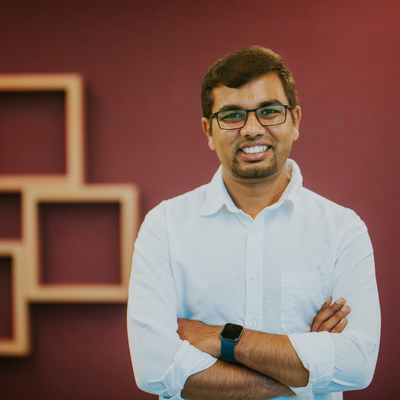
Harsha Sanjeeva
Senior Software Engineer at Cisco | Kubernetes Security & AI Agent Access Control
San Jose, California, United States
Actions
Harsha Sanjeeva is a Senior Software Engineer at Cisco, where he works on cloud network access infrastructure.
Harsha is the creator of Plexar, an open-source tool for Kubernetes blast radius analysis that helps platform teams prioritize CVE remediation based on network reachability, not just CVSS scores. He has deep experience with Cilium, Tetragon, SPIFFE/SPIRE, and the Trivy ecosystem. His work sits at the intersection of Kubernetes security, eBPF-based observability, and AI agent access control.
His current research focuses on extending Network Access Control concepts to Kubernetes workloads and autonomous AI agents, including posture-driven network policies and MCP (Model Context Protocol) interception for AI agent governance.
He has authored multiple technical articles on zero-trust architectures for cloud-native environments and AI systems.
Area of Expertise
Topics
Your AI Agents Have Network Access, Who's Watching? Blast Radius Visibility for AI Workloads in K8's
87% of container images in production have critical vulnerabilities (Sysdig 2023).
The average time to patch: 62 days (Datadog 2025). During that window, every
vulnerable pod — including the ones running your AI agents — has unrestricted
network access to databases, APIs, and the internet.
Nobody's watching.
In this talk, I'll show how AI workloads in Kubernetes face a unique security blind
spot: the gap between "we found a CVE" and "we did something about it." Traditional
scanners like Trivy and Kubescape find vulnerabilities — but no tool shows you which
vulnerable pods have the widest blast radius, or which AI agents can reach sensitive
data stores they shouldn't.
I'll introduce Reflex, an open-source tool that combines CVE severity with network
reachability analysis to answer the question every platform team should be asking:
"If this pod gets exploited, what can the attacker reach?"
What you'll learn:
- Why CVSS scores alone are misleading — a 7.5 in a pod with internet egress is
more dangerous than a 9.8 in an isolated pod
- How to visualize blast radius: mapping CVE severity × network reachability in
real Kubernetes clusters
- Live demo: scanning a production-like cluster, revealing which AI workloads have
unrestricted access, and generating NetworkPolicies to contain them
- Why AI agents (MCP, tool-calling LLMs) need network access control — and how
the EU AI Act is about to make this mandatory
- The "scan → prioritize → recommend → enforce" maturity model for Kubernetes
security posture
This talk includes a live demo using real Kubernetes services, Trivy vulnerability
data, and Cilium network policies. Attendees will leave with a practical framework
for prioritizing CVE remediation by blast radius — not just severity score — and
an open-source tool they can run against their own clusters.
Ideal for: Platform engineers, SREs, security engineers, and AI/ML engineers
deploying models and agents in Kubernetes.
AI DevSummit + DeveloperWeek Management 2026 Sessionize Event
Please note that Sessionize is not responsible for the accuracy or validity of the data provided by speakers. If you suspect this profile to be fake or spam, please let us know.
Jump to top