
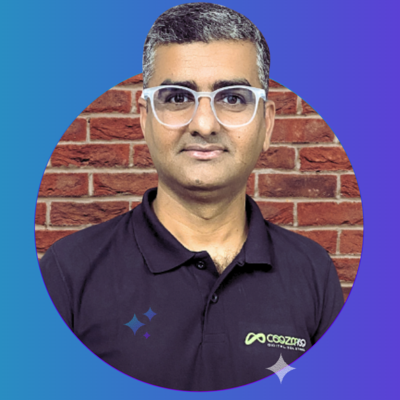
Hastimal Jangid
Co-Founder, RankRabbit.ai | Coozmoo - Cloud and AI Engineering
Houston, Texas, United States
Actions
Hastimal Jangid is a Cloud, Data, and AI technology leader, enterprise architect, researcher, and technical speaker with 15+ years of experience designing large-scale distributed, data-intensive, and AI-powered systems. He is 10× AWS, 7× GCP, 3×Azure, Kubernetes, Snowflake, Databricks, GenAI, GitHub, and Anthropic MCP Certified, combining deep multi-cloud expertise with emerging AI technologies.
His work and research focus on Large Language Models (LLMs), Agentic AI, AI Search and Retrieval, RAG, Model Context Protocol (MCP), cloud-native AI infrastructure, real-time data engineering, AI security, and responsible AI, with particular interest in applications across healthcare and biomedical systems.
As Co-founder of RankRabbit AI, Hastimal explores how LLMs and AI agents discover, retrieve, rank, reason over, and recommend information across platforms such as Gemini, ChatGPT, Claude, Perplexity, and Google’s AI-powered search experiences. His research interests include LLM retrieval and grounding, multi-agent systems, AI search, information quality, explainable AI (xAI), knowledge-base poisoning, AI security, and trustworthy AI systems.
His engineering background spans AWS, Google Cloud, Microsoft Azure, Kubernetes, distributed systems, Big Data, machine learning, MLOps, real-time streaming architectures, and AI agent infrastructure. He has designed and delivered enterprise technology initiatives across healthcare, financial services, retail, travel, media, and digital commerce.
As a technical speaker, Hastimal translates emerging AI research into practical architectures and hands-on demonstrations. His talks explore the intersection of LLMs, AI agents, MCP, cloud infrastructure, K8, search, security, and healthcare AI—explaining how modern AI systems work, where they fail, and how engineers can build them securely, responsibly, and at scale.
Badges
Area of Expertise
Topics
AgentOps on Kubernetes: Tracing AI Agents with OpenTelemetry
An AI agent can return HTTP 200 while still choosing the wrong tool, taking the wrong path, or spending seconds across multiple model and service calls. This session demonstrates how OpenTelemetry can trace agent workflows running on Kubernetes. We will instrument model interactions, retrieval, tool calls, and supporting services and follow a single request across the complete workflow. Attendees will learn how existing cloud-native observability practices can help operationally better.
The Hidden Layer in AI Healthcare: Who Controls the LLM Recommendation?
Patients are increasingly turning to LLMs and AI systems for medical guidance before traditional healthcare channels, but these systems do not simply generate answers; they actively shape recommendations by ranking, filtering, and prioritizing medical information, providers, and treatments. This introduces a hidden recommendation layer inside AI systems where outcomes are influenced by training data, retrieval pipelines, system prompts, and safety alignment layers. In healthcare, this creates a critical security and governance challenge, as these recommendation pathways are not transparent or auditable. The talk explores how LLM recommendation stacks work, where control points exist, and why emerging risks such as prompt injection, content poisoning, and recommendation manipulation directly impact patient safety. It also highlights the governance gap in AI-driven healthcare decisions, raising the core question of who ultimately controls what AI recommends and how that control is exercised.
Beyond Generative Search: Building Evidence-Grounded Agentic AI for Healthcare Discovery
As patients increasingly use generative AI to discover providers, services, and health information, healthcare search is shifting from ranked links toward AI-generated recommendations. But healthcare discovery requires more than fluent answers—it requires trustworthy evidence, source transparency, and traceability.
This session presents an evidence-grounded agentic AI framework that decomposes patient questions into targeted searches, retrieves healthcare provider data and biomedical literature from authoritative sources, ranks evidence, and generates responses grounded in verifiable citations. Using a working healthcare discovery prototype, the session demonstrates how specialized AI agents can separate planning, retrieval, evidence ranking, and response generation. The goal is to explore how agentic AI can support a more transparent and trustworthy future patient journey while reducing the risks of hallucination and unsupported recommendations.
Cloud Careers: Combining AWS, Security, and AI Skills - Founder's Journey
The cloud industry is evolving faster than ever, and the most valuable professionals are no longer experts in just one domain. Organizations are looking for people who can combine cloud architecture, cybersecurity, and AI to build secure, scalable, and intelligent solutions.
In this session, I'll share my personal journey—from learning AWS and cloud technologies to building expertise in security, exploring generative AI, and eventually starting my own company. Along the way, I'll discuss the lessons learned, the challenges faced, and the skills that have had the greatest impact on my career.
Whether you're a student, aspiring cloud engineer, developer, security professional, or someone looking to transition into cloud and AI, this session will provide practical advice on building the right skills, gaining hands-on experience, and creating a long-term career roadmap.
What you'll learn:
1. Why AWS, cybersecurity, and AI are a powerful combination for today's technology careers
2. A practical learning roadmap for building cloud, security, and AI skills
3. How to gain real-world experience through projects, certifications, and community involvement
4. The importance of security-first thinking when designing cloud solutions
5. Lessons learned from transitioning from engineer to founder
6. Common career mistakes to avoid and strategies for continuous growth
7. How to build a strong professional brand through open-source contributions, technical content, public speaking, and networking
By the end of this session, you'll have a clear roadmap for developing in-demand technical skills, growing your career in cloud and AI, and understanding how continuous learning and community involvement can open doors to new opportunities, including entrepreneurship.
2026 UT REAL Health AI Symposium Sessionize Event
Tulsa AWS Community Day Sessionize Event
Please note that Sessionize is not responsible for the accuracy or validity of the data provided by speakers. If you suspect this profile to be fake or spam, please let us know.
Jump to top