
Jessé Moraes Braga
Full-Stack Software Engineer, Part-Time AI Babysitter.
Full-Stack Software Engineer, Teilzeit-KI-Babysitter.
Engenheiro de Software Full-Stack e babá de IA nas horas vagas.
Hamburg, Germany
Actions
Jessé is a full-stack developer and consultant at iits-consulting, with close to nine years of experience in Kotlin and Vue.js. His work leans heavily on Domain-Driven Design, Clean Architecture, and Event Storming, mostly because he's seen what happens to systems when nobody draws boundaries early.
He was born in the Amazon region of Brazil, grew up in São Paulo, studied Information Systems at the University of Bremen, and these days he's based in Hamburg. He has been writing software since his early academic life back in Brazil.
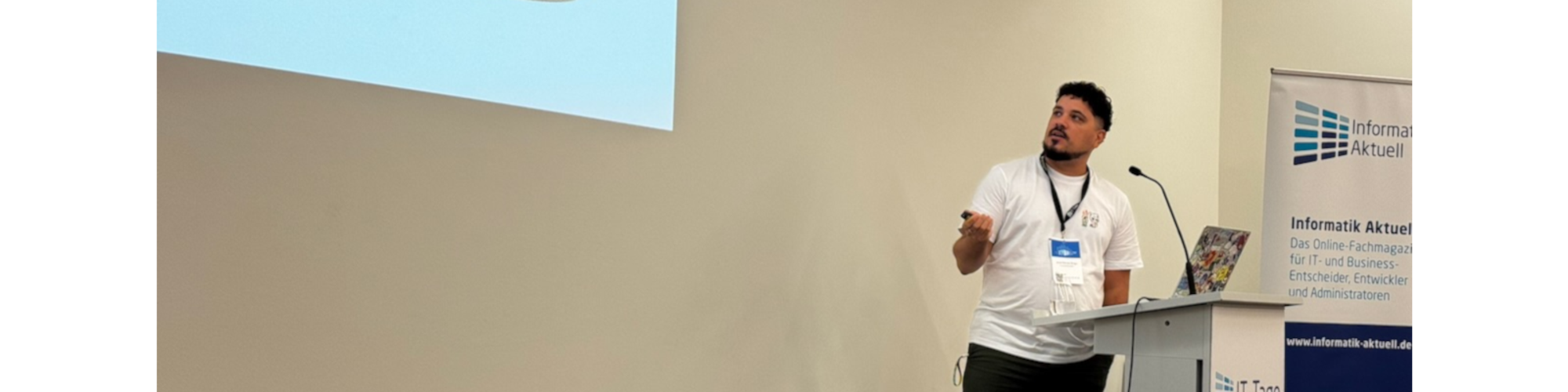
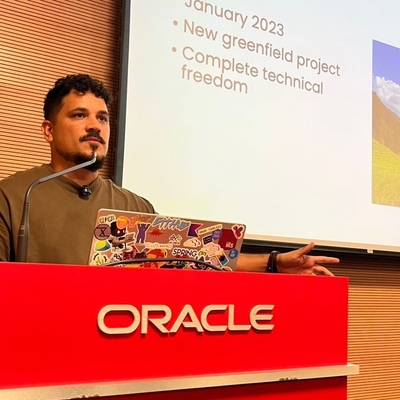
Jessé speaks at conferences and user groups including IT-Tage Frankfurt, Kotlin Devs Brasil (official KUG), and SouJava São Paulo (official JUG). He keeps coming back to one point: architecture isn't something you do once at the start of a project, it's a daily habit. Right now he's especially curious about what that habit looks like once AI is writing a good chunk of the code.
Jessé ist Full-Stack-Entwickler und Berater bei iits-consulting mit knapp neun Jahren Erfahrung in Kotlin und Vue.js. Seine Arbeit ist stark von Domain-Driven Design, Clean Architecture und Event Storming geprägt. Der Grund: Er hat immer wieder gesehen, wie Systeme ohne früh gezogene Grenzen aus dem Ruder laufen.
Geboren in der Amazonas-Region Brasiliens, aufgewachsen in São Paulo, studierte er Wirtschaftsinformatik an der Universität Bremen und lebt heute in Hamburg. Software schreibt er schon seit seiner frühen akademischen Zeit in Brasilien.
Jessé spricht auf Konferenzen und bei User Groups wie den IT-Tagen Frankfurt, Kotlin Devs Brasil (offizielle KUG) und SouJava São Paulo (offizielle JUG). Ein Gedanke begleitet ihn dabei immer wieder: Architektur ist nichts, was man einmal zu Projektbeginn erledigt, sondern eine tägliche Gewohnheit. Aktuell beschäftigt ihn besonders, wie diese Gewohnheit aussieht, wenn KI einen Großteil des Codes schreibt.
Jessé é desenvolvedor full-stack e consultor na iits-consulting, com quase nove anos de experiência em Kotlin e Vue.js. Seu trabalho é fortemente influenciado por Domain-Driven Design, Clean Architecture e Event Storming. O motivo: ele já viu, repetidas vezes, o que acontece com sistemas quando ninguém define os limites logo no início.
Nascido na região amazônica do Brasil e criado em São Paulo, ele estudou Sistemas de Informação na Universidade de Bremen e hoje vive em Hamburgo. Ele escreve software desde os primeiros anos da sua vida acadêmica, ainda no Brasil.
Jessé é speaker em conferências e grupos de usuários, incluindo o IT-Tage Frankfurt, o Kotlin Devs Brasil (KUG oficial) e a SouJava São Paulo (JUG oficial). Ele sempre volta a um ponto: arquitetura não é algo que se faz uma vez, no início do projeto, mas sim um hábito diário. No momento, ele está especialmente curioso sobre como esse hábito se transforma à medida que a IA passa a escrever boa parte do código.
Area of Expertise
Topics
Event Storming in Real Life
As developers, we’re familiar with terms like “domain driven design”, as well as several architectural patterns. Nonetheless when it comes to designing and developing business applications we feel stuck in the same patterns, typically with the stack we're more familiar with. So how do we break this pattern and try something new? How do we get all the stakeholders on board? And what are the possible implications of taking another direction when starting a new project?
This talk is about discussing possible answers to these questions, but mostly about sharing the experience my team and I made when starting a Greenfield project 3 years ago. Join me if you want to find out how I pitched this idea to my team, got the P.O. and the customer on board and what results followed in short, middle and long term. Meaningful change is around the corner.
Reclaim Architecture - Judgment in the Age of AI Agents
In the era of AI and vibe coding it's easy to build new software, start new projects. Generated code has been evolving rapidly along with the quality it carries. Meanwhile we've been busy developing Skills, Guardrails and brand new techniques to try and make AI more predictable, more deterministic. So what's the role of a Software Developer or a Software Architect nowadays? And how can we expect to shape the future?
AI-Agents produce a lot of code very fast... much faster than anyone can review it. So quality becomes not only about code ownership, testing and prodding. It turns into guardrails and rule-setting in order to steer agents in the right direction.
But these are not the goal of this talk. In this talk, we are going to go back to the basics that make for a good Software Developer and Architect in the first place. Understanding the business domain, the boundaries that are meaningful to your use case and how to recognize them, what trade-offs are worth taking, and what judgment calls are yours to make. Why? Because automating code output is a given, but thinking isn't. Maybe anyone can write good code, AI-assisted or not. But the knowledge and the tools to shape the code architecturally have to be taught on to the next generation of Software Architects.
So let us embrace AI-assisted development, but not set for poor architecture, big balls of mud, endless rewrites. Let's have a say in what the loop is, and not just be the human in it. Let's reclaim architecture!
An Honest, Unscripted Conversation about AI in Open Source
I've interviewed several Open Source Software Contributors... this talk is about their struggles (!), after all, we all rely on OSS.
With the up and coming of AI, there has been a flood of contributions to OSS. The headlines and opinions differ greatly, from AI finding a 15 year old vulnerability in the Linux kernel to curl being DDoSed by AI-generated bug reports. So let's dig into questions like: does AI open the door for more contributors, or does it just shift the burden onto already thin-stretched maintainers? Can we trust AI to review as fast as it helps generate?
I would like to invite you to exchange your own ideas and opinions on the topic so that we can try and shape the future of our community. So grab a snack and let's have an honest and open-minded talk about the future of Software Development and Open Source Software.
SouJava Meetup March 2026
Event Storming in Real Life (Event Storming na Vida Real)
Kotlin Devs Brasil Meetup - Official Brazilian KUG
Event Storming in Real Life (Event Storming na Vida Real)
IT-Tage 2025
Event Storming in Real Life
Please note that Sessionize is not responsible for the accuracy or validity of the data provided by speakers. If you suspect this profile to be fake or spam, please let us know.
Jump to top