
Juho Nevalainen
AI Strategist, CTO and Executive Advisor
Helsinki, Finland
Actions
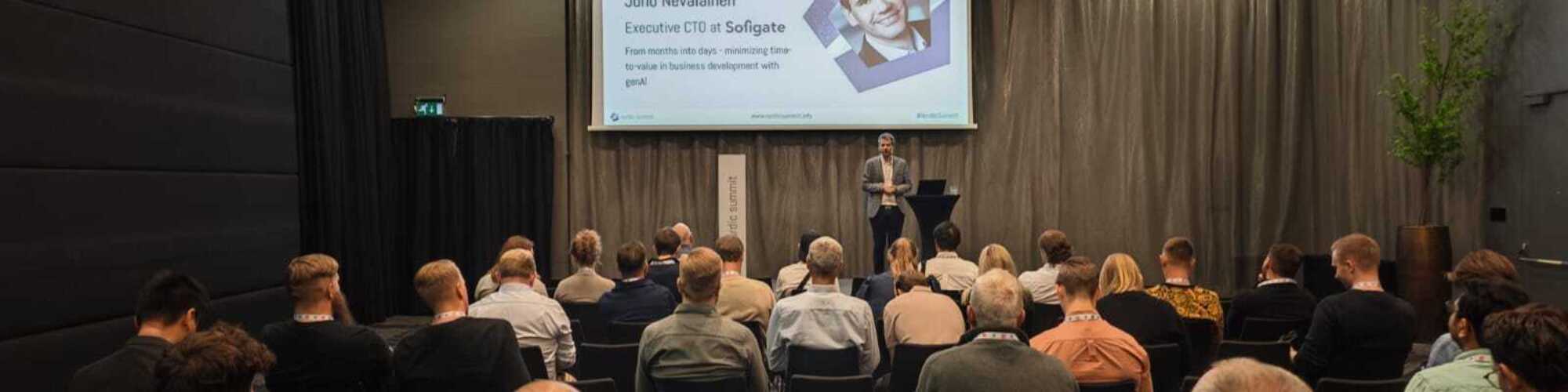
Juho Nevalainen leads Enterprise AI Services at Sofigate, a Nordic business technology company. He's an experienced CTO, AI strategist and executive advisor. For 15 years he has advised C-level executives and business leaders on turning technology into business results. Today his work focuses on taking AI agents from pilots into everyday operations in Nordic enterprises and public organisations. He has spoken at AI Fokus (2025 and 2026), Nordic Summit, Build Stuff and We Make Future. Watch his AI Fokus '26 talk: https://youtu.be/ZJTMeVIlfS4?si=9NztjAi0HKZutZRI
Links
Area of Expertise
Topics
From months into days - accelerating time-to-value in business development with AI
Today's most crucial metric is time-to-value; how can businesses turn their ideas and needs into working solutions rapidly and how to take the solutions into use efficiently. Technology itself is not the answer - it requires new leadership capabilities to realize the value of AI.
So far, AI has been delegated to the IT organizations by the business management resulting PoC's, demos and test cases - but only little measurable business value or improved productivity.
In this session you will discover how to anyone can be designer future business with the help of generative AI. What was earlier done in months, can now done in days or even hours. You will hear stories of how organizations have approached the AI leadership, learn methodologies best practices how business management and IT can determine the most important business capabilities and match the best-fit technologies to meet the business needs - all with generative AI.
Even more, in the session you will realize how to take the business design into reality in a way that the business management truly owns their transformation - all the way to the value realization instead of monitoring it from the distance. This asks for an AI operating model that will be explained in detail in the session.
At the end of the day, you will learn in practice how business management should take initiative in leading the AI development in an organization instead of delegating or outsourcing the leadership.
Target audience; CEO's, CTO's, CIO's, CDO's, CFO's
Duration from 30 min to 45 min
From Pilots to Practice: Leading the agentic AI transformation
This session presents a practical blueprint to shorten time-to-value by treating Plan, Build and Run as one continuous engine. The bottleneck is rarely delivery any more: AI has made building fast and cheap. It is planning and decision-making.
Leaders cannot set ambitious goals without understanding what is now possible, and without clear priorities AI only accelerates activity.
We focus on three levers that consistently speed up value: hands-on business ownership rather than delegation to IT; platform-first delivery, since in Sofigate's research the benefits so far have come mainly from agents built on business platforms; and one shared operating model that business, IT and partners can execute together as agents scale.
In the session, concrete examples are provided on how the small municipality of Konnevesi (increased their productivity by 85% in the AI pilot) and how another customer from a narrow pilot to AI agents and reached about 70% of password-reset requests resolved automatically)
Attendees leave with a diagnostic for where time-to-value is lost and a "first six weeks" approach from ideas to operational impact.
Key learnings:
- Diagnose where time-to-value is lost across planning, delivery and operations
- Apply three levers that speed up outcomes: business ownership, platform-first delivery and a shared operating model
- Keep ownership, quality and security under control as AI agents scale
CIOs/CTOs, digital & transformation leaders, product/platform owners, enterprise architects, delivery/service leaders.
Format
35–40 min talk + Q&A
Why Your AI Strategy Is Failing Before the Code Runs
Most companies approach AI engineering as a tooling problem: give engineers better models, copilots and agents, and adoption will follow.
It won't.
We learned this ourselves at Sofigate. Giving every employee AI licences built skills fast, but costs rose and business results did not follow until we changed how work was organised.
As AI becomes part of software development, the constraint shifts from model capability to organisational capability. In our experience, one developer can effectively steer only around ten agents before reviews and decisions start piling up. The bottleneck moves from writing code to deciding, reviewing and owning it.
This talk argues that your AI engineering strategy is only as strong as the organisation around it, and works through five leadership decisions: how to move from experimentation to adoption, how humans and agents divide the work, what changes in roles and practices, how to govern without killing speed, and how to measure impact rather than AI activity.
Not another tooling overview, but a short, practical playbook for engineering leaders.
Key learnings:
- Recognise when AI engineering has become an organisational problem rather than a tooling one
- Design how humans and agents divide work, review and ownership
- Replace AI activity metrics with engineering and business outcomes
Why the Hard Part in AI Is Changing How We Work
Most organisations approach AI transformation with a technology question: what can we automate? The more important question is how to organise work when automation changes what people need to do, and where the organisation needs people more, not less.
When the Finnish municipality of Konnevesi automated grant processing, handling time fell by about 85% in the pilot, and the time went to difficult cases and faster decisions for residents.
Other companies cut customer service staff, watched satisfaction collapse and hired people back. The difference was not the technology. It was leadership.
This session covers four areas leaders must redesign: the work itself, end to end rather than task by task; roles and teams, as AI changes the economics of expertise; leadership and accountability, as managers start leading teams of people and digital colleagues; and the transformation itself, which cannot be run as disconnected pilots.
It also addresses the question most organisations avoid: what should we do with the capacity AI creates? The answer should not automatically be doing more with less.
Key learnings:
- Decide which work stays human, which is AI-assisted and which is delegated
- Define accountability when people and digital colleagues contribute to the same outcome
- Plan how AI-created capacity is reinvested before benefits are counted
From AI Adoption to AI-Native Engineering: What Leaders Need to Redesign
The first phase of AI in software engineering was simple: give developers AI coding tools and let experimentation spread.
The next phase is harder.
As coding agents take on larger tasks across files, systems and the whole lifecycle, work moves faster but coordination does not get simpler. Some developers become heavy users, others barely use the tools. Review and quality practices drift. New bottlenecks appear in architecture, context, testing, security and decision-making.
Leaders see activity rising without knowing whether outcomes improve. At this point, AI adoption becomes an operating-model challenge.
This session applies lessons from building an industrial agent factory to engineering organisations: keep each agent's task narrow enough to validate, give every agent a named owner, focus governance on what gets built and what is ready for release, and scale control with autonomy and risk. It also applies a lesson known since the 1980s: people cannot reliably take over a process they were never part of, which changes how review and supervision must be designed.
Participants get an AI-Native Engineering Leadership Framework to assess where they are today and what to change next.
Key learnings:
- Identify the organisational conditions required for agentic development to scale across teams
- Design review, supervision and ownership models for work shared by developers and agents
- Set governance and measurement priorities without creating bureaucracy
AI fokus 2026 Sessionize Event
Build Stuff 2025 Lithuania Sessionize Event
Nordic Summit 2025 Sessionize Event
AI fokus Sessionize Event
WMF - We Make Future
WMF is an international trade fair on artificial intelligence, technology and digital innovation at BolognaFiere, Bologna, Italy
My session is titled "accelerated time-to-value in business transformations - powered by genAI".
Sofigate Dreamforce '25 pre-conference
Sofigate organized a pre-conference for customers before the 2025 Dreamforce event.
In the pre-conference, my session was titled accelerated time-to-value with Salesforce.
Copenhagen AI Living Lab
Sofigate customer & key stakeholder conference about how to utilize generative AI in business transformation end-to-end.
Sofigate Knowledge '24 pre-conference
Before the 2024 ServiceNow's Knowledge conference Sofigate organized a pre-conference for customers and partners in Las Vegas.
My session in the pre-conference was titled accelerated time-to-value with ServiceNow and genAI
Digijohtamisen päivä
Digijohtamisen päivä (the day of digital management) is a Finnish annual conference that gathers 100+ CIO's and c-level IT executives to discuss about latest trends and topics around IT management and digital development.
My session was about how business management can utilize generative AI in business design
Please note that Sessionize is not responsible for the accuracy or validity of the data provided by speakers. If you suspect this profile to be fake or spam, please let us know.
Jump to top