
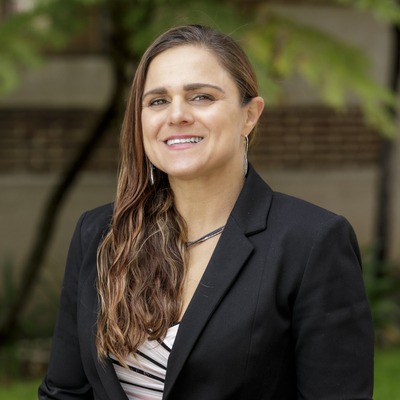
Julie Hopper
USC, Sustainability Data Analyst - PhD
Actions
Dr. Julie Hopper joined USC’s Office of Sustainability in 2022 as a data analyst, where one of her current projects involves calculating Scope 3 Emissions from USC’s purchased goods and services, as well as from employee and student commuting. In addition to calculating Scope 3 Emissions data, Julie led the design and implementation of USC’s Assignment: Earth Dashboard, and oversaw the completion of USC’s 2024 STARS Gold Report. In efforts to collect and analyze data for the dashboard and STARS report, Julie led the development and implementation of USC’s Sustainability Survey, as well as data programming tools to help automate the collection of sustainability curriculum and research data and dashboards to showcase these data in a user-friendly format for the USC community. The code underlying these data programming tools and dashboards are open-access via USC's Sustainability Github account to assist other institutions that are interested in adapting these methods. Prior to this position, Julie conducted research and taught undergraduate courses in Environmental Studies and Ecology at USC. Julie holds a PhD in Environmental Science, Policy and Management from the University of California, Berkeley.
Sustainability Data Activists Unite!
This session provides the space for all data analysts and data enthusiasts to meet and exchange information and skills in order to advance sustainability initiatives across our institutions. The time will be used to network with one another, exchange information, discuss data challenges and solutions, and exchange tools/code that we have developed in relation to sustainability data. If desired, and if there is time, it can even be a work space to solve issues in real time. Come one, come all- data activists unite!
Scope 3 emissions (Cat 1 & 2)- Collection, Accounting and Decision Making: Network Meeting
Scope 3 emissions from Purchased Goods and Services (PGS) and Capital Goods represent some of the largest and most challenging sources of greenhouse gas emissions for higher education institutions. This networking session will provide an opportunity for participants to introduce themselves, exchange knowledge, share institutional approaches, and discuss lessons learned and emerging best practices for quantifying and reducing these emissions.
The discussion will focus on methodologies for calculating PGS and Capital Goods emissions, as well as strategies for engaging common suppliers at both the institutional and sector levels. Participants will explore how coordinated approaches can improve the quality and consistency of institutional emissions reporting while encouraging suppliers to enhance their own emissions data and reduction efforts. By fostering collaboration across institutions, the session aims to advance more efficient, effective, and scalable approaches to Scope 3 emissions management.
This networking session will be followed by a conference Learning Lab on Monday, October 5, 2026, from 3:30–5:15 p.m. ET, where participants will have the opportunity to continue these discussions and learn about some practical calculation tools that help automate the classification of purchased goods and services to obtain emission factors.
A Methodology for Higher Ed Purchased Goods and Services Scope 3 Emissions Accounting and Management
Scope 3 Emissions can be as daunting and opaque as they are indirect. There is a real need for clarity and standardization to help campuses focus on meaningful action. Here, we focus on the Scope 3 - Category 1 (Purchased Goods and Services) and review a potential framework for data collection and calculation based on the Purchased Goods & Services Calculation Methodologies deep dive performed through the AASHE Scope 3 Community of Practice. Highlights of this work include standardized methodologies and approaches to calculate these emissions and proposed actions that can drive impact and support the sustainability goals of higher ed institutions. We also share open-access tools that can be used to streamline the process of categorizing purchased goods and services and summarizing their related scope 3 emissions. Lastly, we will open up the session for discussion and questions, and explore future opportunities to obtain more accurate emissions factors.
Julie Hopper
USC, Sustainability Data Analyst - PhD
Actions
Please note that Sessionize is not responsible for the accuracy or validity of the data provided by speakers. If you suspect this profile to be fake or spam, please let us know.
Jump to top