

Kevin Maes
Agentic Engineer @BlueFolders.ai. Previously @Stately.ai
Málaga, Spain
Actions
I’m a software developer from the United States, currently based in Málaga, Spain. I love building software and I have focused on React and state management for the past decade. In recent years I’ve worked on statechart visualization tooling at Stately.ai, and mobile and desktop fintech applications using XState at Lab49. I’m currently at BlueFolders.ai building Navion Logistics, an AI-native platform combining durable execution with deterministic and agentic workflows. My passions include data art, personal finance apps, public speaking, and continuously rehydrating my roots in creative coding.
Area of Expertise
Topics
Laying Foundations for Stateful Web Game Development
Orchestrating complex state across an entire application is challenging, yet interactive games put this to the test by requiring robust state management across multiple levels, between hundreds of entities. This case study explores the creative process of building a React game from the ground up, using XState, the open-source TypeScript library for state machines. We'll witness the actor model in action as it coordinates game characters, their animations, and sounds. Within the context of modern AI-assisted development, we'll cover compositional patterns and practical tips for coding with actor systems in any application, not just games. Finally, we'll explore how state machines unlock testing options for application logic and even automation. Games allow us to merge solid engineering principles with immense creativity, and web developers can leverage all of this using their everyday skills!
- Practical tips for using the actor model to orchestrate state in any large-scale or complex application, using a game as an ideal case study.
- Requires sound played from my laptop
State That Survives: React Meets Durable Execution
From UI state to data-loading, React developers have plenty of solutions for managing client-side state. But what happens when a user action kicks off a process that takes hours or days to complete? Where does that state live, and how does your UI stay connected to it?
A new wave of durable execution solutions is addressing exactly this: backend processes that persist long-running state, retry on failures, and survive continuous deployments without interruption. Built on lessons from Navion, an AI-native logistics company, this talk shows how React and Temporal (rooted in the actor model) work together in production to coordinate the automation and human oversight of thousands of delivery orders.
I'll demonstrate how React 19's server features wire directly to workflows by querying their state, sending signals and updates to running processes, and surfacing errors to users. The benefits of durable execution will become clear and you'll take away a practical understanding of when to use its power and how to wire it into your React application.
Duration: Approximately 30 minutes, flexible.
Target Audience: Intermediate
Agentic Chartering: Trustworthy AI Features in your React App at Runtime
AI features in React apps are a negotiation between two opposing forces: autonomous agents and deterministic workflows. But instead of splitting the difference, what if we could get these opposing forces to work together safely and predictably?
Introducing Chartering: Rather than generating tool-calling code, the LLM authors the workflow itself as a charter, a declarative state machine. Separating implementation from orchestration gives us an iterative development lifecycle, complete with validation, testing, data privacy, and governance. Crucially, this is a runtime architecture: those guarantees reach the end users interacting with the live agentic features in your React app, not just developers at build-time. The same architecture runs in production today at Navion, an AI-native logistics platform coordinating thousands of fuel deliveries, where a dispatch assistant authors charters and a durable, governed runtime executes them in front of real customers.
The end result unlocks the strengths of both sides: an agent that's free to think and safe to ship.
Target audience: frontend and full-stack engineers adding agentic features to products, especially those already using or curious about state machines and durable execution. No ML background required; prior exposure to state machines helps but isn't assumed.
The architecture is presented as a vendor and product-neutral mental model, grounded in real production use at Navion Logistics (BlueFolders.ai) — a pattern to apply with an open source implementation, not a product to buy. Technical requirements: standard A/V (HDMI), confidence monitor preferred; no special setup.
People To Pixels: Crafting A Personal Data Art Pipeline
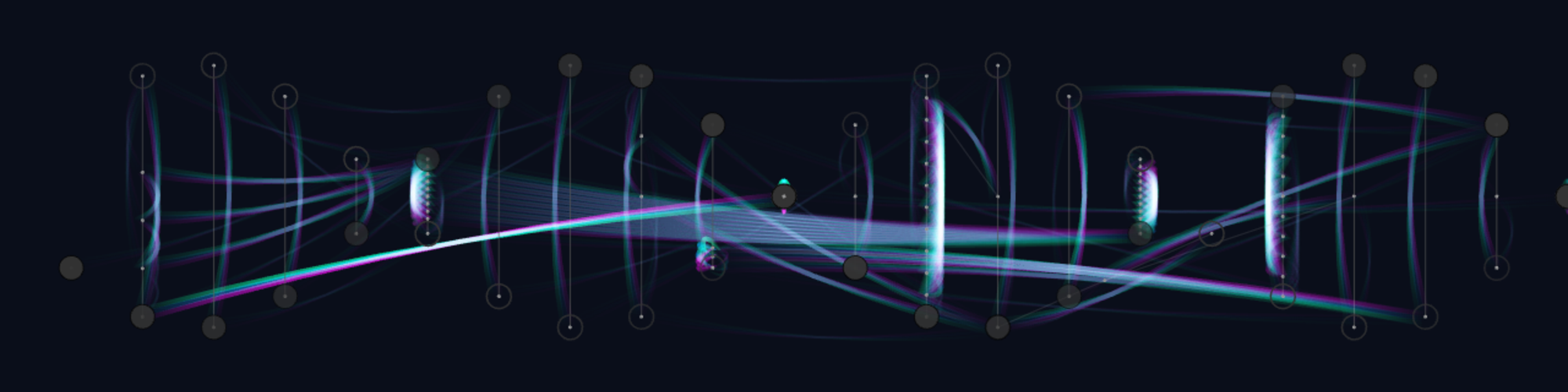
Some side projects start with a technology. This one started with a box of family photos and years of genealogy research: a 1,600-person family tree spanning continents and centuries, stored in GEDCOM, a line-based text format from 1984. Combine it with ideas even older than the format, like graph theory and state machines, then add modern web technologies and creative coding, and those ancestors come back to life.
CLI tools, graph optimizations and a user-configured pipeline of composable components transform family data into a unique form of art on a digital canvas: abstract, yet still traceable back to the people behind it. This case study will show how anyone can collect data and turn it into digital creations that express meaning far beyond their original bytes. You’ll leave with practical patterns for designing any data-to-visual pipeline: patching up messy real-world data, composing small, pure transformations, and orchestrating predictable yet highly creative async workflows.
A new talk focused on the engineering process and patterns behind a working data-art application I've built and continue to develop.
Target audience: web developers of all levels. No genealogy, art or graph-theory background needed.
Duration: Approximately 30 minutes, flexible. Includes a live browser demo.
Please note that Sessionize is not responsible for the accuracy or validity of the data provided by speakers. If you suspect this profile to be fake or spam, please let us know.
Jump to top