
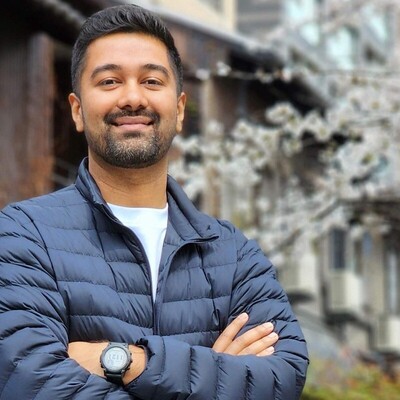
Kunal Lanjewar
Staff Engineer
Los Angeles, California, United States
Actions
Kunal Lanjewar runs tier‑zero infrastructure at Riot Games, where he builds and operates production AI agents and backend services that power games like VALORANT and League of Legends. He’s the author of Guild, an open‑source local cognition layer that gives AI agents shared memory and task coordination across coding tools via MCP. Previously, he helped scale Sky: Children of the Light to 300M+ downloads and millions of daily active players, and built the backend for its Guinness World Record–holding Aurora concert. His work has been featured at GDC, DataCon LA, and on the MongoDB Podcast. Earlier in his career he also built systems for NASA missions.
Links
Area of Expertise
Topics
Agents Come and Go. Keep Their Wisdom.
Your agents are disposable workers. What they learn shouldn't be.
Almost every agent session starts from zero. You re-explain the codebase, the conventions, the decisions you already made last week. Ten minutes of onboarding before any real work happens.
The common fix is to micromanage it up front: cram the architecture into a `AGENT.md`, write a `.cursorrules` for edge cases, package procedures into rigid skills. Before long you are maintaining brittle rulebooks the agent re-reads every time, eating your context window. And the strange part is, you get better results by deleting most of it.
The mistake is treating the agent itself as the asset. Agents are meant to be ephemeral; their wisdom is not: the decision you made and why, the approach you tried, the gotcha that cost you a day. Controlling that with static files and skills suppresses the agent's reasoning. Recall does the opposite: instead of front-loading everything, it pulls the relevant history just in time and lets the agent's own intuition take over. And that history belongs on your own machine where the embeddings run locally, so semantic recall never leaves the box.
The most surprising thing I found building this is that recall isn't really about speed. It stops agents from redoing solved work and re-litigating settled decisions, so the compounding value shows up as judgment.
In this talk, you will learn when to hard-code context and when to recall it, the design choices that keep a recall layer from rotting into a junk drawer of stale facts, and what I learned using it across my own projects, including why the best agent on your team is the one you can delete tomorrow.
Your Hero Agent Needs a Party
A front-door persona, a party of deterministic specialist agents, A2A between.
Your support bot deflects half its tickets, then, soloing a problem it was never built for, confidently runs the wrong `kubectl` command. Most teams respond by rewriting the prompt. The real fix is a multi‑agent party of specialists. This talk gives you a production pattern that turns one over-leveled hero agent into a coordinated party of specialists you can trust on tier-zero infrastructure.
Persona and ReAct agents make great heroes at the front door. Any team can copy one, paste it into their stack, and adjust the behavior in plain English. But if you send a lone hero to clear the dungeon, whether it is a deploy or an incident, a non-deterministic Reason-Act loop tends to loop, over-act, or punt back to a human. More prompts and more skills do not reliably level it up.
Instead of soloing, keep the persona as the front-door face and give it a party: deterministic DAG specialists where the graph is fixed and the LLM is called only at decision points. For example, a deployment specialist can list rolling pods, choose the next tool, run it, read logs, and then diagnose the result. Each specialist is a class with one job and a narrow set of tools, and they coordinate over A2A for capability discovery and delegation across frameworks. Reliability and tighter least-privilege access become properties of the design, not something you try to bolt onto a prompt.
You’ll leave with the pattern: where to draw the line between the hero and its specialists, how to shape a DAG specialist so it decides instead of flails, and where A2A fits as the seam between them, grounded in lessons from a tier‑zero fleet.
AI Engineer World's Fair 2026 Sessionize Event
Kunal Lanjewar
Staff Engineer
Los Angeles, California, United States
Links
Actions
Please note that Sessionize is not responsible for the accuracy or validity of the data provided by speakers. If you suspect this profile to be fake or spam, please let us know.
Jump to top