
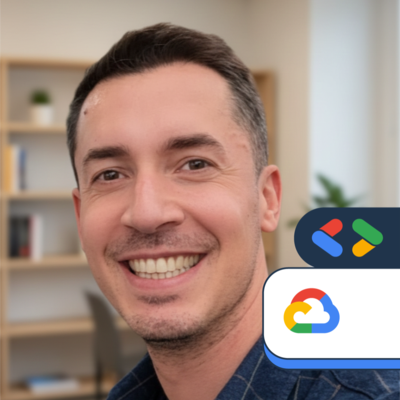
Goran Minov
Regional Technical Strategist @ Okta | Google Developer Expert (GDE) in Google Cloud: Cloud AI
London, United Kingdom
Actions
Goran is a Google Developer Expert (GDE) in Cloud AI, Cloud AI & Cyber Security Architect, and 8x Google Cloud Certified Professional, holding key credentials including Google Cloud Professional Cloud Architect, DevOps Engineer, and Database Engineer.
Currently, he serves as a Senior Technical Account Manager at Okta, helping enterprises automate and secure their identity infrastructure. His passion lies in architecting secure machine learning workflows, deploying autonomous applications via the Gemini Enterprise Agent Platform, and ensuring multi-agent systems are governed by strict Secure-by-Design and Zero Trust principles.
Topics
Building Stateful Agentic Apps with the Gemini Interactions API
Traditional LLM integrations force developers to act as state managers. Between manually maintaining bloated history arrays, persisting multi-turn conversation context across distributed backends, and writing glue code for tool execution loops, building reliable autonomous workflows often feels more like database plumbing than agent engineering.
The Gemini Interactions API fundamentally shifts this paradigm by introducing native, server-side statefulness and unified agent orchestration. In this session, we will break down the underlying architecture of the Interactions API and explore the client.interactions interface. Moving beyond standard prompt-and-response patterns, we will demonstrate how native state tracking, persistent interaction chaining, and integrated tool invocation eliminate boilerplate and simplify production agent architecture.
Key Takeaways
How the Gemini Interactions API natively maintains conversational state and context history without manual token management or client-side storage layers.
Implementing the client.interactions interface to orchestrate autonomous multi-step tool execution loops.
Architectural best practices for building scalable, stateful agentic applications on Google Cloud with drastically reduced code complexity.
Autonomous Remediation with CodeMender and Google Cloud
Modern software supply chains generate security alerts faster than engineering teams can triage them. Static analysis tools and dependency scanners uncover thousands of vulnerabilities, but remediation remains painfully manual. Simple LLM code generators often fall short: they lack repository context, hallucinate non-existent APIs, and fail to verify whether fixes break adjacent unit tests.
In this practical, code-first session, we explore CodeMender, an agentic remediation system designed to diagnose, rewrite, and verify code at repository scale. We examine how CodeMender decomposes vulnerability repair into an iterative loop: parsing abstract syntax trees (ASTs), formulating semantic patches with Gemini, and deterministically validating fixes using isolated runtimes on Google Cloud. Attendees will discover how to transition from passive alerts to an autonomous remediation pipeline that submits verified, compilable pull requests directly into their CI/CD lifecycle.
Key Takeaways
Deconstructing CodeMender: how agentic code-repair loops analyse, patch, and verify repository vulnerabilities.
Mitigating regression risks through automated test execution and semantic diff validation.
Running sandboxed remediation environments using Cloud Build and Cloud Run.
Integrating autonomous remediation agents into existing enterprise CI/CD and workflows.
"Redefine Possible" Panel
Break barriers, not ceilings. Join our panelists as they "Redefine Possible" in tech. Discover how women are reshaping industries, challenging norms, and inspiring the future.
Build your private Cloud Framework for Phishing Email Filtering
Have you ever wondered if you can build your phishing filtering solution? The purpose of this talk is to present a Cloud-based Phishing Email Framework. It will do so by utilising several products available on the Google Cloud Platform, hoping to create a base for a possible expansion. The implemented Cloud Framework will confirm the Cloud's easiness with zero infrastructure needed but can still achieve impressive results.
Build a DevOps Agent with the Gemini Interactions API
The Gemini Interactions API is a framework designed to streamline the development of stateful AI agents. Instead of requiring the developer to manually store, manage, and continuously re-upload a growing list of chat history and tool results, the Interactions API maintains the conversational state on the server. By simply passing a previous_interaction_id, your agent can "remember" its past actions, natively orchestrate tool usage, and drastically reduce the code complexity required to build autonomous loops.
Let's build a DevOps Agent to handle simulated infrastructure failures on a fictitious space station using Python and the Gemini Interactions API:
Telemetry Scan (Tool): The agent will check the current status of the station's life support and power grids.
Diagnostic Reasoning: The agent will analyse the telemetry to pinpoint the root cause of an anomaly (e.g., "Power grid 4 is failing").
System Repair (Tool): The agent will autonomously call repair functions (e.g., reroute_power_grid()) to stabilise the station.
Throughout this process, you will see how the Interactions API tracks the entire sequence of events seamlessly, without you having to write a single line of history-management code.
GDG London IO Extended 2026 Sessionize Event
IWD 2025 - GDG London Sessionize Event
DevFest Pisa 2023 Sessionize Event
Please note that Sessionize is not responsible for the accuracy or validity of the data provided by speakers. If you suspect this profile to be fake or spam, please let us know.
Jump to top