

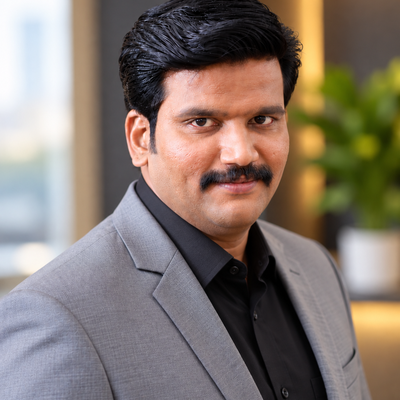
Lokesh Kannaiyan
Virtual Firewall Product Head | SonicWall | Award winning International Author
Bengaluru, India
Actions
Lokesh Kannaiyan is a Senior Product Manager at SonicWall, leading the NSv virtual firewall portfolio across cloud and virtualized environments. He works at the intersection of cloud-native networking, cybersecurity, and AI security, exploring how security must evolve for modern workloads, agents, and inference. He is also the author of “Product Management Simplified” and a frequent speaker on cybersecurity and technology.
Area of Expertise
Topics
Strengthening Azure Security with Virtual Firewalls
As enterprises increasingly migrate mission-critical workloads to Microsoft Azure, securing cloud infrastructure requires more than traditional perimeter security. Organizations must rethink network segmentation, traffic inspection, secure connectivity and high availability in dynamic cloud environments.
This session explores how virtual Next-Generation Firewalls (NGFWs) can strengthen Azure’s native security capabilities and provide additional layers of protection for enterprise workloads.
We will examine virtual firewall deployment architectures on Azure, including network topology, subnet segmentation, routing, inbound and outbound traffic inspection, high availability, and site-to-site VPN connectivity.
The session will also explore practical deployment considerations across Azure VM families, network interface requirements, scalability, performance, licensing and operational challenges.
Through architecture examples and practical demonstrations, attendees will understand how to design resilient cloud network security architectures using virtual NGFWs alongside Azure-native security services.
The focus is on practical architecture decisions, deployment patterns and lessons learned rather than a product demonstration.
Securing the Cloud Sustainably: The Role of Virtual Firewalls in Energy-Efficient Infrastructure
Cloud adoption is accelerating, but securing distributed workloads also introduces challenges around infrastructure efficiency, resource utilization, and operational complexity.
Virtual firewalls offer an opportunity to rethink how network security is deployed in modern cloud environments. By integrating security capabilities directly into virtualized and cloud infrastructure, organizations can build scalable security architectures while making more efficient use of compute, networking, and infrastructure resources.
In this session, we will explore how virtual firewalls contribute to sustainable cloud security, covering deployment models across public cloud and virtualization platforms, right-sizing firewall instances, optimizing resource consumption, and balancing security performance with infrastructure efficiency.
We will also discuss practical architectural considerations, including centralized versus distributed security enforcement, high availability, workload scaling, and the importance of selecting the right firewall capacity for different workloads.
Attendees will leave with practical insights into designing secure, scalable, and resource-efficient cloud network architectures that support both cybersecurity and sustainability objectives.
Beyond the Perimeter: Securing Cloud Workloads with Virtual Firewalls
As organizations increasingly adopt public cloud, hybrid cloud, and virtualized infrastructure, traditional perimeter-based security approaches are no longer sufficient. Applications and workloads are distributed across multiple environments, creating new challenges around network visibility, segmentation, threat prevention, and consistent security enforcement.
This session explores how virtual next-generation firewalls can extend enterprise-grade network security beyond traditional data centers and into modern cloud environments.
We will examine the security challenges associated with protecting workloads across Microsoft Azure, AWS, VMware, and hyperconverged infrastructure. Through practical architecture examples and deployment scenarios, we will explore how virtual firewalls enable network segmentation, intrusion prevention, secure connectivity, traffic inspection, and consistent security policies across distributed environments.
Attendees will also learn about common cloud network security design mistakes, deployment considerations, high-availability architectures, and strategies for building scalable security architectures without compromising performance or operational flexibility.
The session will provide practical insights into designing and deploying secure cloud network architectures for modern enterprise workloads.
AI-Native Network Security: Securing Agents, LLMs, and the Infrastructure They Run On
The rapid adoption of AI agents and LLM-powered applications is introducing a new generation of security challenges. Traditional network security controls were designed for applications, users, and workloads, but AI-driven systems introduce new attack surfaces involving prompt injection, tool abuse, data exfiltration, insecure MCP integrations, and unauthorized agent actions.
In this session, we will explore how to rethink network security for the AI era. We will examine emerging attack techniques against LLM applications and autonomous AI agents, understand why traditional security controls are insufficient, and explore how AI firewalls and modern network security architectures can protect AI workloads.
Through practical demonstrations and real-world attack scenarios, attendees will learn how to identify vulnerabilities, implement security controls, and build defense-in-depth architectures for AI\-powered applications.
Key topics covered:
- Emerging security threats targeting LLM applications and AI agents
- Direct and indirect prompt injection attacks
- MCP security, tool abuse, and excessive agent permissions
- Data exfiltration and unauthorized AI actions
- AI firewalls and runtime security controls
- Integrating network security with AI application security
- Building defense-in-depth architectures for AI workloads
The AI Firewall: Securing LLM Applications and Agentic AI Against Emerging Threats
Generative AI and autonomous AI agents are rapidly transforming how organizations build applications, process information, and automate business operations. However, these advancements introduce a new class of security challenges that traditional cybersecurity controls were never designed to address.
From prompt injection and jailbreaks to sensitive information disclosure, model manipulation, insecure tool integrations, and malicious Model Context Protocol (MCP) interactions, securing AI-powered applications requires a fundamentally different approach.
This session explores the emerging concept of the AI Firewall and how organizations can build effective security controls around LLM applications and agentic AI systems. It examines real-world attack scenarios, the OWASP Top 10 for LLM Applications, Shadow AI risks, runtime inspection, AI-aware traffic controls, and strategies for protecting interactions between users, models, data sources, and external tools.
Through practical attack demonstrations and defensive architecture patterns, attendees will learn how to identify AI-specific threats, implement layered security controls, and establish a security-first approach to deploying enterprise AI applications.
The objective is to move beyond securing traditional applications and explore what it takes to secure the next generation of intelligent, autonomous systems.
Securing the Agentic AI Stack: From Prompt Injection to Tool Abuse
The rapid adoption of Generative AI is transforming applications into autonomous systems capable of reasoning, accessing enterprise data, invoking external tools and executing actions on behalf of users. However, this evolution introduces a new attack surface that traditional application and network security controls were never designed to address.
Prompt injection, jailbreaks, system prompt leakage, sensitive data exposure, malicious MCP servers, excessive tool permissions and unauthorized agent interactions are emerging as critical security challenges for organizations deploying AI-powered applications.
In this session, we will explore the evolving threat landscape of agentic AI and examine why securing the model alone is insufficient. We will look at the security boundaries across the AI application stack, including user prompts, models, retrieval-augmented generation (RAG), APIs, MCP servers, external tools and enterprise infrastructure.
Through practical attack scenarios and architectural examples, we will demonstrate how attackers can manipulate AI applications, exploit excessive agent permissions and abuse tool integrations. We will also explore a defense-in-depth approach combining AI-aware security controls, identity and access management, network segmentation, runtime inspection, data protection and continuous monitoring.
Attendees will leave with a practical framework for identifying AI-specific risks, evaluating agentic application security and designing security architectures that enable organizations to adopt AI without compromising enterprise security.
Beyond Azure Network Security Groups: Securing Cloud Workloads with Virtual Firewalls
As organizations move mission-critical workloads to Microsoft Azure, securing cloud infrastructure requires more than traditional network security controls.
Azure provides native capabilities such as Network Security Groups, Azure Firewall, and Virtual Network security controls. However, enterprises often need additional capabilities for advanced traffic inspection, network segmentation, centralized security enforcement, and consistent security policies across hybrid and multi-cloud environments.
In this episode, we will explore how Next-Generation Virtual Firewalls complement Azure's native security architecture and help organizations build a stronger cloud security posture.
We will discuss practical deployment architectures, hub-and-spoke networking, north-south and east-west traffic inspection, high availability, routing considerations, performance sizing, and operational challenges.
The discussion will also explore how organizations can extend their existing enterprise firewall security policies into Azure without compromising scalability, availability, or operational simplicity.
Key discussion areas
* Azure's native network security architecture and its capabilities.
* Azure Network Security Groups vs. cloud-native and third-party virtual firewalls.
* Designing secure hub-and-spoke architectures using virtual firewalls.
* North-south and east-west traffic inspection.
* High availability, load balancing, routing, and failover considerations.
* Performance sizing and deployment considerations for Azure virtual firewalls.
* Extending enterprise security policies into hybrid and multi-cloud environments.
* Common deployment mistakes and lessons learned.
Securing the AI Runtime: Defending LLMs, AI Agents and MCP Workloads
Generative AI and autonomous AI agents are rapidly becoming part of modern cloud-native applications. However, as organizations integrate Large Language Models (LLMs), Retrieval-Augmented Generation (RAG), APIs and Model Context Protocol (MCP) servers into their environments, they introduce a new and evolving attack surface.
Traditional application and network security controls are not always sufficient to address threats targeting AI applications.
This session explores the emerging AI security landscape and demonstrates how organizations can identify, understand and mitigate threats against LLM-powered applications and AI agents.
We will examine practical attack scenarios, including prompt injection, jailbreaks, sensitive information disclosure, system prompt leakage, insecure tool execution and excessive agent permissions. We will also explore the role of AI firewalls, runtime inspection, network segmentation and policy enforcement in protecting AI workloads.
Attendees will gain a practical understanding of how to build a layered security strategy for AI-powered applications without compromising innovation and productivity.
Beyond Cloud Security Groups: The Case for Virtual Firewalls in Cloud-Native Infrastructure
As organizations increasingly adopt cloud-native architectures, hybrid infrastructure and distributed workloads, network security is becoming more complex. Cloud security groups, native network policies and perimeter-based controls provide important capabilities, but they do not always offer the depth of inspection, centralized policy enforcement and advanced threat prevention required by enterprise environments.
Virtual firewalls bring enterprise-grade network security capabilities into virtualized and cloud environments, enabling organizations to extend security controls beyond traditional hardware-based infrastructure.
This session explores the evolving role of virtual next-generation firewalls in securing modern cloud-native and hybrid environments.
We will examine how virtual firewalls can provide consistent security enforcement across public clouds, private clouds and virtualized platforms, while addressing challenges such as network segmentation, east-west traffic inspection, encrypted traffic visibility, high availability and operational scalability.
Key areas covered include:
- Evolution from hardware firewalls to virtual and cloud-delivered network security.
- Virtual firewalls versus native cloud security groups and Kubernetes network policies.
- Securing workloads across VMware, KVM, Proxmox, Nutanix and public cloud environments.
- Network segmentation and east-west traffic protection.
- High availability, performance, scalability and deployment considerations.
- Integrating virtual firewalls into modern cloud-native and hybrid infrastructure architectures.
Attendees will gain practical architectural insights into where virtual firewalls fit within modern cloud security strategies and how to design scalable, consistent and resilient network security architectures.
12 Reasons Why Azure Workloads Need Next-Generation Virtual Firewall Security
As organizations accelerate their cloud adoption, Microsoft Azure has become a critical platform for hosting business applications, workloads and infrastructure. But as cloud environments become more distributed and interconnected, securing network traffic, controlling access and maintaining visibility across workloads become increasingly important.
In this episode, we explore 12 reasons why organizations should consider deploying a Next-Generation Virtual Firewall in Microsoft Azure.
Through practical architecture discussions and real-world use cases, we will examine how virtual firewalls complement Azure's native security capabilities, provide advanced network threat protection, enable secure connectivity between cloud environments, and help organizations implement consistent security policies.
The conversation will cover:
- Why Azure workloads need dedicated network security controls.
- Azure-native security versus third-party Next-Generation Firewalls.
- Network segmentation and east-west traffic protection.
- Securing north-south traffic and internet-facing workloads.
- Site-to-site VPN and hybrid cloud connectivity.
- SSL/TLS inspection and advanced threat prevention.
- High availability and resilient firewall architectures.
- Scaling virtual firewalls as workloads grow.
- Securing multi-tier application environments.
- Centralized security management and visibility.
- Common deployment considerations and architectural mistakes.
- Practical recommendations for designing a secure Azure environment.
The goal is to help Azure architects, cloud engineers, security professionals and IT decision-makers understand where virtual firewalls fit into their cloud security strategy and how to build more resilient, secure Azure environments.
Beyond Prompt Injection: Breaking and Defending Real-World LLM Applications
Abstract
Large Language Models are rapidly becoming part of modern applications, powering chatbots, copilots, AI assistants and enterprise workflows. But integrating an LLM into an application introduces an entirely new attack surface that traditional application security controls were never designed to address.
This session explores how attackers can exploit LLM-powered applications through prompt injection, jailbreaks, sensitive information disclosure, insecure output handling, excessive agency and weaknesses in retrieval-augmented generation (RAG).
Through practical attack scenarios and demonstrations, we will examine how seemingly harmless user inputs and untrusted external content can manipulate AI behaviour, expose sensitive information and influence downstream application actions.
The session will also explore defensive strategies, including input and output validation, trust boundaries, privilege separation, secure RAG implementation, AI guardrails, monitoring and adversarial testing.
Attendees will leave with a practical understanding of the OWASP Top 10 for LLM Applications and a repeatable approach to identifying and mitigating security weaknesses in AI-powered applications.
Key takeaways:
- Understand the evolving attack surface of LLM applications.
- Recognise and reproduce common prompt injection and jailbreak attacks.
- Identify risks involving RAG, sensitive information and insecure outputs.
- Implement practical defensive controls and security testing strategies.
- Build security into the LLM application development lifecycle.
AI-Native Network Security: Rethinking Security for Agents, Inference and LLM Workloads
AI is changing how applications communicate, execute actions, and interact with data. LLM applications, inference services, autonomous agents, model APIs, vector databases, and MCP-based tools introduce new communication patterns and security boundaries that traditional network security was not designed to address.
This session explores how network security must evolve as AI workloads become integral to cloud-native infrastructure. It examines the shift beyond IP, port, and application-based controls toward workload identity, application context, data sensitivity, mode and AI-specific risks.
The session maps security boundaries across inference, agent-to-agent communication, model APIs, MCP servers, external tools and explores practical approaches to securing these interactions.
Drawing on cloud and virtual network security experience, the talk proposes an architectural framework combining cloud-native networking, identity, application-layer policies, and AI-aware security controls.
DCG Cybersecurity Workshop 2026
Glad to be speaking at Cybersecurity Workshop 2026 in Coimbatore!
I presented “AI Firewall: Securing LLM Applications Against Emerging AI Threats” as part of Track A – Blue Team.
As organisations increasingly adopt LLM-powered applications and AI agents, securing these applications against emerging threats is becoming more important than ever. In this session, we’ll explore how AI firewalls can help address these evolving security challenges.
Looking forward to sharing insights and connecting with the cybersecurity community!
📅 Date: Saturday, 24 October 2026
📍 Venue: Kuya Technologies, Coimbatore
AI-SEC Community Chennai
AI Firewall 101: Securing the AI-Driven Enterprise
https://www.youtube.com/watch?v=1j0RHhljyeQ
🎤 Speaker: Lokesh Kannaiyan | Senior Product Manager – NSv & NSM, SonicWall
AI is changing how users, applications, data, and systems interact — creating new security challenges that traditional firewalls were not designed to address.
In this session, we explore the fundamentals of AI Firewall and how organizations can approach security for the rapidly evolving AI ecosystem.
In this talk:
• Evolution of firewalls and why traditional security controls are not enough
• What is an AI Firewall?
• Shadow AI and AI application visibility
• AI-specific security threats and risks
• Protecting sensitive data in AI interactions
• SSL Inspection and AI security controls
• Prompt injection, jailbreaks, and other emerging AI threats
• MCP and the changing AI security boundary
• Key AI Firewall use cases
• Building a practical approach to AI security
This session is designed to provide security and technology professionals with a practical foundation for understanding AI Firewall concepts, use cases, and the evolving AI security landscape.
#AIFirewall #AISecurity #CyberSecurity #NetworkSecurity #GenerativeAI #LLMSecurity #ShadowAI #MCP
Pratham - Nirmaan, the pre-incubator of IIT Madras
Had a wonderful experience interacting with over 100 student founders, both online and offline, at IIT Madras through the Nirmaan Initiative (IIT Madras’s pre-incubator that supports student founders with mentorship, funding, and resources to turn ideas into impactful startups.)
I spoke on “Competitive Analysis for Startups”, and what stood out was the energy, curiosity, and thoughtfulness these young entrepreneurs brought to the discussion.Their passion to learn, experiment, and build with purpose was truly inspiring — a reminder that the next wave of innovation often begins in places like this.
Grateful to the Nirmaan team for creating such a strong platform that nurtures entrepreneurial thinking within academia.
https://www.linkedin.com/feed/update/urn:li:activity:7384639634464632833/
Chef Conf 2022
Excited to present at #ChefConf22 on Key Customer Benefits delivered for our #ChefCompliance customers.
Key Benefits Delivered:
* Attestations
* InSpec Parallel
* InSpec Suggest
* Progress Bar Streaming Reported
* New Resources and Premium Content
* View Large Compliance Report
In case you missed watching the session, the recording is available here:
https://www.youtube.com/watch?v=955P9Beoijk
Thanks to Clinton Wolfe, Vasundhara Jagdale and Nikita Mathur for the awesome demo of key #InSpec features. Thanks to Compliance Content and Cloud Resources team as well for keeping customers happy and delighted.
Please note that Sessionize is not responsible for the accuracy or validity of the data provided by speakers. If you suspect this profile to be fake or spam, please let us know.
Jump to top