
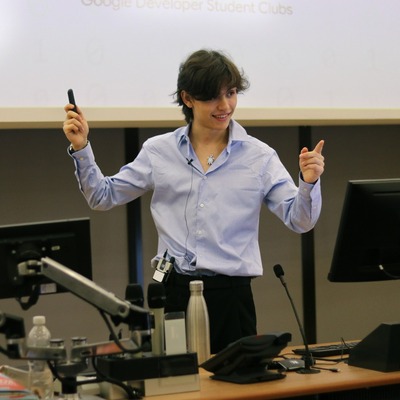
Lorenzo Satta Chiris
Director of Excode
Exeter, United Kingdom
Actions
Lorenzo Satta Chiris is an AI researcher and systems engineer specialising in agent autonomy, multi-agent orchestration, and alignment. He co-developed the AURA framework, a risk assessment model for quantifying and monitoring autonomy in AI agents, and leads ongoing research on agent systems, adversarial LLM behaviour, alignment formalisation, and post-AGI governance as a Global Excellence Engineering and Entrepreneurship scholar at the University of Exeter.
Lorenzo has delivered talks at Google DevFest, Microsoft Azure AI Connect, AWS Agentic Hackathon, MLCon, the Cornish Tech Showcase, the Dutch AI Conference and others on guardrailed multi-agent systems, agentic systems in production, and human-AI interaction design. He serves as President of Google Developer Group Exeter and directed the world's largest student-led coding and AI bootcamps (2,500+ participants), winning Tech South West's Best & Most Innovative Organisation award.
As CTO of Oorbital, he architects and deploys guardrailed multi-agent systems in production, integrating RAG pipelines, LLM orchestration, and safety guardrails for industry clients. He also led a 500-student field study on multi-agent architectures for personalised education, worked on enterprise agent upskilling and consulting, and developed agentic frameworks for orchestration, the agentic web, and agent safety.
Through his blog, read by over 200,000 tech enthusiasts worldwide, and his work as a technical writer, Lorenzo connects AI research to practitioners, educators, and the broader public. He brings a rare profile to the stage, sitting at the intersection of production AI engineering, safety research, and large-scale education, focused on bringing safe, useful autonomy from lab to lecture hall to real-world operations.
Area of Expertise
Topics
Shipping Safe AI Agents: A Production Safety Playbook from 2,500 Deployments
Teams are shipping AI agents that send emails, update customer records, and execute transactions. When those agents misbehave, the result is not an abstract "AI failure" but concrete outages, angry users, and legal exposure. Recent production incidents (chatbots inventing company policies, agents silently deleting databases, AI systems generating harmful advice) confirm the pattern: if you think safety is expensive, try an accident.
This session is a condensed safety playbook drawn from deploying guardrailed multi-agent systems across education (serving 1,500+ university students) and enterprise clients, and from co-authoring AURA, an open-source agent risk assessment framework (arXiv preprint). It walks through three real failure modes from those deployments: an agent that silently escalated its own tool permissions, a RAG pipeline that confidently cited non-existent policy documents, and a multi-agent workflow where agents contradicted each other on a customer-facing response. For each failure, the session covers the root cause, the architectural fix that resolved it, and the monitoring signal that now catches it early.
Concretely, attendees will see how to scope agent capabilities using structured tool schemas, implement human-in-the-loop checkpoints without destroying latency, build evaluation harnesses that catch dangerous behaviour before production rollout, and set up audit logging that makes post-incident review straightforward. Every pattern comes with code-level pointers and metrics from real deployments.
ARC-AGI and the Road to General Intelligence: Levels, Benchmarks, and Approaches
What do we really mean by AGI, and how close are we in practical terms? If GPT-style models feel intelligent, why do they collapse on ARC-AGI?
Inspired from my research dissertation on AGI and experiments with agentic systems, this session offers a grounded, developer-oriented walkthrough of ARC-AGI and its role in evaluating general intelligence in AI systems. We start by clarifying the levels of AI capability, from narrow systems to AGI and ASI and then present benchmarks and most promising approaches.
We will dive into:
- What AGI/ASI mean
- What ARC-AGI is testing (and what it is not)
- Why generalisation, abstraction, and efficiency matter
- How ARC-AGI compares to other benchmarks and evaluation paradigms
The second half zooms out to survey the most promising technical approaches toward AGI, including:
- Agentic and curriculum-based training
- Neuro-symbolic and abstraction-driven systems
- World-model-centric learning
- Hybrid approaches combining learning, reasoning, and memory
The goal is helping developers understand what progress toward AGI actually looks like, what signals are meaningful, and where current systems still fundamentally fall short.
Building AI-Native Entreprises: A Practical Framework for CTOs to leverage ethical AI-systems
Most AI transformations fail not because of technology, but because organizations lack the structural frameworks to deploy, monitor, and govern autonomous systems effectively. Drawing from deploying production AI systems for multiple companies, this session presents a battle-tested approach to AI transformation that balances innovation velocity with operational safety.
Through the lens of AURA (Agent Autonomy Risk Assessment), an open-source framework I co-developed for monitoring and deploying autonomous agents in production, we'll dissect three critical phases of AI transformation: Assessment (measuring AI readiness and usefulness across teams and infrastructure), Implementation (deploying systems that deliver measurable ROI), and Governance (maintaining oversight without throttling innovation).
Key takeaways include:
- An AI readiness and safe implementation assessment that identifies organizational gaps before they become expensive failures
- Metrics from production deployments
- Practical AI oversight mechanisms
- Case studies from implementing AI systems
CTOs will leave with immediately actionable models of AI implementation, allowing to leverage this revolution to improve company processes in a responsible way.
If you’re fielding pressure to become an “Agentic, AI-first, AI-powered, AI-everything” company and trying to separate hype from value, this session provides the pragmatic roadmap for leading AI transformation that delivers ROI while managing the unique risks of autonomous systems.
With Great Autonomy comes great Responsibility: Building Safe & Ethical AI Agents in Production
As we rush to deploy autonomous AI agents in production, we're creating systems with unprecedented impact and decision-making power - from managing support tickets to executing financial transactions and supporting clinical decisions. But, as uncle Ben (Spiderman) wisely told us, with great autonomy comes great responsibility (and potential liability). Recent production failures (Claude Blackmailing, OpenAI suicide case, Grok tweets, Privacy scandals, Replit DB Deletion, Air Canada’s Chatbot fictional policies lawsuit….) underline the principle: if you think safety is expensive, try an accident. Because even if your AI agent won't pass the Turing Test, it might fail your unit tests... and then delete them.
Drawing from production deployments, running AI upskilling programmes, and co-authoring the AURA (Agent Autonomy Risk Assessment) framework, this talk presents a practical safety playbook for developers and product teams. We will show how theoretical AI principles can be turned into implementable code patterns and best practices that work with Google's Gemini API and Vertex AI, that every developer needs before shipping their next AI feature. This talk provides immediately actionable patterns that prevent your AI agent from becoming the next cautionary tale, preventing Murphy’s Law to turn into full Age of Ultron style.
Tech Without Tears: Bits and Bites on How to Teach Tech
Would you stop learning French because Google Translator exists?
And should you abandon/not learn coding because of AI?
Who will be obsolete first: the CEO of NVIDIA or coding?
Should you teach your coworker to code? What about your child?
To these questions, I answer with the words of Steve Jobs:
"Everybody should learn to program a computer, because it teaches you how to think."
Coding is not merely a set of words. It is a way of thinking, a problem-solving toolkit, and an approach to understanding the world. By teaching tech, we create connections—both human and neural—that unlock the potential for creativity, innovation, and a better future.
In my talk, I will cover why and how to learn and teach coding and tech. Focusing on how to explain tech concepts, leverage AI to teach/learn tech, and democratise tech within your environment.
AURA: A Practical Risk Framework for Autonomous AI Agents
Autonomous AI agents are moving from experiments into systems that touch real customers, money and infrastructure, yet many teams still improvise their safety practices, with maturity and governance representing one of the major barriers to AI deployment. This session presents AURA, an open source Agent Autonomy Risk Assessment framework developed from research and production deployments at the University of Exeter. We turn diffuse concerns about “rogue agents” into concrete risk dimensions and a quantitative scoring model that engineers, product owners and risk stakeholders can use in a shared, repeatable way.
Using realistic failure scenarios for tool using agents, we show how AURA helps you reason about autonomy levels, capability scope, tool access, oversight mechanisms and monitoring. The focus is on integrating risk thinking into your existing MLOps stack through checklists, scorecards and design templates, managing Governance and Compliance requirements. Attendees will leave with a reference risk scoring tool, example assessments and a set of practical steps for embedding agent risk reviews into their current development and deployment lifecycle.
A Post-AGI World: How We Share Responsibility For The Next Intelligence Leap
AGI is usually talked about as either hype to overinvest in or catastrophe to fear, which makes it hard to treat it rationally and professionally. In this inspiring keynote, inspired from a published paper on the topic, I reframe AGI as a technical, political, economic transition that needs to be planned, not just survived. Using clear, accessible scenarios drawn from original research, I sketch plausible post AGI futures and transition and how organisations can brace for impact. We will talk about scalable intelligence, autonomy, risks, potentiality and governance. The talk highlights how responsibility for the long-term trajectory of intelligent systems is quietly distributed across developers, companies, regulators and civil society, and what it looks like in practice to act as a responsible steward in your own role.
Designing Human–AI Interactions: The UX/UI of the Future
As AI agents become autonomous decision-makers rather than passive tools, the way humans interact with them must evolve. This session explores the interaction models, UX patterns and interface primitives that will define human–AI collaboration in 2026 and beyond. We will examine how autonomy, reversibility, transparency and memory control reshape UI design, and why traditional chatbot and static website paradigms are no longer sufficient.
Using production examples from modern agentic systems, we walk through practical design patterns for proactive agents, multi-step collaborative workflows, alignment-aware interfaces and safety-centred feedback loops. Each pattern is paired with concrete implementation guidance developers can apply immediately to their own applications.
Orchestrating Guardrailed Multi-Agent Systems on Azure AI Foundry
Multi-agent systems are powerful, but without structured orchestration and orientation they become unpredictable and impossible to control. This session shows how to build reliable, governable multi-agent workflows using Azure AI Foundry and the Microsoft Agent Framework. We break down a real scenario into coordinated agent roles – researcher, planner, critic, executor, safety-checker – each with clear autonomy boundaries and escalation rules, along with MCP tools and human-in-the-loop protocols. Foundry’s native multi-agent layer replaces custom routing logic with explicit schemas, deterministic interactions, and policy-driven constraints that keep behaviour stable and observable.
Devfest Milano 2026 Sessionize Event
The AI-Native Workplace Summit 2026 Sessionize Event
Global Data & AI Virtual Tech Conference 2026 Sessionize Event
Applied AI Conference 2026 Sessionize Event
Web Summer Camp 2026 Sessionize Event
London AI UserGroup User group Sessionize Event
AgentCon Rome Sessionize Event
Malta Microsoft AI User Group Meetup Series 2026 User group Sessionize Event
DevOpsCon & MLCon 2026 Sessionize Event
AI in The New Era Sessionize Event
Dutch AI Conference 2026 Sessionize Event
Azure AI Connect 2026 Sessionize Event
DevFest London 2025 Sessionize Event
AI Upskilling Sessions
Speaker and CTO. Teaching University Staff and Students how to leverage AI and develop AI skills.
The BIG Cornish Tech Showcase Sessionize Event
ExAI
Organiser and Guest Speaker on the University of Exeter Theoretical AI course.
Entrepreneurship Fest
The largest University of Exeter Entrepreneurial event with 100+ attendees.
I served as organiser and panel moderator.
Excode
The Largest UK coding Bootcamp. I was Director of the project as well as lecturer.
Lorenzo Satta Chiris
Director of Excode
Exeter, United Kingdom
Actions
Please note that Sessionize is not responsible for the accuracy or validity of the data provided by speakers. If you suspect this profile to be fake or spam, please let us know.
Jump to top