
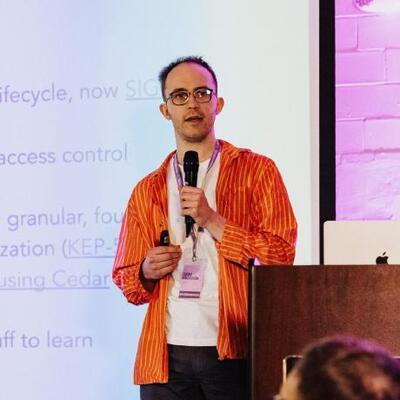
Lucas Käldström
CNCF Ambassador and Senior Applied Scientist at AWS
Helsinki, Finland
Actions
Lucas is a Kubernetes and cloud native contributor since 10+ years. He is and has been a CNCF Ambassador for over 7 years, and was awarded Top CNCF Ambassador 2017 with Sarah Novotny. Lucas is a Cedar Policy maintainer, contributes to Kubernetes SIG Auth, and works on integrating Cedar Policy's automated reasoning access control capabilities with the cloud native ecosystem as a Senior Applied Scientist in the open source Cedar team at AWS. Lucas is running meetups and KCD Helsinki in Finland, and has spoken at 10+ KubeCons. Previously, Lucas was a Staff Software Engineer at Upbound, co-led SIG Cluster Lifecycle, co-created kubeadm, and ported Kubernetes to ARM.
Area of Expertise
Topics
Tools and strategies for making the most of Kubernetes access control
Have you ever struggled writing least-privilege access control policies for Kubernetes? Are you concerned about the wide permissions of installed Helm charts? Do you manage to regularly audit who has access to sensitive resources?
In this talk, Kubernetes contributor Lucas introduces you to open source tools that help you on your defense in depth journey for securing the Kubernetes API surface. Lucas demonstrates how to right-size your RBAC rules semi-automatically, audit who can access sensitive resources, and check whether policy refactors are correct.
This talk is part of a journey to improve Kubernetes access control in core. However, to make this initiative successful, user feedback is needed throughout the process. You’ll learn about the planned Kubernetes Conditional Authorization feature, which will make authoring right-sized policies easier.
By the end of the talk, you will know how to get involved, and future directions for improved Kubernetes access control.
What Can Your AI Agents Actually Do? Cedar Analysis for AI Agents
How do you defend against principals (e.g. AI agents) using their access grants, which all look fine when considered individually, for something they weren't supposed to? For example, the ability to read private data and write data to the internet might be fine in isolation, but when combined, allows for data exfiltration.
It all starts from being able to express privileges in various systems in one unified and analyzable language. The CNCF project Cedar Policy offers a unified language and engine for attribute-, relation- and role-based access control policies, along with unique policy querying and analysis features, perfect for use in agentic systems.
By compiling the semantics of various systems' access control policies into one format, one can statically analyze how agents e.g. could collude with each other to extend their permissions or acquire privileges in a target system through an intermediate one.
This brings us to a form of "calculus for permissions", which allows us not to only reason about explicit permissions, but also implicit ones. This means one can prove, not just unit-test, invariants (under the given assumptions) of the defined permissions themselves, such as "AI agents must never be able to exfiltrate data", and ask "is there any AI agent that can reach this secret resource?"
Lightning Talk: Towards Safe, Fast and Formally Verified Access Control
Access Control is key to securing the increasing amount of data stored, processed and exchanged today. Users and legislation demand privacy, organizations require confidentiality and business continuity, and more and more data is exchanged between business entities through APIs. However, there is no standard for access control, no lingua franca to let two different systems understand how exchanged data should be protected, and it’s near-impossible to query a system for “what resources do I have access to?” or “who has access to this resource?”. Furthermore, just as configuration changes as a major source of outages, policy changes are hard to reason about, as the intricacies of real-world systems makes it demanding to see if the old policy is the same as the new one, leading to risk aversion or outages.
In this lightning talk, we’ll cover how access control policies can be distilled down to Mathematics, and thus analyzed through the lens of logic. Given this, one can formally verify that a changed policy is exactly the same as the old one, or at least, doesn’t let bad things happen (e.g. allow public access to any resource). Two different systems can verify their implementations of a policy to be equal. Finally, querying the policies for who can do what becomes possible. The best of all is that all of this can be done today, using open source tooling, using the Cedar Policy project.
Expanding the Capabilities of Kubernetes Access Control
Kubernetes RBAC is an effective way of managing ACLs in one cluster. However, there are many other effective paradigms out there, such as Attribute- & Relation-based Access Control. In this talk, we’ll demystify how these differ, and when to use respective paradigms, giving context and guidance. We’ll highlight how Kubernetes access control has recently evolved towards supporting lots of different use-cases.
We take this opportunity to cover multiple perspectives: security within a single cluster (zooming in) and security within real-life production environments with external services and multiple clusters (zooming out). As containers became ubiquitous first with excellent tools like Docker, we believe the same can and will happen for access control, yielding uniform, interoperable and understandable authorization.
Finally, we'll propose future work that could be done to supercharge Kubernetes and ensure it keeps up with the ever increasing security requirements in our industry.
Keynote: The Proof is in the Pudding: Can we formally prove correctness of (AI-generated) code?
Now that LLMs are capable of generating code like we expect humans to, how will the role of the software engineer evolve? No one knows for sure, but Jevon's paradox, which has proven itself time and time again, states that as the unit cost of something (in this case, writing code) goes down, the total demand increases. Thus, if we end up with an unprecedented amount of code, how do we ensure our systems don't collapse under their own weight?
Not only code has gotten easier to generate, so has mathematical proofs. Tools such as Lean, SAT/SMT solvers, differential testing, and Rust have recently gained popularity as key pillars for making sense out of the complexity of the AI era. Mathematical proof of correctness lets the team move fast without breaking things.
Using LLMs to generate Lean proofs is very similar to Kubernetes letting you focus entirely on the desired state instead of how to get there. In the second decade of Kubernetes, how can the cloud native community answer the challenge of ever-increasing complexity, with possibly tons of newly-contributed code being AI-generated? Can formal verification stand up to the challenge and the community rally around it?
Cedar: A rock-solid access control building block for the cloud native ecosystem
Building fine-grained access controls into your open source project is a difficult challenge.
We can reduce and amortize this challenge by centralizing the complexity in a general-purpose authorization engine. Before Kubernetes, everyone built stacks from the ground up. With Kubernetes, distributed systems complexity is centralized and shared by the community, saving everyone time and effort.
Cedar Policy, a recently-donated CNCF Sandbox project, aims to remove the heavy lifting of implementing access control. Cedar supports role-, relation-, and attribute-based access control paradigms. It can be embedded into any application or run as a service. It has a flexible, typed schema that enables a tight feedback loop in your IDE. Uniquely, Cedar policies are analyzable, allowing answering questions like “is the refactored policy equal to the previous one?” or "who has access to this resource?"
This talk introduces Cedar and presents a case study on how it can be used to make Kubernetes access control more fine-grained, expressive and understandable.
Beyond 'Can You Mentor Me?' - Crafting the Contribution Ladder
Mentorship, a cornerstone of the community's success, offers a transformative path to growth and development. However, finding the right mentor and building a successful mentorship relationship can be challenging.
This panel discussion brings together experienced mentors from diverse roles within the Kubernetes community including maintainers, tech leads, and committee members. The panel members will share their insights on how to get the most out of mentorship at different stages of your Kubernetes journey, as you climb the Contributor ladder.
By the end of this panel, the audience will understand essential takeaways for effective mentorship at different contributor ladder marks. The project maintainers can take inspiration from how the Kubernetes project maintainers make use of various mentorship techniques such as Role Based Shadowing, Peer-to-Peer Learning, and Mentorship Cohorts that can help any project especially CNCF incubating projects stick new contributors to the project.
Avoiding the Heat Death of Kubernetes and the CNCF Landscape
The concept of entropy is a measure of disorderliness or chaos. The second law of Thermodynamics states that the Universe evolves spontaneously towards more chaotic states, eventually to “the Heat Death”. Kubernetes started off as a container orchestrator for stateless web apps. But now, what once was an orderly list of use-cases, has become a turbulent sea of possibility and complexity. This is also the case for the CNCF Landscape as a whole.
With novel use cases in e.g. AI, cloud native will also need to evolve, increasing entropy. However, as we navigate these possibilities with Kubernetes at the base, it is critical that we talk about some of the philosophies and early decisions of the project, as well as how they have fared with an evolving industry. In doing so, we understand what we can rely on it for and what we can’t.
Continuing from Tim Hockin’s keynote, join us as we talk about the physics of cloud native and how our community can deal with unseen use cases and scale.
KubeCon + CloudNativeCon North America 2026 Sessionize Event Upcoming
MCP Dev Summit Toronto 2026 Sessionize Event
KCD Helsinki 2026 Sessionize Event
KCD Suisse Romande 2025 Sessionize Event
KubeCon + CloudNativeCon North America 2025 Sessionize Event
KCD Helsinki 2025 Sessionize Event
KubeCon + CloudNativeCon North America 2024 Sessionize Event
KubeCon + CloudNativeCon Europe 2024 Sessionize Event
Please note that Sessionize is not responsible for the accuracy or validity of the data provided by speakers. If you suspect this profile to be fake or spam, please let us know.
Jump to top