
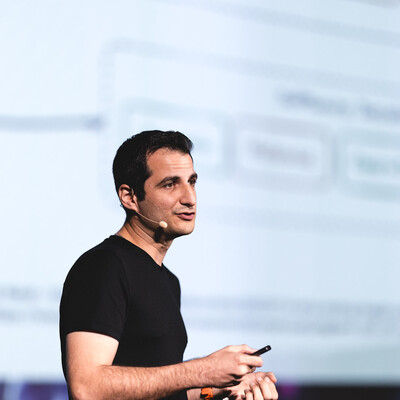
Makan Sepehrifar
Staff Engineer at Productboard
Amsterdam, The Netherlands
Actions
Makan Sepehrifar is a software architect whose fascination with the intricacies of organizational behavior and cognitive psychology has led him to redefine the way technology interfaces with human understanding. Looking at software architecture as a craftsmanship process, he realized that the more abstract you look at it, the more complexities arises. His career has been a testament to his commitment to bridging the gap between technology and human behaviour, resulting in innovative software solutions that not only work efficiently but also self-adaptive teams that embrace the mindset of agile.
Links
Area of Expertise
Topics
Falling in Love with Platform Engineering: The CUPID Way
In recent years, large organizations have adopted Internal Developer Portals (IDPs) to balance governance and autonomy. Despite their promise, many platforms prioritize compliance over usability. This talk explores enhancing platform engineering through principles like product mindset, user experience, and key metrics, while questioning the optimal granularity of services in the “Golden Path.”
Inspired by Dan North’s “Joyful Software”, during this talk the concept of “Joyful Engineering” and the CUPID principles are proposed to transform service building approaches. By focusing on self-containment, idempotency and single purpose, organizations can improve service acceptance and foster collaboration.
Key takeaways include:
- Understanding why IDPs aren’t a magic solution for developer experience.
- Finding the balance between autonomy and governance.
- Adoption of Cupid Principles (Composable, Unix Philosophy, Predictable, Idiomatic, Domain-based) to Platform Engineering.
- Leveraging the “Everything as Code” mindset with Agentic AI to shape the future of developer experience.
Developer Experience : From Hype to Reality
The term “developer experience” (DevEx) emerged in the early 2010s as a response to the growing importance of developer communities in the tech industry, ensuring happy and productive developers through a seamless experience. While numerous theoretical guidelines exist for DevEX, this talk focuses on practical implementation and case studies. Drawing from our own experiences in large organizations like Rabobank & Bol.com, we explore diverse approaches to fostering a DevEx culture. We will show how different high-level incentives behind DevEx Culture adoption, change the strategies of big and mid-size orgs toward the implementation.
Takeaways:
- Understanding the relation between Developer Experience (DX) and Platform Engineering.
- Learned lessons from real-world examples of large/mid-sized companies.
- Practical tips on what services can bring more value for your company
- Best measurements to help your company to weight their success in developer experience and platform engineering
Capability Mesh: Architecture for the Agentic Era
Ten years ago, microservices chaos led to "Service Mesh" solving the discoverability problem by replacing network endpoints with meaningful references, enabling scalability and observability. It worked brilliantly for connecting services. Today we're living through the same cycle with Generative AI and Agents, but the chaos is about integration, not networking. The old problems discoverability, scalability, observability are back because orchestrators now pick agents by capability, not name. Plus we face new challenges: explainability of agent actions and the possibility of unintended actions due to the non-deterministic nature of large language models. We need the same evolutionary leap from "Service Mesh" to "Capability Mesh" shifting from technical service contracts to semantic capability integration for autonomous AI.
Key Topics and Take Aways:
- From OpenAPI to MCP: The Protocol Shift in Agentic AI
- Capability Hierarchies: Composing Agents at Scale
- Human-on-the-Loop: Redefining Our Role in Agent Systems
- Policy as Code: Governing Autonomous Agents
- Observability & Safety: Tracing Agent Behavior
Demystifying MCP: Beyond the Hype
What is the Model Context Protocol (MCP), and why should you care? This talk shares real lessons from implementing MCP servers at a major Dutch bank.
We'll explore what MCP actually does by looking at its main parts: Protocol Itself, Clients, Hosts, the Registry, and Gateways. You'll see practical Java and Spring AI code examples that show how these pieces work together in production systems.
The talk covers important new features like authentication, authorization, and MCP Apps. But more importantly, we'll answer a key question: what problem does MCP really solve?
Here's our main point: MCP solves an integration problem, not necessarily an AI problem. It's a way to connect your existing systems with AI models in a standard way. Understanding this changes how you should think about using it.
We'll finish by discussing real security challenges. When you work at a bank or another regulated company, you face questions about data protection, access control, and compliance. Based on our experience, we'll share what you need to watch out for.
You'll leave understanding what MCP is, when to use it, and what risks to consider before implementing it in your organization.
Platmosphere | Chapter 2026: Master the Vibe Sessionize Event
Dutch AI Conference 2026 Sessionize Event
Makan Sepehrifar
Staff Engineer at Productboard
Amsterdam, The Netherlands
Links
Actions
Please note that Sessionize is not responsible for the accuracy or validity of the data provided by speakers. If you suspect this profile to be fake or spam, please let us know.
Jump to top