
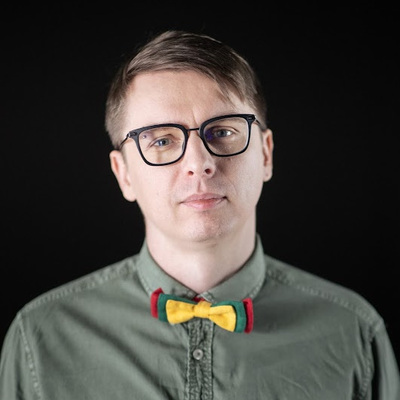
Mangirdas Judeikis
OSS Maintainer & Contributor|| Entrepreneur || Opensource Geek || Co-Founder @ synpse.com || Founder @ faros.sh
Vilnius, Lithuania
Actions
Mangirdas Judeikis is a OSS software engineer and the founder of the projects Synpse.com and Faros.sh in his free time. With over a decade of Kubernetes expertise, Mangirdas now helps drive the next-generation KRM ecosystem for Platform Mesh, building upon the Kubernetes API & Resource Model (platform-mesh.io).
As an entrepreneur and open-source enthusiast, he is passionate about leveraging Go and Kubernetes to build robust, scalable solutions. Mangirdas embraces the SRE philosophy of owning the systems he creates, ensuring reliability and performance in every project he undertakes.
He is an active contributor to the Kubernetes ecosystem, participating in various SIGs and maintaining kcp.io, a CNCF Sandbox project and maintainer of kube-bind.io. Beyond his professional endeavours, Mangirdas enjoys spending time with his family, cycling, motorbiking, skiing, hiking, and camping, finding balance through his adventurous off-screen activities.
Badges
Area of Expertise
Topics
Deep dive into Generic Control Planes and kcp
The Kubernetes code now allows native construction of generic control planes without container types and in new form factors other than your beloved clusters, be it customized apiserver binaries or embedded into other applications.
This talk gives an in-depth explanation of what a generic controlplane is, how to construct it, how to extend it with custom types and how to control which native Kube APIs like secrets, configmaps, etc. or mechanisms like resource quota or RBAC are available.
Specifically, we will cover three variants:
1. single-tenant generic control planes using upstream Kubernetes.
2. multi-tenant generic control planes using kcp to scale horizontally in one process.
3. multi-shard and multi-region generic control planes with focus on backing SaaS services
Exploring Multi-Tenant Kubernetes APIs and Controllers with kcp
While Kubernetes transformed container orchestration, creating multi-tenant platforms remains a significant challenge. kcp goes beyond DevOps and workload management, to reimagine how we deliver true SaaS experiences for platform engineers. Think workspaces and multi-tenancy, not namespaces in a singular cluster. Think sharding and horizontal scaling, not overly large and hard to maintain deployments. With novel approaches to well-established building blocks in Kubernetes API-Machinery, this CNCF sandbox project gives engineers a framework to host and consume any kind of API they need to support their platforms.
In this hands-on workshop, participants will learn how to extend Kubernetes with KCP, build APIs, and design controllers to tackle multi-tenancy challenges. By exploring real-world scenarios like DBaaS across clusters, attendees will gain practical skills to create scalable, multi-tenant platforms for their Kubernetes environments.
From Operator to Platform API: A Kubernetes Engineer's Journey
Platform Engineering has been a hot topic in the Cloud Native ecosystem for a while. But how can engineers build a scalable platform out of all the building blocks that the ecosystem already provides? And how can platforms be decoupled from running individual Kubernetes clusters for developers?
This talk builds upon kcp, a Kubernetes-like control plane for declarative APIs, and dives into the various patterns enabling a central platform API with OSS building blocks from the Cloud Native community. We will look at multicluster-runtime, kcp's api-syncagent, the existing operator ecosystem and how to pull them all together into a coherent developer experience that is more cost-efficient than "traditional" approaches.
To wrap things up, we will discuss how NeoNephos' Platform Mesh factors into transforming platform teams and their Kubernetes operator installations into fully fledged managed service providers for both internal and external users.
Extending Kubernetes Resource Model (KRM) Beyond Kubernetes workloads
Writing consistent APIs is hard. The Kubernetes Resource Model (KRM) is the foundation of Kubernetes’ success because it is consistent, predictable, and easy to understand, and it provides a declarative approach to managing infrastructure and applications. But what if KRM could transcend Kubernetes itself?
This talk will explore the paradigm shift of how one could use KRM with kcp or Kubernetes Generic control plane to provide more than just workload management. This is not a new concept, Crossplane and many other tools are already doing this. But if we could take this further? What if each cloud API would look and feel like Kubernetes API? We will extensively cover how “kcp + friends” in the CNCF ecosystem fulfill that vision.
At the end of the talk, the audience will walk away with knowledge of KRM++, the approaches on building a scalable multi-tenant control plane for managing resources in their multi-cluster Kubernetes based infrastructure, possibly hybrid cloud.
Platform Mesh: Breaking API Lock-In for True Multi-Cloud Service Portability
Platform engineering with CRDs is great—until you add a second cluster or cloud provider. Suddenly, you're locked into provider-specific APIs. Migrating a database from provider A to B requires rewriting manifests and workflows. This API fragmentation is the new vendor lock-in.
We propose the Platform Mesh: a layer providing generic, portable service APIs to consumers. Application teams request a generic Postgres instance, and the mesh intelligently provisions it on any capable backend (AWS RDS, on-prem operators), translating APIs on the fly. This enables seamless, policy-driven migration between providers—even with live data—creating true service portability.
This talk demonstrates how generic APIs strengthen cloud sovereignty by treating providers as interchangeable commodities within the native Kubernetes Resource Model. We'll explore alignment with the EU Data Act, which mandates provider switching capabilities and data portability for cloud services.
Deep dive into Generic Control Planes and kcp
The Kubernetes code now allows native construction of generic control planes, without container types and in new form-factors other than your beloved clusters, be it customized apiserver binaries or embedded into other applications.
This talk gives an in-depth explanation of what a generic controlplane is, how to construct it, how to extend it with custom types and how to control which native Kube APIs like secrets, configmaps, etc. or mechanisms like resource quota or RBAC are available.
Specifically, we will cover 3 variants:
1. single-tenant generic control planes using upstream Kubernetes.
2. multi-tenant generic control planes using kcp to scale horizontally in one process.
3. multi-shard and multi-region generic control planes with focus of backing SaaS services.
Why Kubernetes is inappropriate for platforms, and how to make it better.
The ecosystem is building platforms on Kubernetes now, starting with a hub cluster and then sticking tools for Gitops, for application descriptions and for infrastructure management together, with the goal to create custom APIs for the platform consumers. This works, but hits limits of Kube as a framework quickly. Can we do better? Oh yes, we can!
This talk is about extending Kube, adapting its architecture to be a better fit for a world where instead of container orchestration two new personas are at the center:
(a) the service & API provider
(b) the self-service consumer, often developers or application owners.
We focus on 3 dimensions to enable Kube to serve platform engineering better:
- from kcp we take the workspace hiararchy as a vastly better multi-tenancy primitive.
- cross-workspace API exports and bindings tailor-made for the service provider and consumer personas.
- cluster mounting that integrates Kube clusters for a unified user interface and identity management.
KCD Helsinki 2025 Sessionize Event
KubeCon + CloudNativeCon Europe 2025 Sessionize Event
KubeCon + CloudNativeCon North America 2024 Sessionize Event
KubeCon + CloudNativeCon Europe 2024 Sessionize Event
Mangirdas Judeikis
OSS Maintainer & Contributor|| Entrepreneur || Opensource Geek || Co-Founder @ synpse.com || Founder @ faros.sh
Vilnius, Lithuania
Actions
Please note that Sessionize is not responsible for the accuracy or validity of the data provided by speakers. If you suspect this profile to be fake or spam, please let us know.
Jump to top