
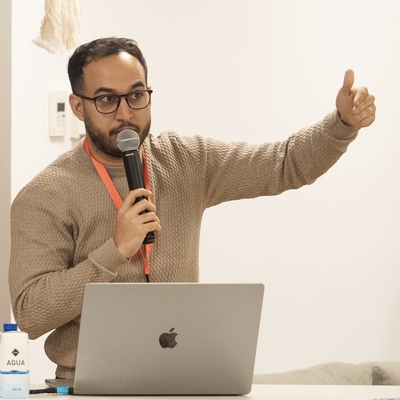
Manuel Fernandez
Ingeniero de software en ThoughtWorks
Madrid, Spain
Actions
I'm a Software Engineer with over 6,5 years of experience, currently working at Thoughtworks, where I contribute to designing and building software solutions in complex engineering environments.
My professional interests lie at the intersection of software engineering, architecture, and artificial intelligence. I'm particularly interested in integrating AI into real-world software development workflows—not simply using it to generate code, but embedding it into engineering processes that preserve architectural integrity, team conventions, code quality, and established best practices.
Throughout my career, I've worked with software design approaches such as Domain-Driven Design (DDD), Ports & Adapters, and strict Test-Driven Development (TDD). More recently, I've focused on exploring context engineering and agentic development systems, building AI-assisted workflows that connect the entire development lifecycle, from an initial requirement or Jira ticket to a reviewable Pull Request, while keeping engineering quality and human oversight at the centre.
Alongside my engineering work, I'm actively involved in the tech community as a speaker, sharing experiences, lessons learned, and practical insights through talks and community events. I'm particularly passionate about making complex technical concepts accessible to other developers and encouraging a critical, hands-on approach to emerging technologies.
Area of Expertise
Topics
The Green Test Illusion
Passing tests doesn't necessarily mean building the right software.
Acceptance tests turn requirements into executable specifications, helping teams verify expected behaviour. However, creating and maintaining them has traditionally been expensive. AI is changing this equation, making it easier to generate and maintain executable scenarios. But does having more tests mean having more confidence?
This talk explores verification versus validation, evolving requirements, and the limits of acceptance tests as representations of system behaviour. Through practical examples, we'll examine whether a system can be reconstructed from its tests, why exhaustive coverage is often impossible, and how techniques such as equivalence partitioning, pairwise testing and set cover help identify meaningful scenarios.
Generating tests is becoming cheaper. Knowing what to test remains an engineering challenge.
Beyond the Code: Decision-Making Under Uncertainty in the Age of AI
Software engineering is full of decisions made under uncertainty. Architectural choices, technical trade-offs and prioritisation often require us to act with incomplete information and unpredictable consequences.
In the age of AI, we can explore alternatives and execute decisions faster than ever. But does having more information and faster tools actually make us better decision-makers?
Through an interactive strategy simulation, this talk explores how we approach uncertainty, assess risks and deal with the consequences of our choices. We'll connect these experiences to real-world software engineering challenges, from architectural decisions and technical debt to AI-assisted development.
Discover practical ways to evaluate trade-offs, recognise irreversible decisions and adapt when new information changes the picture.
Because good engineering isn't about always making the right decision. It's about knowing how to make the best possible one with what you know.
De prompts a contexto: cómo conseguir que los agentes de IA programen mejor sin quemar tokens
Usar un asistente de programación es fácil. Conseguir que trabaje bien con un proyecto real es otra historia.
En esta charla exploraremos cómo diseñar el contexto que reciben los agentes de IA para mejorar la calidad del código y evitar consumo innecesario de tokens. Veremos cómo organizar instrucciones y skills con carga progresiva, navegar documentación técnica mediante índices jerárquicos, compartir interfaces en lugar de archivos completos y mantener sesiones de trabajo enfocadas en una tarea.
A través de ejemplos prácticos y errores habituales, descubriremos qué decisiones ayudan a los agentes a trabajar con mayor precisión y cómo aplicar estas técnicas a nuestro flujo de desarrollo diario, utilizando herramientas como GitHub Copilot y otros asistentes de programación.
Please note that Sessionize is not responsible for the accuracy or validity of the data provided by speakers. If you suspect this profile to be fake or spam, please let us know.
Jump to top