
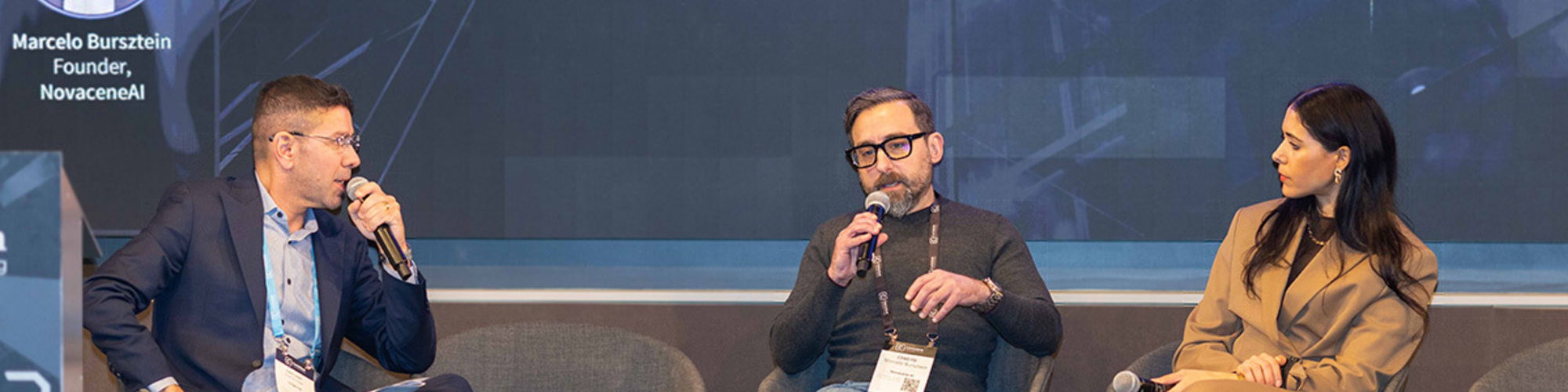

Marcelo Bursztein
CEO, Novacene AI Corp.
New York City, New York, United States
Actions
Marcelo Bursztein works with business leaders who need to make sense of unstructured data; whether to extract deeper insights faster or to automate data-driven decision-making at scale.
As Founder of NovaceneAI, he helps organizations reduce manual effort and unlock strategic clarity by applying AI to complex, unstructured datasets.
Area of Expertise
Topics
Human-Governed Agentic AI: Turning Fragmented Legacy Data into Trusted Financial Workflows
Financial institutions understand AI’s potential—but most initiatives stall before delivering operational impact. The root cause is rarely the model itself. Instead, AI struggles to scale because data is fragmented across legacy systems, difficult to govern, and hard to translate into explainable, auditable action in regulated environments.
This session introduces a practical approach to deploying human-governed agentic AI workflows on top of existing financial systems. Rather than replacing core platforms or pursuing risky rebuilds, the approach focuses on making legacy data AI-ready, orchestrating agentic workflows, and embedding human oversight directly into decision loops.
Attendees will learn how governed agentic workflows enable financial teams to move beyond pilots and dashboards—accelerating insight generation, reducing manual effort, and maintaining regulatory trust. The session emphasizes real-world patterns for explainability, auditability, and human-in-the-loop control that allow AI to operate safely in high-stakes financial environments.
Target audience
• Financial services executives and senior leaders
• Data, analytics, and AI leaders
• Risk, fraud, cybersecurity, and operations teams
• Compliance, governance, and regulatory stakeholders
• Digital transformation leaders in regulated environments
Key takeaways
• Why most AI initiatives stall in financial services despite strong investment
• The role of fragmented legacy data in slowing AI adoption
• What human-governed agentic AI workflows are—and why they matter
• How to embed explainability, auditability, and human oversight into AI workflows
• Practical paths to operational AI without rebuilding existing systems
Session format
• Strategy- and architecture-focused presentation
• Illustrative examples of governed agentic workflows
• Discussion of real-world deployment patterns in regulated environments
• Audience Q&A
Preferred session duration
• 30 minutes (conference breakout)
• 45 minutes (with Q&A)
• 60 minutes (deep-dive or executive roundtable format)
Technical requirements
• Projector or large display
• HDMI or USB-C connection
• Internet access optional (not required for core delivery)
Delivery notes
• Suitable for financial services, AI governance, risk, and digital transformation tracks
• Designed for both executive and technical audiences
• Focuses on principles, patterns, and outcomes rather than vendor-specific implementation
First public delivery
• Suitable for first public delivery as a strategy-led, real-world–informed session
Relevant conference types
• Financial services and banking conferences
• AI governance, risk, and compliance events
• Data, analytics, and enterprise AI forums
• Cybersecurity, fraud, and operational resilience conferences
Beyond Social Listening: Turning Online Reviews into Product Intelligence with AI
Social listening has become a default tool for understanding customer sentiment—but it captures only a narrow slice of the real conversation. Product reviews, app store feedback, and long-form consumer narratives often contain far richer insight, yet remain underutilized due to scale, complexity, and analysis cost.
This session presents a real-world case study from a corporate communications and data intelligence team that moved beyond traditional social and media monitoring to analyze thousands of online product reviews using generative AI. By applying advanced natural language processing and thematic clustering, the team transformed unstructured review data into quantifiable product insights in hours rather than days.
Attendees will learn how AI can surface pain points, strengths, and mixed sentiment at scale—enabling faster, evidence-backed decision-making for product, brand, and reputation strategy. The session reframes online reviews not as anecdotal noise, but as a high-signal source of actionable intelligence.
Target audience
• Corporate communications and public relations leaders
• Brand, reputation, and risk advisory professionals
• Product marketing and product strategy teams
• Customer insights and data intelligence teams
• Digital analytics and AI leaders
Key takeaways
• Why social listening alone provides an incomplete view of customer reality
• The strategic value of online reviews as a product intelligence signal
• Using AI to extract themes, pain points, and mixed sentiment from large review datasets
• Quantifying qualitative product feedback to support data-driven decisions
• Delivering fast, cost-effective insight without large research budgets
Session format
• Case study–driven presentation
• Anonymized examples of review data, thematic clustering, and sentiment breakdowns
• Discussion on integrating AI-driven review analysis into existing insight workflows
• Audience Q&A
Preferred session duration
• 30 minutes (conference breakout)
• 45 minutes (with Q&A)
• 60 minutes (extended discussion or applied use-case session)
Technical requirements
• Projector or large display
• HDMI or USB-C connection
• Internet access optional (not required for core delivery)
Delivery notes
• Suitable for communications, PR, brand analytics, product marketing, and AI tracks
• Designed for both executive and practitioner audiences
• Fully anonymized content with no client, product, or platform disclosure required
First public delivery
• Suitable for first public delivery as an anonymized real-world case study
Relevant conference types
• Public relations and corporate communications conferences
• Brand, reputation, and risk management events
• Product marketing and customer insights forums
• Data, AI, and applied analytics conferences
From Verbatim Chaos to Actionable Truth: Scaling Ethical AI for Employee Insight in Healthcare
Healthcare organizations rely heavily on open-ended employee survey comments to understand culture, engagement, and lived experience. Yet transforming thousands of verbatim responses into timely, reliable, and unbiased insight remains a persistent challenge. Manual theming is slow and costly, while traditional sentiment tools often fail to capture nuance—especially in environments where feedback includes sensitive topics such as equity, psychological safety, and workplace harm.
This session presents a real-world case study from a large, multi-site healthcare organization that adopted generative AI to responsibly analyze employee verbatim data at scale. Attendees will learn how the organization validated AI outputs, addressed ethics and privacy concerns, and operationalized qualitative insight without compromising trust or governance.
The result: a dramatic reduction in manual effort, improved sentiment accuracy, and leadership-ready insights that enabled focused action planning across the organization. This session demonstrates how to quantify the qualitative—ethically, transparently, and at scale in regulated healthcare environments.
Target audience
• Healthcare executives and senior leaders
• HR, People & Culture, and Organizational Development professionals
• Employee engagement and people analytics teams
• Privacy, ethics, and responsible AI stakeholders
• Digital transformation leaders in regulated industries
Key takeaways
• Why manual verbatim analysis becomes a structural bottleneck at scale
• How to validate generative AI for high-stakes qualitative analysis
• Practical approaches to reducing bias in sentiment and thematic classification
• Turning qualitative feedback into leadership-ready, actionable evidence
• Designing AI workflows that preserve privacy, ethics, and auditability
Session format
• Case study–driven presentation
• Anonymized examples of themes, sentiment distributions, and insight summaries
• Interactive discussion and audience Q&A
Preferred session duration
• 30 minutes (conference breakout)
• 45 minutes (with Q&A)
• 60 minutes (extended discussion or workshop format)
Technical requirements
• Projector or large display
• HDMI or USB-C connection
• Internet access optional (not required for core delivery)
Delivery notes
• Suitable for healthcare innovation, HR analytics, people analytics, and responsible AI tracks
• Designed for both executive and practitioner audiences
• Fully anonymized content with no client identification or proprietary disclosure
First public delivery
• Suitable for first public delivery as an anonymized real-world case study
Relevant conference types
• Healthcare innovation and digital health conferences
• HR, employee experience, and people analytics events
• Responsible AI, data ethics, and governance forums
• Public sector and regulated-industry analytics conferences
Read Between the Shops: Using AI to extract real CX insight from mystery shopper narratives
Mystery shopper programs generate some of the richest customer experience data available—detailed, observational, and deeply contextual. Yet the very verbosity that makes this feedback valuable also makes it difficult to analyze at scale. Traditional manual coding approaches are time-consuming, inconsistent under tight timelines, and often limit how deeply analysts can explore open-ended responses.
This session presents a real-world case study from a customer experience research and advisory organization that adopted generative AI to accelerate and deepen analysis of mystery shopper feedback. Attendees will learn how AI was used to surface sentiment, themes, and mixed signals within narrative reports, enabling faster turnaround while preserving analytical rigor.
The session explores how qualitative CX data can be transformed from a reporting burden into a strategic asset—delivering richer insight, stronger client storytelling, and more actionable recommendations.
Target audience
• Customer experience (CX) and customer insights leaders
• Market research and advisory firms
• Retail, hospitality, and service operations leaders
• Analytics, data science, and insight teams
• Digital transformation leaders working with qualitative data
Key takeaways
• Why verbatim mystery shopper feedback becomes a bottleneck at scale
• Limitations of traditional manual coding under tight client timelines
• Using generative AI to extract sentiment, themes, and mixed signals from verbose narratives
• Capturing subtle “nuggets” of insight often missed in top-line summaries
• Delivering faster, deeper, and more consistent insights to client stakeholders
Session format
• Case study–driven presentation
• Anonymized examples of verbatim feedback, sentiment splits, and thematic summaries
• Discussion on integrating AI into existing CX research workflows
• Audience Q&A
Preferred session duration
• 30 minutes (conference breakout)
• 45 minutes (with Q&A)
• 60 minutes (extended discussion or applied workshop)
Technical requirements
• Projector or large display
• HDMI or USB-C connection
• Internet access optional (not required for core delivery)
Delivery notes
• Suitable for CX, market research, analytics, and digital transformation tracks
• Designed for both practitioner and leadership audiences
• Content is fully anonymized with no client identification or proprietary disclosure
First public delivery
• Suitable for first public delivery as an anonymized real-world case study
Relevant conference types
• Customer experience and customer insights conferences
• Market research and analytics events
• Retail, hospitality, and service-industry forums
• Data, AI, and applied analytics conferences
If It’s Written, It’s Data: Turning handwritten customer feedback into usable insight with AI
Many organizations still rely on paper-based feedback forms to capture customer input—particularly in training, professional services, and frontline environments. While these handwritten comments often contain valuable insight, the effort required to transcribe, categorize, and analyze them manually makes systematic analysis slow, expensive, and infrequent.
This session presents a real-world case study from a professional services organization that used AI to automate the extraction and analysis of handwritten customer feedback. By combining computer vision, natural language understanding, and data visualization, the organization transformed thousands of handwritten forms into structured, sentiment-labeled insights within minutes.
Attendees will learn how AI can unlock previously inaccessible qualitative data, reduce operational friction, and enable continuous feedback loops—turning paper-based inputs into actionable intelligence without requiring technical expertise from end users.
Target audience
• Customer experience and customer service leaders
• Professional services and training organizations
• Marketing and insights teams
• Operations and process improvement leaders
• Digital transformation and applied AI practitioners
Key takeaways
• Why handwritten feedback remains a blind spot in modern analytics
• Using computer vision to transcribe handwritten text at scale
• Applying sentiment analysis to previously unstructured, manual inputs
• Visualizing qualitative feedback to identify recurring issues and patterns
• Enabling continuous feedback analysis without increasing staff workload
Session format
• Case study–driven presentation
• Anonymized examples of handwritten-to-digital transcription
• Illustrations of sentiment categorization and dashboard-based insights
• Audience Q&A
Preferred session duration
• 30 minutes (conference breakout)
• 45 minutes (with Q&A)
• 60 minutes (extended discussion or applied workflow session)
Technical requirements
• Projector or large display
• HDMI or USB-C connection
• Internet access optional (not required for core delivery)
Delivery notes
• Suitable for CX, service operations, applied AI, and digital transformation tracks
• Designed for both executive and practitioner audiences
• Fully anonymized content with no client identification or proprietary disclosure
First public delivery
• Suitable for first public delivery as an anonymized real-world case study
Relevant conference types
• Customer experience and service design conferences
• Professional services and training industry events
• Digital transformation and automation forums
• Applied AI, data, and analytics conferences
Human-Governed Agentic AI - Turning Fragmented Data into Trusted Workflows
Organizations understand AI’s potential, but many initiatives stall before delivering meaningful operational impact.
The problem is rarely the model alone. More often, AI struggles to scale because data is fragmented across legacy systems, governance is added too late, and decision processes lack the explainability and human oversight required in regulated environments.
This session explores a practical framework for deploying human-governed agentic AI workflows on top of existing systems. Rather than waiting for large-scale modernization, the approach focuses on making data AI-ready, orchestrating governed agentic workflows, and embedding human oversight directly into decision loops.
Attendees will learn how organizations can move beyond pilots by designing for trust from the start; combining explainability, auditability, and human-in-the-loop control to enable safe, scalable AI adoption in high-stakes environments.
* Target Audience *
• Executive sponsors and senior leaders responsible for AI investment, risk, and operational outcomes
• Implementation teams across data, analytics, AI/ML, engineering, architecture, governance, risk, and compliance
• Business and operational leaders in operations and customer-facing functions who are using, or exploring how to use, AI in day-to-day processes.
//
* Session Format & Duration *
30-60 minute talk with Q&A, structured as a practical presentation that combines a clear problem framing, a deployment model, and actionable patterns for moving AI from pilot to production.
//
* Key Takeaways *
• Why AI initiatives stall between pilot and production in complex organizations
• A practical framework for deploying human-governed agentic AI workflows
• How to design AI systems for explainability, auditability, and human oversight
• Reusable deployment patterns for trusted AI in regulated environments
//
* Technical Requirements *
• Projector or large display
• HDMI or USB-C connection
• Internet access optional but preferred
//
Please note that Sessionize is not responsible for the accuracy or validity of the data provided by speakers. If you suspect this profile to be fake or spam, please let us know.
Jump to top