
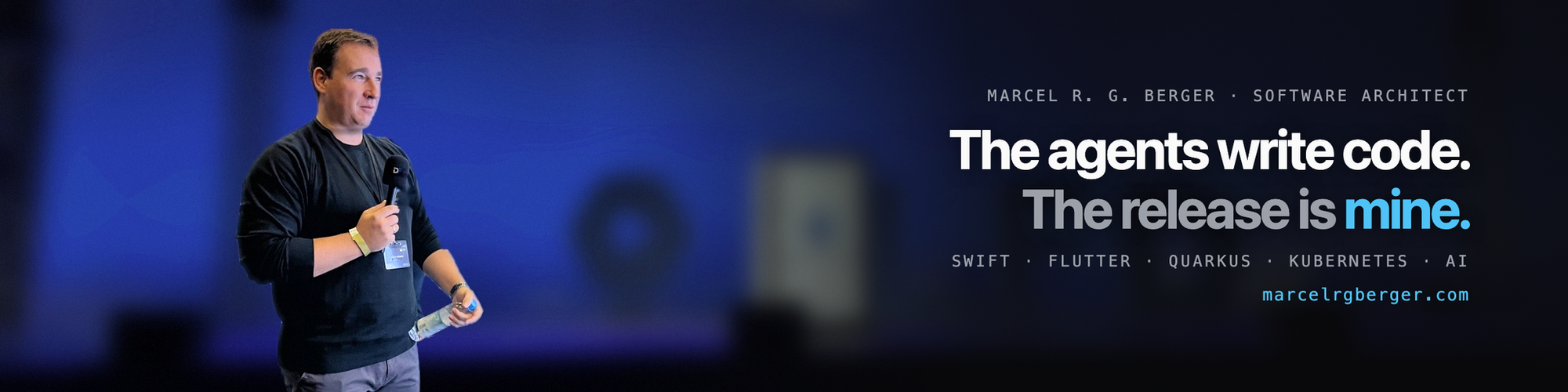

Marcel R. G. Berger
Software architect, 20+ years. Sets the architecture and reviews the work, whether a human or an AI agent wrote it. Builds and runs apps for iPhone, Android and Mac. Founder of The App Architect.
Softwarearchitekt, 20+ Jahre. Gibt die Architektur vor und prüft die Arbeit, ob von Menschen oder KI-Agenten. Baut und betreibt Apps für iPhone, Android und Mac. Gründer von The App Architect.
Actions
Marcel R. G. Berger is a software architect with more than 20 years of experience. As the founder of The App Architect he builds, takes over and runs apps for iPhone, Android and Mac, together with the backends behind them. Before that he built software that has to work for banks, insurers, energy companies and public authorities.
He works with AI coding agents such as Claude Code, Codex and Grok under the same engineering standards as human developers: written conventions in a wiki, development in the IDE, pull requests and CI/CD pipelines. As the architect he sets the structure and the architecture, reviews the changes and is accountable for quality and the release decision. He also runs what he ships: his own apps DokuAI, Sommelio, SnapShots and CivoCloudManager run on his own Kubernetes infrastructure on Civo with ArgoCD. His stack is Swift and SwiftUI, Flutter, Quarkus with GraalVM, Kafka and PostgreSQL.
He is the author of "Solopreneur: The Art of Working Alone" and has been giving talks at companies since 2018. He speaks in English and German. His talks cover AI-assisted development in production, holding coding agents to the same engineering standards as a human team, and running apps and infrastructure as a solo engineer.
Marcel R. G. Berger ist Softwarearchitekt mit mehr als 20 Jahren Erfahrung. Als Gründer von The App Architect baut, übernimmt und betreibt er Apps für iPhone, Android und Mac samt der Backends dahinter. Davor hat er Software gebaut, die funktionieren muss: für Banken, Versicherungen, Energieversorger und Behörden.
Er arbeitet mit KI-Coding-Agenten wie Claude Code, Codex und Grok nach denselben Entwicklungsstandards wie mit menschlichen Entwicklern: schriftliche Konventionen im Wiki, Entwicklung in der IDE, Pull Requests und CI/CD-Pipelines. Als Architekt gibt er Struktur und Architektur vor, macht die Reviews und verantwortet Qualität und Release-Entscheidung. Was er ausliefert, betreibt er auch selbst: Seine Apps DokuAI, Sommelio, SnapShots und CivoCloudManager laufen auf seiner eigenen Kubernetes-Infrastruktur bei Civo mit ArgoCD. Sein Stack: Swift und SwiftUI, Flutter, Quarkus mit GraalVM, Kafka und PostgreSQL.
Er ist Autor von „Solopreneur: The Art of Working Alone“ und hält seit 2018 Vorträge in Unternehmen, auf Deutsch und Englisch. Seine Themen: KI-gestützte Entwicklung in Produktion, Coding-Agenten mit denselben Engineering-Standards wie ein menschliches Team und der Betrieb von Apps und Infrastruktur als Solo-Engineer.
Area of Expertise
Topics
The agents write code. The release is mine. en de
I build and run apps for iPhone, Android and Mac with AI coding agents such as Claude Code, Codex and Grok. They work under the same engineering standards as human developers: written conventions in a wiki, development in the IDE, pull requests, CI/CD pipelines and code review. I set the structure and the architecture, and I decide what gets released.
In this talk I show how that works in practice: how to write conventions an agent can actually follow, where the pipeline catches what an agent gets wrong, what I look for when I review generated code, and which decisions I never hand over. The examples come from my own apps and backends in production.
Takeaways: how to hold coding agents to the standards of your team, which guardrails pay off first, and why writing code faster does not change who answers for the release.
Available in English and German.
Die Agenten schreiben den Code. Die Freigabe gebe ich. en de
Ich baue und betreibe Apps für iPhone, Android und Mac mit KI-Coding-Agenten wie Claude Code, Codex und Grok. Für sie gelten dieselben Entwicklungsstandards wie für menschliche Entwickler: schriftliche Konventionen im Wiki, Entwicklung in der IDE, Pull Requests, CI/CD-Pipelines und Code-Reviews. Struktur und Architektur gebe ich vor, und ich entscheide, was veröffentlicht wird.
Im Vortrag zeige ich, wie das in der Praxis funktioniert: wie man Konventionen schreibt, denen ein Agent wirklich folgen kann, wo die Pipeline auffängt, was ein Agent falsch macht, worauf ich beim Review von generiertem Code achte und welche Entscheidungen ich nie abgebe. Die Beispiele stammen aus meinen eigenen Apps und Backends im Produktivbetrieb.
Mitnehmen: wie man für Coding-Agenten dieselben Standards anlegt wie für das eigene Team, welche Leitplanken sich zuerst lohnen und warum schnelleres Code-Schreiben nichts daran ändert, wer für das Release geradesteht.
Auf Deutsch und Englisch verfügbar.
A screen is not an app: what production really takes en de
AI tools can generate a working screen quickly. That is a prototype. An app that real users rely on needs much more: authentication and authorisation, data models and migrations, error handling, monitoring, rollback, updates and store review cycles, and someone who keeps it running after the release.
I have built software for banks, insurers, energy companies and public authorities, and today I build, take over and run apps for companies. In this talk I walk through what separates a demo from a production app, using the questions that come up when an existing app is taken over. It is meant for developers and for the people who buy apps: what to ask, what to expect, and what it costs to leave things out.
Takeaways: a practical production checklist, the questions to ask a vendor, and how to tell a prototype from a system you can rely on.
Available in English and German.
Ein Screen ist keine App: Was Produktion wirklich braucht en de
KI-Werkzeuge können schnell einen funktionierenden Screen erzeugen. Das ist ein Prototyp. Eine App, auf die sich echte Nutzer verlassen, braucht viel mehr: Anmeldung und Berechtigungen, Datenmodelle und Migrationen, Fehlerbehandlung, Monitoring, Rollback, Updates und Store-Reviews und jemanden, der sie nach dem Release am Laufen hält.
Ich habe Software für Banken, Versicherungen, Energieunternehmen und Behörden gebaut und baue, übernehme und betreibe heute Apps für Unternehmen. Im Vortrag gehe ich durch, was eine Demo von einer produktiven App unterscheidet, anhand der Fragen, die bei der Übernahme einer bestehenden App auftauchen. Er richtet sich an Entwickler und an alle, die Apps einkaufen: was man fragen sollte, was man erwarten kann und was es kostet, Dinge wegzulassen.
Mitnehmen: eine praktische Checkliste für den Produktivbetrieb, die richtigen Fragen an einen Anbieter und woran man einen Prototyp von einem verlässlichen System unterscheidet.
Auf Deutsch und Englisch verfügbar.
Apps in production: your own cluster, run with AI, serving users worldwide en de
My apps run on my own Kubernetes cluster on Civo in London and serve users around the world. There is no ops team. The cluster has separate pools for development, test and production, and the development and test pools scale down to zero nodes when nothing runs. ArgoCD deploys from Git, Prometheus, Grafana, Loki and Alertmanager watch it, and alerts reach me in Nextcloud Talk.
AI is part of the daily operation. I use coding agents to read logs and metrics, to prepare changes to Helm charts and manifests, and to keep the setup documented. Every change still goes through Git, a pull request and ArgoCD, and I review it before it reaches production.
In this talk I show the setup and the parts that needed extra work: a small reconciler I built to label new nodes, and a cluster autoscaler that ArgoCD has to own because Civo otherwise resets its configuration. I also show where AI saves time and where it must not act on its own.
Takeaways: a production setup one person can run, how to let AI help with operations without letting it change production on its own, and the monitoring that keeps a small cluster reliable.
Available in English and German.
Apps in Produktion: der eigene Cluster, mit KI betrieben, für Nutzer weltweit en de
Meine Apps laufen auf meinem eigenen Kubernetes-Cluster bei Civo in London und bedienen Nutzer auf der ganzen Welt. Ein Ops-Team gibt es nicht. Der Cluster hat getrennte Pools für Entwicklung, Test und Produktion, und die Pools für Entwicklung und Test skalieren auf null Nodes, wenn nichts läuft. ArgoCD deployt aus Git, Prometheus, Grafana, Loki und Alertmanager überwachen den Betrieb, und Alarme erreichen mich in Nextcloud Talk.
KI gehört zum täglichen Betrieb. Ich lasse Coding-Agenten Logs und Metriken auswerten, Änderungen an Helm-Charts und Manifesten vorbereiten und die Dokumentation aktuell halten. Jede Änderung läuft trotzdem über Git, einen Pull Request und ArgoCD, und ich prüfe sie, bevor sie in die Produktion geht.
Im Vortrag zeige ich den Aufbau und die Teile, die Extraarbeit brauchten: einen kleinen selbstgebauten Reconciler, der neue Nodes beschriftet, und einen Cluster-Autoscaler, den ArgoCD verwalten muss, weil Civo dessen Konfiguration sonst zurücksetzt. Außerdem zeige ich, wo KI Zeit spart und wo sie nicht allein handeln darf.
Mitnehmen: ein Produktiv-Setup, das eine Person betreiben kann, wie KI im Betrieb hilft, ohne Produktion eigenmächtig zu ändern, und das Monitoring, das einen kleinen Cluster verlässlich hält.
Auf Deutsch und Englisch verfügbar.
Marcel R. G. Berger
Software architect, 20+ years. Sets the architecture and reviews the work, whether a human or an AI agent wrote it. Builds and runs apps for iPhone, Android and Mac. Founder of The App Architect.
Actions
Please note that Sessionize is not responsible for the accuracy or validity of the data provided by speakers. If you suspect this profile to be fake or spam, please let us know.
Jump to top