
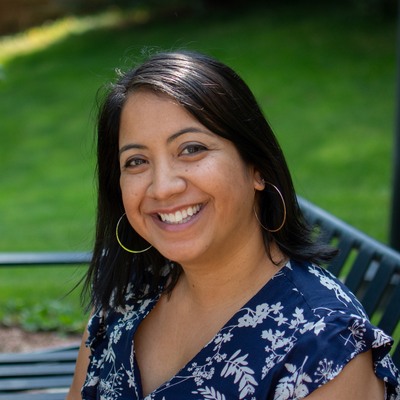
Noreen Naseem Rodríguez
Associate Professor of Elementary Education & Educational Justice, Core Faculty Asian Pacific American Studies, Michigan State University
East Lansing, Michigan, United States
Actions
Noreen Naseem Rodríguez is an Associate Professor of Elementary Education and Educational Justice in the Department of Teacher Education and core faculty in the Asian Pacific American Studies and Muslim Studies Programs at Michigan State University. Her current research, funded by the Spencer Foundation, examines the implementation of Asian American Studies in K-12 classrooms across the U.S. She has published over fifty peer-reviewed book chapters and articles in scholarly and practitioner journals such as Harvard Educational Review, Curriculum Inquiry, and Journal of Children's Literature, and is co-author of Social Studies for a Better World: An Anti-Oppressive Approach for Elementary Educators with Katy Swalwell and Teaching Asian America in Elementary Classrooms with Sohyun An and Esther Kim. Before becoming an award-winning researcher and teacher educator, Noreen was a bilingual elementary teacher in Austin, Texas for nine years.
Area of Expertise
Topics
Why Asian American Studies Has Failed to Impact K-12 Education: Tensions and Possibilities
In 2012, Timothy Yu published, “Has Asian American Studies failed?” in the Journal of Asian American Studies. Yu’s article interrogated the failure of Asian American Studies as a field to significantly impact the public discourse on race in the United States. In 2025, several states across the nation now have mandates requiring the teaching of AAPI histories and/or Asian American studies in response to the anti- Asian and Asian American violence that emerged during the COVID-19 pandemic. Yet many teachers in the states with Asian American history/studies mandates still do not teach about Asian America in any substantive way, from kindergarten through twelfth grade. Therefore, in this panel, we ask, “Why has Asian American Studies failed to impact K-12 education?”
An obvious answer to this question is the lack of engagement of Asian American studies scholars with K-12 educators and public schools in ways that might shift educators’ professional development through collaborations to build Asian American content knowledge. The presenters in this panel are educators who highlight the tensions and possibilities that exist when Asian American Studies is made available to K-12 students and teachers, with attention to how it can disrupt the curricular status quo and transform U.S. public education, particularly east of California. If our organization is truly committed to working toward a more liberatory collective future as stated in the 2026 call for proposals, we must recognize the vital role of K-12 schools and teachers in this effort.
Centering K-12 Classrooms
In this sponsored session, the K-12 Section will center the K-12 classrooms as spaces for the examination of politics, power, and perspective. We will first present current research about the teaching of Asian American and Pacific Islander histories in K-12. Then, we will engage in open discussion about the current landscape.
New Directions in Asian American Youth Studies
This roundtable will examine current research of Asian American youth and propose new trajectories for the field of Asian American Studies. Since the 1999 special issue on “Second generation Asian Americans’ ethnic identity” in Amerasia Journal there has been a burgeoning growth of studies of Asian American youth. A critical examination of youth has long been crucial to understanding broader intersecting forces of race, class, gender, sexuality, dis/ability, politics, and citizenship. This roundtable brings together leaders and new emerging scholars who are pushing the field new directions. The participants will interrogate theoretical and pedagogical approaches to examining Asian American youth in diverse cultural and political practices and settings including import car culture, Asian Baby Girl subculture, undocumented Asian immigrant youth resistance, Asian American studies courses, Southeast Asian refugee identities and collectivity, community based feminist youth spaces, and high school student affinity groups. Participants will examine how forces of US settler colonialism, US militarism, neoliberal multiculturalism, and anti-Asian violence mediate Asian American youth agency, resistance, and meaning making. To encourage discussion among panelists and audience members, the panelists will briefly describe their research using two key terms before we turn to a wider dialogue.
Noreen Naseem Rodríguez
Associate Professor of Elementary Education & Educational Justice, Core Faculty Asian Pacific American Studies, Michigan State University
East Lansing, Michigan, United States
Actions
Please note that Sessionize is not responsible for the accuracy or validity of the data provided by speakers. If you suspect this profile to be fake or spam, please let us know.
Jump to top