
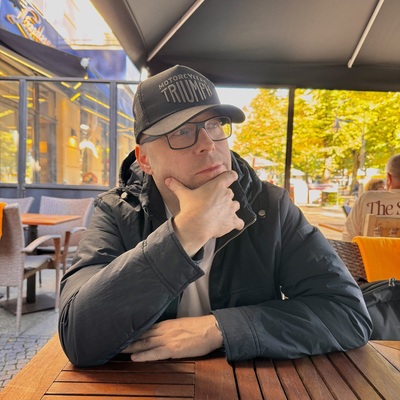
Oliver Fischer
Digital Product Architect and Backend Developer
Digital Product Architect und Backend Developer
Berlin, Germany
Actions
Oliver Fischer took his first steps on his maths teacher’s Sinclair QL, before getting his own Atari 800XL and then getting a taste of the mainframe world on an EC 1055. Today, he works as a digital product architect on backend and platform solutions for successful digital products.
Oliver Fischer seinen ersten Schritte am SinclairQL seines Mathematiklehrers gemacht, ∞µehe er seinen eigenen Atari 800XL bekam und dann selber an einer EC 1055 einen Blick in die Mainframe-Welt werfen musste. Heute wirkt er als Digital Produkt Architekt an Backend- und Plattform-Plattformen für erfolgreiche Digitalprodukte.
Area of Expertise
Topics
Back to basics! – Command-line applications at their best! de en
Commandline Applications sind zurück, auch wenn sie nie wegwaren, aber die Trends der letzten Jahre von jegweder Art der Automatisierung hin zur Nutzung durch Coding Agents haben sie wieder in die erste Reihe zurückgebracht. Wir machen die ganze Reise von Anfang an. Wir erfahren warum (\r)\n, wie man den Cursor durch das Terminal in alle Richtungen jagt, über Sockets kommunizieren kann, wie wir eine Commandline Application und eine Application mit einem Terminal User Interface bauen, Man-Pages baut, Dokumentation im Browser bereitstellt und noch ein Video für Youtube aufnimmt. Alles mit Java als natives Binary und mit ein paar freien Tools.
Back to basics! – Command-line applications at their best! de en
Command-line applications are back – even though they never really went away – but the trends of recent years, moving away from any form of automation towards the use of coding agents, have brought them back into the spotlight. We’ll be taking you through the whole journey from the very beginning. We’ll find out why (\r)\n, how to move the cursor in all directions within the terminal, how to communicate via sockets, how to build a command-line application and an application with a terminal user interface, how to create man pages, how to make documentation available in the browser, and even how to record a video for YouTube. All using Java as a native binary and a few open-source tools.
By people and machines, for people and machines: Doc-As-Code, from AsciiDoc to RAG en de
What if we and our preferred LLM were to use the same technical documentation? Technical documentation for a system can now be structured in such a way that it is equally accessible to both humans and LLMs. A single source of truth for both user groups with different requirements. Doc-As-Code forms the basis for this and can really come into its own here.
In this talk, we’ll look at what such a documentation system might look like and what structure is best suited to documenting systems end-to-end – from the product vision, through architecture, to operations – even beyond the boundaries of a single system. Supplemented by a RAG system and connected via an MCP server, all information can also be made available organisation-wide for LLMs and agents.
The end result is better documentation and a better developer experience. Risks and limiting factors will also be addressed.
An example of how such a system can be set up will be demonstrated using Antora, AsciiDoc, Agent Skills and a RAG system.
Von Menschen und Maschinen für Menschen und Maschinen: Doc-As-Code von AsciiDoc bis RAG en de
Wie wäre es, wenn wir und unser bevorzugtes LLM die gleiche technische Dokumentation verwenden würden? Technische Dokumentation für ein System kann heute so aufgebaut werden, dass sie gleichermaßen für Menschen als auch für LLMs verfügbar ist. Eine Source of Truth für beide Konsumentengruppen mit unterschiedlichen Anforderungen. Doc-As-Code bildet hierfür die Grundlage und kann seine Vorteile hier ausspielen.
In diesem Vortrag sehen wir uns an, wie ein solches Dokumentationssystem aussehen kann und welche Struktur sich hierfür eignet, um Systeme durchgängig zu dokumentieren, von der Produktvision, über Architektur bis hin zu Betrieb, auch über die Grenzen eines einzelnen Systems hinweg. Ergänzt durch ein RAG-System und angebunden über einen MCP-Server können alle Informationen auch organisationsweit für LLMs und Agenten zur Verfügung gestellt werden.
Am Ende stehen eine bessere Dokumentation und eine bessere Developer Experience. Dabei wird auch auf Risiken und limitierende Faktoren eingegangen.
Wie ein solches System aufgebaut werden kann, wird beispielhaft mit Hilfe von Antora, AsciiDoc, Agent Skills und einem RAG-System gezeigt.
Please note that Sessionize is not responsible for the accuracy or validity of the data provided by speakers. If you suspect this profile to be fake or spam, please let us know.
Jump to top