
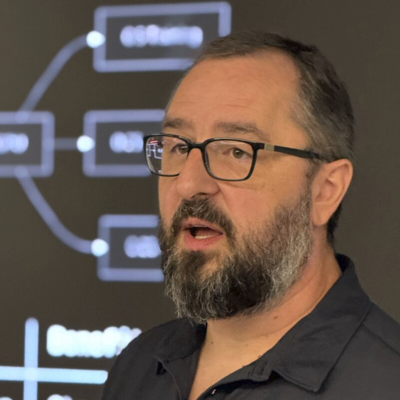
Piotr Zaniewski
🌐 Cloud Platforms Architect | 📢 Speaker ✍️ Blogger | 🚀 Digital Transformation
Frankfurt am Main, Germany
Actions
An active contributor to open source, content creator on Medium and YouTube, focusing on practical, scalable solutions in cloud-native environments. DevOps and Platform Engineering practitioner and advocate.
Links
Area of Expertise
Topics
Curl a GPU Into Your Cluster: Hybrid Kubernetes for AI Development
AI development has a cluster problem: laptop Kubernetes like kind can't host real GPUs, so engineers juggle Docker Compose, full clusters, and scripts that drift from production. We show a pattern where one laptop kubectl context spans local Docker workers and a cloud NVIDIA T4, joined by a single curl over a WireGuard tunnel, so the same workload runs locally and on cloud GPU without two separate setups.
The idea is Kubernetes-native: any Linux host (KVM, GCE, bare metal) becomes a node by pasting a one-line curl that installs kubelet and connects over the tunnel, in one tenant cluster. We demo it live: laptop Docker workers, a local KVM node, and a GCE T4 in a single context. We pull llama3.2 onto the T4, deploy a service that talks to it, expose it through a built-in LoadBalancer, and pause/resume the cluster like a laptop.
We close with the failure modes (tunnel reconnect after sleep, egress cost on model pulls, GPU eviction) and the GitOps that keeps the topology declarative.
Curl a GPU Into Your Cluster: Hybrid Kubernetes for AI Development
AI work puts a model and a GPU inside the developer's inner loop, and a laptop cannot hold the GPU. This talk shows a platform pattern that keeps the fast parts of the loop local and brings GPU capacity in from outside. A vind cluster (vCluster in Docker) runs the control plane and workers as containers on the laptop, with LoadBalancers and images served through the laptop's Docker. A cloud VM with an NVIDIA T4 then joins the same cluster as a private node: one curl command installs kubelet and connects it over a WireGuard VPN, so the same kube context reaches local workers and the remote GPU.
The demo is live. A Stack declared in vcluster.yaml waits for the GPU node, loads a 12B model into the T4's memory behind Ollama, and runs a health check before developers get the endpoint. The audience then calls the model from their phones.
We close the loop by moving the app to Git and Argo CD, and with what self-service GPU access still needs: auto nodes for on-demand capacity, tenant boundaries, quotas, idle GPU cost, and telemetry.
The Cheapest GPU Is the One That Doesn’t Exist
AI developers want a GPU the way they want a kind cluster: kubectl apply and it's there, kubectl delete and it's gone, no console in between. The cloud default punishes that: provisioning latency, sticky nodes, per-tenant security setup. We give developers a kubectl context with an auto-provisioning GPU under it: a T4 or L4 in ~3 minutes, gone in ~30 seconds, zero infra to touch.
Live demo: a dev creates a GPU-template tenant cluster, applies a pod, and a node auto-provisions in GCP. The pod runs, is deleted, the node disappears 30s later. Under the hood is a four-piece contract: tenant Kubernetes for isolated RBAC and node pools; Karpenter for auto-provisioning; an idle policy (consolidateAfter 30s) collapses nodes on idle, not on cluster delete; and a tunnel keeps the experience kubectl-native, not console-native.
We close with the failure modes (Karpenter template/provider drift, NodeProvider creds silently disabled) and the GitOps boundary that keeps multi-team setups intact.
Flexible Kubernetes Multitenancy with vCluster
In this session, we’ll explore how to implement flexible multitenancy in Kubernetes using vCluster. You’ll learn how to design platforms that can adapt to different isolation requirements, resource sharing needs, and trust models within a single cluster.
We’ll explore: - Multitenancy Spectrum: Understanding the three dimensions of multitenancy - isolation levels (physical/logical/none), resource sharing (dedicated/pooled/shared), and trust boundaries (zero/partial/full) - Flexibility in Practice: How to mix and match different multitenancy models for different teams and workloads - vCluster Deep Dive: How virtual clusters enable this flexibility while maintaining strong isolation boundaries - Real-World Scenarios: Live demo showing how to implement different multitenancy patterns based on actual use cases
AI-Driven Multi-Tenancy: Building Autonomous Kubernetes Management with MCP and vCluster
Learn how AI agents can reason about and manage Kubernetes infrastructure through practical patterns and real-world examples. This session explores the vCluster MCP server implementation, demonstrating how Model Context Protocol enables AI agents to safely interact with complex systems. We'll examine successful agent collaboration patterns, common antipatterns to avoid, and the critical role of human oversight. Through live demos, you'll see how multiple agents can work together on infrastructure tasks while maintaining security boundaries. Ideal for AI engineers and platform teams exploring practical AI applications beyond chatbots.
Introduction to vCluster: Building Internal Developer Platforms
The workshop introduces participants to vCluster, demonstrating how to create and manage virtual Kubernetes environments for multiple development teams. Attendees will learn to use vCluster effectively, starting with basic setups and progressing to more advanced configurations. Throughout the workshop, participants will take on the perspective of a platform engineering team, making decisions and implementing solutions to serve the needs of various development groups within an organization.
Key Focus Areas:
- Introduction to vCluster and virtual Kubernetes clusters
- Setting up and configuring virtual Kubernetes clusters
- Managing multiple development environments
- Implementing shared services and optimizing resources
- Enhancing developer workflows with self-service provisioning
Participants will:
- Set up and configure virtual Kubernetes clusters
- Learn to manage multiple team environments efficiently
- Explore resource optimization and cost reduction strategies
- Implement progressive improvements to virtual cluster setups
- Understand vCluster's role in enhancing developer productivity
How to Build Cloud Native Platforms with Kubernetes
Platform Engineering focuses on empowering developers and organizations by creating and maintaining internal software products known as platforms. In this talk, we will explore what platforms are, why they are important, and uncover best practices for creating and maintaining well-architected platforms.
This content will be valuable for Platform Engineers, Architects, DevOps Specialists, or anyone curious about how platforms can drive innovation and efficiency in development.
The talk will have an introduction presentation and an engaging demo
Piotr Zaniewski
🌐 Cloud Platforms Architect | 📢 Speaker ✍️ Blogger | 🚀 Digital Transformation
Frankfurt am Main, Germany
Links
Actions
Please note that Sessionize is not responsible for the accuracy or validity of the data provided by speakers. If you suspect this profile to be fake or spam, please let us know.
Jump to top