
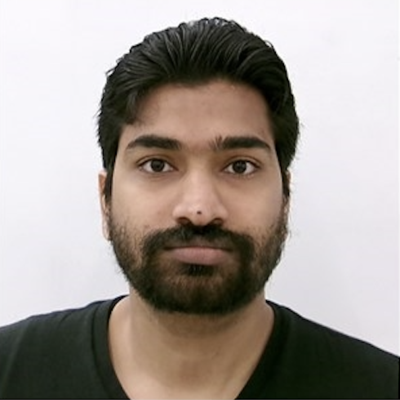
Prashant Kumar Singh
Principal Engineer AWS Lambda
Seattle, Washington, United States
Actions
Principal Engineer specializing in distributed systems and serverless networking at AWS Lambda. Over 9 years of experience designing and delivering large-scale infrastructure solutions that power billions of invocations.
Core expertise: Software-defined networking, data plane architecture, network virtualization, and serverless compute platforms. Strong track record of solving complex technical problems in distributed systems while driving significant business impact.
Key contributions include:
- Designed data plane for software-defined networking in Aurora DSQL
- Enabled Lambda IPv6 expansion and clone-aware networking for Lambda SnapStart
- Delivered Lambda egress integration with VPC Lattice
- Improved VPC networking for AWS Lambda, reducing cold start times
- Implemented critical security and data plane APIs for Lambda with EFS and Container Image support
- Contributed to open-source projects including Dnsmasq for DNS resilience
Technical approach: Focus on building scalable, resilient systems with practical engineering trade-offs. Experience spans network virtualization, ARM architecture enablement, and security-critical infrastructure components.
Patents: 9 issued patents in serverless networking and distributed computing.
Passionate about solving hard technical problems and translating complex business requirements into elegant technical solutions.
Amazon CTO Post on my Work: https://www.allthingsdistributed.com/2026/04/the-invisible-engineering-behind-lambdas-network.html
TNS Article: https://thenewstack.io/aws-lambda-ebpf-rust/
Area of Expertise
Topics
Network Flow and Metering for High density environments using eBPF
We talk about how AWS uses eBPF to generate flow and metering data for high density environments using a eBPF and Rust pipeline for low-overhead and high density environments features thousands of Virtual Machines meeting stringent security standards.
Building Performant Network Infrastructure for Thousands of Snapshotted VMs: eBPF, Geneve, and more
Running thousands of snapshotted VMs presents unique networking challenges that push Linux networking primitives to their limits. This talk explores battle-tested strategies for designing large-scale network topologies that balance performance, isolation, and resource efficiency.
We'll dive into practical solutions for high-density VM environments, covering:
1. Modern tunneling with Geneve for scalable overlay networks that outperform traditional approaches.
2. eBPF-accelerated networking to bypass kernel bottlenecks and achieve line-rate performance.
3. Stateless NAT techniques that enable network reuse without connection tracking overhead.
4. Smart firewall design using device prefix-based iptables/nftables rules that scale to thousands of instances.
5. Namespace pooling strategies to minimize creation/teardown costs during rapid VM snapshot operations.
6. RTNL lock contention and its operational impact on large-scale deployments, plus mitigation strategies.
Attendees will learn how to architect network stacks that handle the unique demands of snapshotted workloads—where VMs are frequently cloned, restored, and migrated—while maintaining security boundaries and predictable performance. Real-world examples will demonstrate how these techniques reduce network initialization time from seconds to milliseconds and handle 10K+ concurrent VM instances on commodity hardware.
LinuxFest Northwest 2026 Sessionize Event
Please note that Sessionize is not responsible for the accuracy or validity of the data provided by speakers. If you suspect this profile to be fake or spam, please let us know.
Jump to top