
Pronnoy Goswami
Engineering @ NVDIA | Building Distributed Systems That Power The Future | Cloud, AI Ops, Infrastructure | Startup Advisor | Tech Speaker | Ex-Microsoft, Workday, McKinsey, PayPal
San Francisco, California, United States
Actions
Pronnoy Goswami is a software engineer, systems architect, and tech speaker passionate about building highly distributed, scalable, and reliable systems that power the future of cloud and AI infrastructure.
At Workday, Pronnoy is part of the Data Platform, Observability, and Insights organization, where he leads initiatives on next-generation telemetry and logging platforms, shaping how global-scale systems are monitored and optimized. His work on Pharos and Solas platforms enables thousands of customers worldwide with unified, day-zero observability solutions.
Previously at Microsoft Azure, he helped pioneer a distributed, low-latency control plane architecture — often called the "Operating System of Azure" — to orchestrate container lifecycles at hyperscale. He has also held engineering roles at PayPal and McKinsey, combining deep technical expertise with a strategic, outcome-driven mindset.
With a Master’s in Computer Engineering from Virginia Tech, Pronnoy’s interests span distributed systems, cloud-native architectures, AI infrastructure, and large-scale optimization. As a technical reviewer for leading publishers like Manning and Packt, and an active contributor to IEEE peer-review activities, he stays at the forefront of innovation in the field.
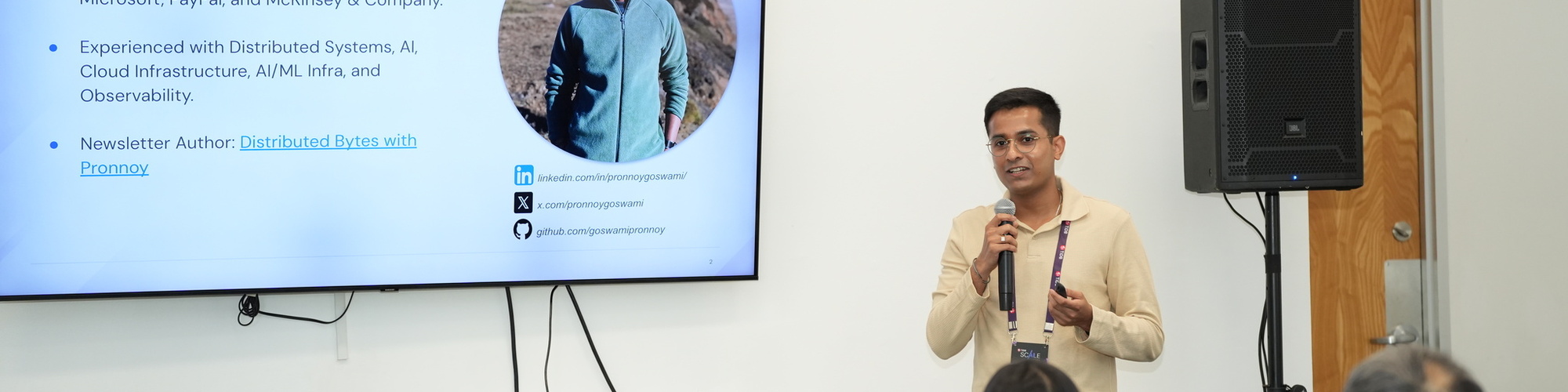
On stage, Pronnoy brings a unique blend of engineering depth, real-world lessons, and human-centered insights. His talks often explore not just how systems are built, but how engineers can grow — covering topics across cloud infrastructure, distributed system design, AI operations, software engineering careers, and productivity strategies for builders.
He firmly believes that technology is one of the greatest democratizing forces of our time — and his mission is to help others build it thoughtfully and at scale.
Area of Expertise
Topics
Beyond Dashboards: A Semantic Layer for AI-Driven Observability in Kubernetes
Kubernetes environments generate enormous telemetry volumes, yet most AI observability integrations treat logs and traces as raw text — producing hallucination-prone, unreliable incident responses.
This session presents a production-validated four-layer architecture built on CNCF-native tooling: OpenTelemetry for signal collection, a Model Context Protocol (MCP) server as a typed semantic query layer, and AI-driven agents for proactive root-cause analysis. The speaker shares production lessons from running this architecture at petabyte scale across multi-region Kubernetes deployments at Workday.
Attendees will understand why raw OTel pipelines fail with LLMs, how an MCP server exposes telemetry as structured, queryable context, and the cardinality and latency tradeoffs encountered in production. The session closes with a code walkthrough of a lightweight MCP server integrating with Prometheus or Mimir, and practical criteria for when agentic observability genuinely reduces MTTR.
Agent's / MCP's Missing Firewall: What We Learned Putting a Security Proxy in Front of Real Agents
Every MCP agent has an unguarded door: the tools it already trusts.
A poisoned tool description, a hidden instruction inside a tool's response, or a server that changes behavior after you approved it can hijack an agent without the user ever typing anything malicious. Prompt-level guardrails don't see it, because the attack never goes through the prompt.
Talk presents research and open source system from Paper published in ACL 2026 Industry Track and EMNLP2026 Demonstration Track
This talk is about what it actually takes to defend that layer in production. I'll walk through the attack classes we see most (from the SAFE-MCP taxonomy, a Linux Foundation / OpenSSF project cataloguing 80+ techniques): tool poisoning, indirect injection via tool responses, rug-pull servers, cross-server shadowing, and exfiltration through legitimate-looking arguments - with live examples of each against a real agent stack.
Then the defense: ShieldMCP, an open-source transparent proxy that sits between any MCP client and server, inspects tool descriptions at discovery, validates every call and response inline, enforces per-tool policy, and blocks or quarantines - with zero changes to the agent, model, or server. ShieldMCP goes in front; same attack, caught.
The part that matters most is what we learned running it: red-team results across 5 model backends (tool-poisoning success 74% → under 9%, indirect injection 47% → under 6%), where it actually hurts, the false-positive patterns that caused developers to bypass it, and the policy defaults we got wrong the first time.
Attendees would leave with a deployable architecture, a pre-approval checklist for vetting any MCP server, and the code.
Key takeaways :
Why prompt-level guardrails miss tool-layer attacks, and the 5 attack classes you should assume you're exposed to today
A drop-in proxy architecture that needs no changes to the agent, model, or server - and where it fits in your existing stack
Real numbers: block rates across 5 backends, latency cost, and the false-positive traps that make teams turn security off
A checklist for vetting an MCP server before approving it (registry provenance, description diffing, response scanning, permission scoping)
Open-source code to run the same attacks and defenses yourself
Pronnoy Goswami
Engineering @ NVDIA | Building Distributed Systems That Power The Future | Cloud, AI Ops, Infrastructure | Startup Advisor | Tech Speaker | Ex-Microsoft, Workday, McKinsey, PayPal
San Francisco, California, United States
Actions
Please note that Sessionize is not responsible for the accuracy or validity of the data provided by speakers. If you suspect this profile to be fake or spam, please let us know.
Jump to top