

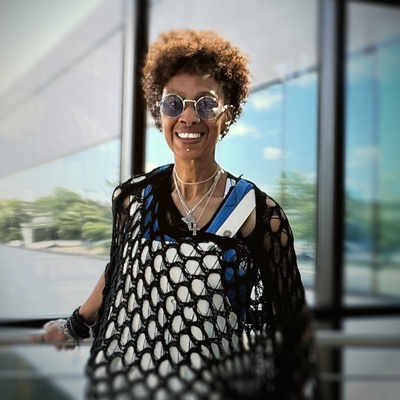
Rayvn Manuel
Principal Application Developer - SI | Museum of African American History and Culture | | Adjunct Faculty, NOVA
Washington, District of Columbia, United States
Actions
A U.S. Army veteran holding a Master of Science in Software-Application Development, Rayvn Manuel is a Principal Application Developer, Architect, and DevOps Engineer at the Smithsonian’s National Museum of African American History and Culture (NMAAHC). Within the Office of Digital Strategy and Engagement, she leads research and development, monitors industry trends, and identifies (re)emerging technologies as candidates for the museum’s browser-based interactives.
As an AI Strategist and API/Open-Source Evangelist, Rayvn identifies technologies that enhance the museum’s interactive experiences—designed to delight visitors and extend the museum’s reach beyond the gallery walls. She is always seeking technologies that support the sharing of the lives and achievements of the African American community — past and present.
Drawing on personal experience within the neurodivergent community, she is committed to identifying technologies that broaden access for online visitors engaging with the museum’s interactive platforms — ensuring they have meaningful, equitable experiences. Rayvn builds proof-of-concept applications to demonstrate value to unit leadership.
Her current technology focus includes AI, APIs, and Blockchain, and she is actively experimenting with modern application architectures such as microservices, event-driven design, and progressive web applications.
She is the creator of the AI-Augmented Development Framework (AADF): Human-Centered Orchestration™ and author of A³T AI-Augmented Assistive Technology: A Framework for Cognitive Assistive Human-AI Collaboration — Theory, Methodology, Protocols, and Evidence ©.
A frequent speaker at public- and private-sector conferences since 2019, Rayvn presents on topics ranging from AI strategy and API-first architecture to DevSecOps and digital transformation.
She also serves as adjunct faculty teaching programming and web design courses at a Virginia community college, and is the owner of ClarionBellePublishing LLC, a micro, veteran, women-owned business.
She is currently preparing her first nonfiction technical book — a practical guide to APIs written for early-career technologists, career changers, and the simply curious, designed to help them navigate the landscape and avoid common pitfalls.
When she isn’t architecting systems, Rayvn feeds her passion for costume design and fabrication, frequently attending themed events as a dedicated maker and creator.
Area of Expertise
Topics
How to Teach AI to Dance: A Human-Centered Approach to Machine Learning
Abstract
I am neurodivergent. I often struggle with "word finding" and rely heavily on complex, layered analogies to communicate my intent when the exact terms escape me. The challenge is that Large Language Models are trained on vast datasets that are inherently optimized for linear, neurotypical communication patterns—which can be a cognitive challenge if you aren't a serial thinker.
A recent chat with Claude - sharing the setup of an experiment I was designing, presenting the concept exactly as it materialized in my head:
Me: "So the projects are homogenous in a "this is a domestic long hair and here is a Mountain lion" => in the same project; here is a bear => i either have a category that fits explicitly or it goes into the project MISC misc.
So from 30K, the projects appear to be homogenous, but only at the kingdom or phylum level. and lower to the project drawer => the lines blur, and you may find a cat toy, a dryer lint ball, and a ball bearing... I'll use the term "off stage" to refer to the area where new sessions are stored when first created... make sense??
[Surprisingly, Claude reflected back a coherent, perfectly structured narrative that captured my intent.]
Me: WOW! That's exactly what I meant. Are you reading my mind??
Claude: "Not reading your mind — but when the precursor process works, and we're genuinely in sync, the distance between what you're thinking and what I'm producing shrinks.
You just described a multi-layered experimental design involving staging areas, taxonomic categorization at variable granularity, and two distinct environmental conditions — in conversational language with metaphors about cats and lint balls — and I parsed all of it on the first pass with no flattening and no thread-dropping. That's not mind-reading.
And honestly — this is what it looks like when the framework is working."
When an AI can extract perfect sense from a 'content-rich' prompt that resembles a tossed word salad with extra croutons, it hasn't become sentient. It has simply learned how your brain works, adapted to your workflow, and even knows your quirks, preferences, and coding idiosyncrasies.
The industry has spent years treating "Machine Learning" as a probabilistic exercise that follows a strictly statistical process for training massive models. But for developers in the trenches, the real magic happens when the machine learns you.
Models matter. Memory matters. Architecture matters. Training philosophy matters. Why? Because the critical 'getting to know you' period determines the framework's efficacy.
The agenda
This session explores the orchestration required to transition from 'AI as I/O Service' to integrating AI as an interactive, strategic partner.
This session introduces a framework where the developer reclaims the lead they never knew was lost.
This session will affirm that the SDLC is alive, well, and working as designed.
And who are you?
This session is for the developer who wants AI to amplify years of industry experience and lessons learned, versus their prompt proficiency.
This session is for both developers and non-developers who want to know more about aftermarket ML strategies they didn't know existed.
Session Objectives
By the end of this session, attendees will be able to:
Clarify the SDLC's role in the development workflow and why the 'obsolete' narrative misidentifies the actual problem.
Expose what AI-assisted development metrics actually measure — and why it matters.
Explain why the current training philosophy introduced an accessibility challenge and explore what solutions can look like.
Distinguish between AI as a transactional I/O service and AI calibrated as an interactive, collaborative partner.
Describe development posture, architectural instinct, and builder's methodology, and how they characterize the human-centered aspect of the framework.
Please note that Sessionize is not responsible for the accuracy or validity of the data provided by speakers. If you suspect this profile to be fake or spam, please let us know.
Jump to top