
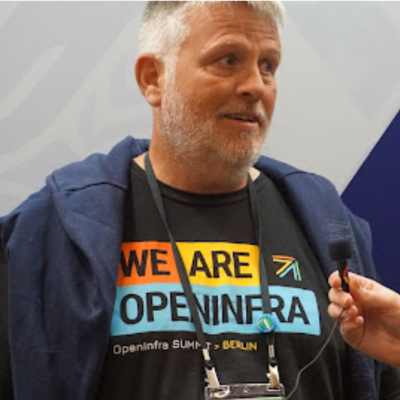
Robert Holling
Osnabrueck University of Applied Sciences, Researcher
Lingen, Germany
Actions
I’ve been working with computers since the mid‑80s (first machine: Commodore 128). From the late‑1990s I consulted across Europe, building enterprise web‑management systems, databases, ERP and data warehouses. For the past 15 years I’ve been a research associate at Osnabrück University of Applied Sciences. Since 2016 my focus has been Open Infrastructure – OpenStack, Kubernetes, 5G and Sovereign Cloud Stack.
Resilient Disaster Information: Mobile OpenStack and Kubernetes for Disaster Information Management
Disaster-management information depends on infrastructure that remains deployable, observable, and recoverable under constrained conditions. This talk introduces the planned SOVRES research framework and its possible UN-SPIDER(1) or GovStack(1) reference domain: a mobile open-infrastructure environment using OpenStack as the IaaS layer and Kubernetes as an optional platform layer. Workloads may run on bare metal, in OpenStack VMs, or on Kubernetes according to their requirements.
The session presents a proposed reproducible evaluation approach, not completed benchmark results. Deployment, lifecycle operations, recovery, observability, provenance, and controlled degradation are treated as testable claims. A planned evidence chain links inventory, manifests, telemetry, workload execution, operator actions, and acceptance criteria.
Attendees are invited to discuss meaningful metrics, failure scenarios, and lifecycle tests for mobile OpenStack environments supporting disaster-information workflows. The goal is an openly reusable reference methodology for resilient, mission-oriented infrastructure.
(1) Discussions regarding a collaboration are planned but have not yet been finalized.
From manual nodes to 3 k‑core OpenStack on Kubernetes - 10 years of evolution
In 2015 we boot‑strapped a five‑node private OpenStack cloud by hand. Ten years later the same environment runs fully declaratively on Kubernetes, powering a mobile data centre with > 3 000 CPU cores and 1.5 PB of Ceph‑backed storage. This talk walks through the complete migration: from ad‑hoc OpenStack installation to a GitOps pipeline, operator‑driven service provisioning, OVN/SR‑IOV networking, and Cinder‑CSI/Rook storage integration. We share hard‑won lessons on immutable infrastructure, observability, rapid scaling, and on‑site deployment of a mobile rack. Finally we outline open challenges – hybrid‑cloud federation or AI‑driven capacity planning – and invite the OpenInfra community to co‑design the next generation of cloud‑native OpenStack.
Not presented yet, session duration probably 20-30 min + Q&A. No special technical needs.
Please note that Sessionize is not responsible for the accuracy or validity of the data provided by speakers. If you suspect this profile to be fake or spam, please let us know.
Jump to top