

Roel Heremans
Keynote Speaker & Transdigital Artist
Brussels, Belgium
Actions
Roel Heremans is a Brussels-based keynote speaker and transdigital artist
working with sound, videogames, neurotechnology and AI.
His talks help audiences understand how emerging technologies are
changing perception, attention, imagination and mental privacy.
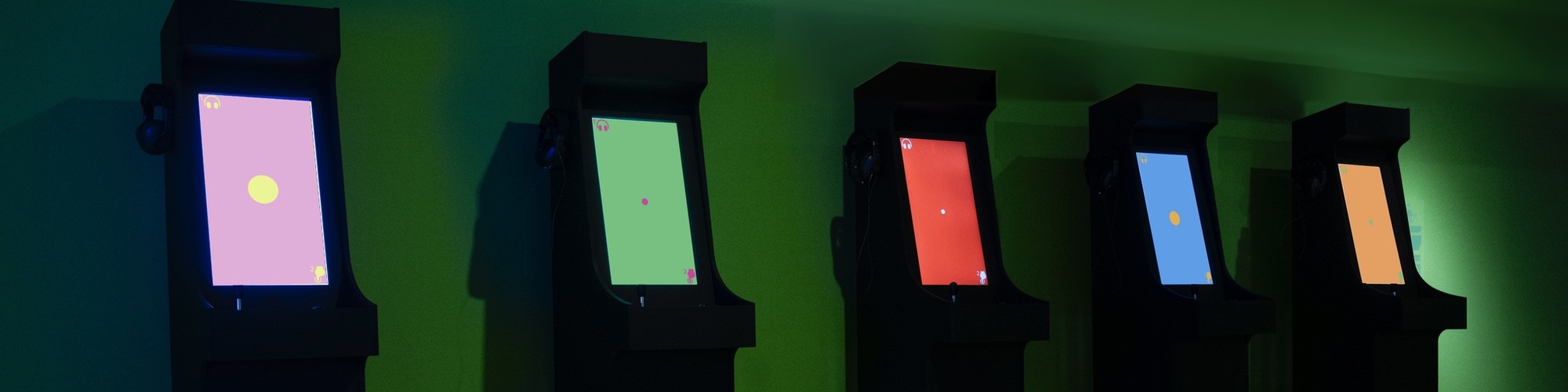
Grounded in interactive installations such as The NeuroRight Arcades,
he connects artistic practice with concrete questions around
human-AI interaction, neuroethics and the future of embodied technology.
Recent work and talks have been presented in contexts including
Ars Electronica, Sónar+D, Science Gallery Monterrey, K11 Wuhan,
Espacio Fundación Telefónica, Elmos Group and Privacy Salon Gent.
Area of Expertise
Topics
The NeuroRight Arcades: Playing the Future of the Mind
What happens when the future of the mind becomes playable?
In this keynote, Roel Heremans presents The NeuroRight Arcades, a series of interactive installations that use the language of arcade games to explore neurotechnology, artificial intelligence and mental privacy. The project invites audiences to reflect on a future in which brain-computer interfaces, biometric data and AI systems increasingly shape how we think, feel and act.
Through concrete examples from the development and presentation of the work, this talk examines how artistic practice can make complex ethical questions tangible. It looks at neurotechnology through the lens of play, public interaction and imagination, offering audiences a clear and accessible entry point into debates around NeuroRights, consent, attention and the future of human agency.
The session is suitable for audiences interested in AI, neurotechnology, digital ethics, media art, videogames, innovation and the future of embodied technology.
Preferred format: keynote, artist talk or conference lecture.
Preferred duration: 30 to 45 minutes, with optional Q&A.
Target audience: innovation professionals, cultural institutions, universities, technology conferences, digital ethics programmes, health-tech and neurotech events.
Technical requirements: projector or large screen, HDMI connection, sound system and wireless microphone for larger rooms.
This session is based on Roel Heremans’ installation project The NeuroRight Arcades, presented in contexts including Sónar+D, Science Gallery Monterrey, IMPAKT Festival, FIBER Festival and Espacio Fundación Telefónica.
Available in English, Dutch and French.
Playtesting the Future: Games, Neurotechnology and Mental Privacy
Videogames are powerful tools for testing possible futures. They create rules, roles, feedback loops and emotional states. In this session, Roel Heremans uses videogame culture as a way to understand the ethical questions emerging around neurotechnology and AI.
The talk explores how brain-computer interfaces, biometric systems and AI-driven environments may change our relationship to attention, behaviour and mental privacy. What happens when inner states become measurable? Who owns neurological data? How can artists, designers, researchers and organisations create more responsible forms of interaction?
Grounded in Roel’s work with interactive installations and public participation, this session connects speculative thinking with concrete artistic case studies. It offers a vivid way to think about neuroethics, human-AI interaction and the social consequences of technologies that move closer to the body and the mind.
Preferred format: keynote, conference talk, lecture or panel contribution.
Preferred duration: 30 to 45 minutes. Can be adapted to a 60-minute lecture with Q&A.
Target audience: AI conferences, game culture events, digital ethics programmes, innovation teams, universities, cultural institutions and public technology events.
Technical requirements: projector or large screen, HDMI connection, sound system and microphone.
This session works well for events connecting technology, ethics, games, culture, AI, neurotechnology and public imagination.
Available in English, Dutch and French.
Neurotechnology, AI and the Future of Imagination
As AI and neurotechnology become more closely connected to perception, attention and behaviour, imagination becomes a crucial space for ethical reflection.
In this keynote, Roel Heremans examines how emerging technologies are reshaping the way we think, imagine and relate to ourselves. Drawing from his practice as a transdigital artist, he presents interactive works in which sound, guided introspection, neurotechnology and public participation create new forms of embodied experience.
The session offers a broader perspective on AI and neurotechnology beyond efficiency and automation. It asks how these systems may influence inner life, mental privacy, creativity and human agency. Through artistic case studies and accessible examples, the talk helps audiences think more clearly about the future of technology as something that enters perception, emotion and imagination.
As AI and neurotechnology become more closely connected to perception, attention and behaviour, imagination becomes a crucial space for ethical reflection.
In this keynote, Roel Heremans examines how emerging technologies are reshaping the way we think, imagine and relate to ourselves. Drawing from his practice as a transdigital artist, he presents interactive works in which sound, guided introspection, neurotechnology and public participation create new forms of embodied experience.
The session offers a broader perspective on AI and neurotechnology beyond efficiency and automation. It asks how these systems may influence inner life, mental privacy, creativity and human agency. Through artistic case studies and accessible examples, the talk helps audiences think more clearly about the future of technology as something that enters perception, emotion and imagination.
Jouw brein, mijn canvas: AI, BCIs en NeuroRights
Brain-computer interfaces and AI are opening a new frontier in the relationship between technology and the human mind. This session introduces the ethical, artistic and social questions surrounding NeuroRights, mental privacy and the use of neurological data.
Through examples from his own interactive installations, Roel Heremans explains how artists can make abstract technological debates tangible for wider audiences. The talk looks at how brain activity, attention and biometric signals are increasingly becoming part of digital systems, and why this raises urgent questions around consent, agency and the protection of inner life.
The title, Jouw brein, mijn canvas, points to the central tension of the session: when the mind becomes readable, measurable or interactive, who gets to interpret it, use it or shape it?
Preferred format: keynote, public lecture, university session, panel introduction or cultural programme.
Preferred duration: 30 to 45 minutes, with optional Q&A.
Target audience: Dutch-speaking innovation events, universities, cultural centres, AI and ethics programmes, media festivals, health-tech contexts and public debates.
Technical requirements: projector or large screen, HDMI connection, sound system and microphone.
This session can be delivered in Dutch as the primary version. An English or French version is also possible.
Relevant themes: AI, brain-computer interfaces, NeuroRights, mental privacy, digital ethics, art and technology.
Please note that Sessionize is not responsible for the accuracy or validity of the data provided by speakers. If you suspect this profile to be fake or spam, please let us know.
Jump to top