

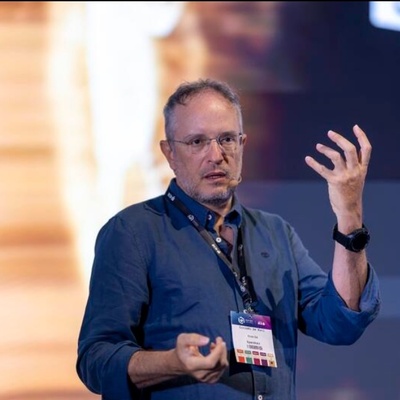
Corrado De Bari
Developer Evangelist, Microservices & AI, Oracle Database
Fiumicino, Italy
Actions
I’m a Developer Evangelist in Oracle’s Database Organization, focused in building Generative AI platforms that harness DBMS AI capabilities, while also championing their adoption as an evangelist. I work on the Kubernetes-based deployment platform for AI microservices, "Oracle Backend for Microservices and AI", and I’m leading the development of the "AI Optimizer and Toolkit" —a low-code platform that empowers developers to design and fine-tune AI Agents using Oracle’s Vector Store.
In Oracle Italy since 2010, he joined Technology Sales Consulting team, working on Italian large and medium accounts on OCI, AI/ML, DataLakes and BPM/SOA platforms. Formerly Sales Engineer at Sun Microsystems, as well as Java & Software Ambassador for Italy, starting his career as architect in Telecom Italia Mobile. He holds the CEFRIEL Master in Information Technology and a bachelor's degree in Computer Science.
Links
Badges

Area of Expertise
Topics
The Oracle AI Microservices Sandbox for RAG rapid prototyping
Although we are inundated with articles and tutorials promising GenAI-based chatbots in just five minutes or so, the reality of developing a reliable agent is much more challenging. Some predict that 30% of projects will be abandoned due to the difficulty of translating proofs of concept and substantial investments into tangible benefits. To help prevent this, an open-source rapid prototyping platform called "Oracle AI Microservices Sandbox" has been released. This platform enables zero-code development of knowledge bases using Oracle DB 23c AI and its Similarity Search capabilities, allowing users to select any LLM for vector embedding and chat completion, whether on-premises or in the cloud, starting from template-based prompt engineering. The hyperparameters related to the LLM and the knowledge base processing can be tested either individually or in bulk, facilitated by the generation of Q&A test datasets to determine accuracy rates. Successfully tested configurations, along with the generated knowledge base, can be published and exported as AI microservices using Spring AI or LangChain, accessible through OpenAI API-compatible REST endpoints.
Accepted @ Analytics and Data Summit 2025
Text-to-SQL: chat with a DB exploiting the Generative AI
The endeavor to translate natural language queries into SQL has been a long-standing objective within the realm of computational linguistics and database management. Recent advancements in Generative Artificial Intelligence mark a pivotal moment in this journey. Current benchmarks have showcased that Large Language Models (LLMs) extend their utility beyond mere code generation to embrace specialized tasks such as Text-to-SQL conversion. This seminar aims to explore the cutting-edge developments in this field, highlighting effective methodologies based on frameworks that transcend the traditional tools and languages commonly associated with data science, like Spring Boot and the innovative "Spring AI" APIs, showing how these modern frameworks can facilitate equally the development of a bridge between natural language processing and database interaction.
Accepted @ Spring I/O 2024
From Prototype to Production: Mastering Enterprise Chatbots with an Open Source Tool
With the explosion of interest in Generative Ai, organizations everywhere are embarking on projects to create enterprise ChatBots using techniques like Retrieval Augmented Generation and Agents, but we've all seen high profile failures. How can you avoid brand embarrassment and make sure your ChatBot or AI Conversational Agent is accurate providing organizations' info? Rapid experimentation, iteration and optimization are the key success factors. In this sessions we learn how you can use an open source GenAI sandbox to find the right LLM, the best parameters setting, the right way to create embeddings from your corpus, and how to evaluate performance and ultimately generate code you can deploy confidently into production. Build a true enterprise quality chatbot backend avoiding risks that can scale on a large knowledge base stored on a Vector DB.
HrOUG 2025
Java for Generative AI: Why not?
Generative AI and its applications are no longer just a prerogative of data scientists using Python but, with Java and Spring Boot skills, it could be approached through the new "Spring AI" framework.
We will see step-by-step how we can implement a Spring Boot application based on Retrieval Augmented Generation (RAG) using a knowledge base stored in a VectorDB and MCP Agents for structured data, leveraging public, hybrid or on-premises LLMs, showing tips&tricks in ingestion, choosing the LLMs models and prompt engineering. An assisted approach, where most of the moving parts will be tested before being implemented will be also shown, to quickly generate code reflecting the tested configurations and use it as a baseline for an AI Microservice. The transition phase to production, through a Backend platform, will not be overlooked.
JavaCro'25
Unlock the Power of Vector Embeddings: from Vector Store to Chatbots
The rise of generative AI has increased the demand for more context-aware applications, particularly in Retrieval-Augmented Generation (RAG) for chatbot development. Vector embeddings are essential for enabling efficient search and retrieval of unstructured data. We’ll explore how a vector store can boost RAG and how developers can harness them using SQL, Python, and Java through frameworks like LangChain or Spring AI. We’ll highlight the importance of vector embeddings in improving chatbot responses and optimizing knowledge retrieval, with practical code examples and a low-code platform.
HrOUG 2025
Oracle Platforms for Supporting Microservices Development: TxEventQ, MicroTx, and the Oracle Backend
In the context of the development of cloud-native and microservice-oriented applications, Oracle offers solutions to simplify integration, management of distributed transactions and interaction with the backend. TXEventQ represents, for example, an innovative messaging service integrated into the database, also designed to replace and integrate technologies such as Kafka, simplifying the architecture and improving operational efficiency. MicroTX, on the other hand, introduces a layer dedicated to the management of distributed transactions between microservices with SAGA pattern, optimized for the cloud-native environment. Finally, Oracle Backend for Microservices and AI allows developers to build microservices in Spring Boot, a platform that significantly reduces the complexity in developing, testing and managing reliable, secure and scalable enterprise microservices integrated with the Oracle Database.
Software Architecture Summit - 20 June 2025 - Bucharest, Romania
Next-Gen AI Assistants: Open, Interoperable, Extensible with WayFlow
The rapid evolution of Generative AI is reshaping how intelligent systems are designed, deployed, and integrated into real-world workflows. WayFlow, a powerful Open Source, Python-based framework built on the Open Agent Specification, introduces a new paradigm for constructing modular, interoperable, and extensible AI assistants. By unifying agent-style interaction models with workflow-oriented capabilities, WayFlow empowers researchers and practitioners to create robust, reusable, and highly adaptable AI solutions.
AI Agent builders, Intermediate level
NL2SQL: Chatting with a DB exploiting Generative AI
The endeavor to translate natural language queries into SQL has been a long-standing objective within the realm of computational linguistics and database management. Recent advancements in Generative AI mark a pivotal moment in this journey. Current benchmarks have demonstrated that Large Language Models (LLMs) extend their utility beyond mere code generation, embracing specialized tasks such as Text-to-SQL conversion.
This seminar aims to explore effective methodologies to tackle the challenges inherent in such projects, illustrating how these functionalities have been integrated into an enterprise-grade DBMS to enable conversational natural-language querying of structured data, including within a multi-agent project.
Accepted @ AgentCon Istanbul 2026
Supercharging mobile GenAI with a low-code platform for backend knowledge agents
Building effective GenAI-powered mobile applications requires a microservices-based backend with collections of knowledge-driven agents tailored to specific tasks. For developers new to Retrieval-Augmented Generation (RAG), creating and deploying these agents can be complex.
In this session, we will introduce Oracle AI Optimizer and Toolkit, an open-source, low-code platform designed to simplify agent development. The toolkit enables rapid experimentation with knowledge base agents, including document ingestion, vector embeddings, prompt design, and LLM completion. It also supports automated generation of large-scale Q&A test datasets for evaluation.
Developers can easily export agents as Spring AI microservices or LangChain MCP servers, and deploy them seamlessly on Oracle Backend for Microservices and AI, an open, highly scalable Kubernetes-based platform. This session will demonstrate how the toolkit accelerates the journey from prototype to production for mobile GenAI applications.
Mobile Developers Week Abu Dhabi 2025 - Abu Dhabi, UAE
Text-to-SQL: chat with a DB exploiting the Generative AI
The endeavor to translate natural language queries into SQL has been a long-standing objective within the realm of computational linguistics and database management. Recent advancements in Generative Artificial Intelligence mark a pivotal moment in this journey. Current benchmarks have showcased that Large Language Models (LLMs) extend their utility beyond mere code generation to embrace specialized tasks such as Text-to-SQL conversion. This seminar aims to explore the cutting-edge developments in this field, highlighting effective methodologies based on frameworks that transcend the traditional tools and languages commonly associated with data science, showing how have been integrated in the Oracle DB23ai to open structured data to conversational query in natural language.
NLOUG - 12 November 2025 Utrecht - Netherlands
Unlock the Power of Vector Embeddings: from Vector Store to Chatbots
The rise of generative AI has increased the demand for more context-aware applications, particularly in Retrieval-Augmented Generation (RAG) for chatbot development. Vector embeddings are essential for enabling efficient search and retrieval of unstructured data. We’ll explore how a vector store can boost RAG and how developers can harness them using SQL, Python, and Java through frameworks like LangChain or Spring AI. We’ll highlight the importance of vector embeddings in improving chatbot responses and optimizing knowledge retrieval, with practical code examples and a low-code platform.
AI Coding Summit - 19 June 2025 - Bucharest, Romania
AgentCon Rome Sessionize Event
Mobile Developers Week Abu Dhabi 2025 Sessionize Event
HrOUG 2025 Sessionize Event
JavaCro'25 Sessionize Event
Analytics and Data Summit 2025 Sessionize Event
Spring I/O 2024 Sessionize Event
Corrado De Bari
Developer Evangelist, Microservices & AI, Oracle Database
Fiumicino, Italy
Links
Actions
Please note that Sessionize is not responsible for the accuracy or validity of the data provided by speakers. If you suspect this profile to be fake or spam, please let us know.
Jump to top