

Lenore Flower
Data Consultant & Trainer - Data Plumber LLC
Washington, District of Columbia, United States
Actions
Lenore Flower (MBA, MCT) is the owner of Data Plumber, LLC, a training-first consulting business that helps SMBs (Small-to-Medium sized Businesses) grow their data people alongside their data ecosystem on the Microsoft stack.
After serving as the BI lead on the client side of a challenging D365 F&O implementation, Lenore transitioned to data & BI consulting work with the explicit goal of becoming the kind of data consultant she had so badly needed herself. She now specializes in collaborating one-on-one with data professionals to both build and learn how to maintain data systems that span D365 F&O, Fabric, Power BI, and Dataverse.
Lenore loves learning and sharing knowledge as part of the broader data community. In addition to being an enthusiastic speaker and attendee at various community events, she co-organizes the Power BI Washington DC User Group (since 2022), and the DUG DC user Group (since 2025), and recently launched "Beautiful Nerds-The Podcast" to help keep the conversation going between community events.
Badges

Area of Expertise
Topics
Talk Data to Me: Essential concepts for Power BI & Fabric Practitioners
Are terms like “ETL,” “Translytical,” or “delta parquet” still fuzzy...and maybe a little intimidating? This session breaks down the core concepts behind Power BI and Microsoft Fabric using plain language and real business examples.
We’ll look at why each major part of the platform exists, the business problems it solves, and the tradeoffs to consider when choosing one tool or approach over another. Attendees will be encouraged to share examples from their own organizations to help connect concepts to real-world needs.
Topics include:
1. Foundational data concepts
- data types vs. data formats
- where the star schema comes from
- ETL vs. ELT vs. ELTL
2. Common sources of confusion in Power BI
- Power Query vs. DAX
- PBIX vs. PBIR
- Implicit vs. explicit measures
- Where new features like TMDL, ontologies, and translytical task flows solve emerging needs for Power BI users
3. How to choose the right Fabric component:
- OneLake ingestion options (mirroring, shortcuts, virtual tables, delta parquet);
- Where to store data (Eventhouse, Lakehouse, Warehouse, Cosmos DB, SQL DBs);
- How to ingest/transform data (Data Factory, Notebooks, Data Pipeline Gen2, SQL views)
You’ll leave with a practical mental model for navigating both Power BI and Fabric, so you’ll know what to explore first, what to use when, and how to map each tool to your business needs.
Race Against the Clock: Power BI Reports to Print-Ready in 50 Minutes (or less!)
You've built a great Power BI report, but now someone needs a printable version with proper page breaks, ready to distribute as a PDF. Can you convert it in 50 minutes?
I couldn't the first time I faced this at work and the resulting panic still haunts me. The demo you'll see today is based on that actual work crisis. Let me show you how to quickly convert a Power BI report into its paginated equivalent so you are prepared for the next print request.
This is a race against the clock. You'll watch the entire conversion in real time as we convert an existing Power BI report into a paginated .rdl using Report Builder and the same semantic model. No skipping steps—just the actual work while the timer runs.
You'll see:
-The Complete Conversion: Every step from opening the .pbix to publishing the finished paginated report
-Layout Decisions: Real-time choices about page breaks, headers, footers, and print formatting
-Problem-Solving in Action: How to handle challenges with parameters, grouping, expressions, and formatting
-Time-Saving Shortcuts: Techniques that keep this fast
-What Works and What Doesn't: Honest assessment of what converts easily vs. what requires more work
The techniques in this session apply to any Power BI report that needs to become print-ready fast. Come ready to learn and leave knowing what this process looks like in practice, including how to overcome stumbling blocks quickly.
Fabric Force: Managing Large-Scale Data at Lightning Speed
As organizations scale their data workloads, choosing the right storage mode in Microsoft Fabric becomes critical for achieving performance, efficiency, and agility. This session empowers architects and technical decision makers to confidently design solutions that balance speed, scale, and cost using the latest capabilities in Fabric.
We’ll dive deep into the pros and cons of Direct Lake, Import, and DirectQuery—exploring how each mode handles large volumes of data, caching, eviction strategies, and memory utilization. Learn how to optimize for performance through compression, partitioning, and refresh logic.
The session concludes with a live performance comparison demo that highlights key differences in responsiveness, load times, and user interactivity across the three storage modes.
You Will Learn:
• How to select the right storage mode based on data volume, refresh needs, and performance goals
• When and why Fabric evicts data from cache—and how to manage it
• Practical techniques for optimizing memory usage and query responsiveness
• Real-world performance results from Direct Lake, Import, and DirectQuery under pressure
Garden Math: IoT Sensors, Fabric Eventhouses, and Data Engineering in Action
When they’re not working on cloud and data projects, Lenore and her pollen-averse husband Cliff attempt to manage a 20×40 garden allotment with no running water and wildly mixed results. Luckily, this pair of dataphiles has something better than gardening talent: real-time telemetry, Raspberry Pis, and an unreasonable willingness to monitor soil moisture like it’s mission control.
This demo-driven session shows how we built an end-to-end IoT pipeline using Fabric Real-Time Analytics to understand and optimize a very analog system: our garden. We’ll cover:
• Building vs. buying IoT sensors to track key garden inputs like sunlight (lux) and soil moisture
• Routing continuous data into Fabric Real-Time Analytics (Eventhouses) and Real-Time Hub
• Exploring real-time data using KQL
• Leveraging Fabric notebooks to incorporate crop requirements data and pollen-tracking APIs
• Creating automated alerts and dashboards to guide decisions and prevent horticultural disaster
While our goals are more kohlrabi than KPIs, garden management often mirrors real-world business challenges. Attendees will learn practical patterns for ingestion, enrichment, and alert creation using Fabric’s real-time data stack—patterns they can reuse across manufacturing, finance, and operational analytics scenarios.
Will this data-driven gardening actually improve yields? Maybe. But we’ll definitely have the telemetry to explain whatever happens. Expect practical guidance, real-world demos, and just enough gardening chaos to keep things interesting.
D365 Data 101
Working with data in D365 applications gets a lot easier once you know what’s going on under the hood. While most users don’t need a developer-level knowledge of D365’s data infrastructure, everyone benefits from understanding how the data infrastructure that supports each D365 application works together.
This low-jargon tour of how D365 data flows from your fingertips to underlying data models (and back!) will help you better understand both how and why D365 systems work the way they do. Learn the underlying data anatomy of each “family” of D365 applications, including how that logic defines your options for integration with other tools, such as Fabric and the Power Platform. Leave this session ready to work with your D365 app of choice with less frustration, greater understanding, and more success!
Mastering the BI Mullet Part 1: Concepts & Strategy
The Challenge: Your organization has big data dreams but limited data staff. Report requests are piling up, and your small team can't possibly build everything users need—but you also can't let BI turn into the Wild West.
The Solution: A BI Mullet.
Microsoft calls it "Managed self-service BI"—discipline at the core and flexibility at the edge. This hybrid approach empowers end users to create their own reports using centrally maintained systems, so your data team can focus on the foundational work that matters most.
But here's the catch: with the wrong systems (or no systems at all), your BI Mullet gets messy fast. This first half of the session establishes the conceptual foundation for growing your BI Mullet with confidence.
You'll learn:
-The key principles of Managed self-service BI and why traditional approaches fail in resource-constrained environments
-How to identify what belongs "at the core" (centralized discipline) vs. "at the edge" (flexible self-service) in your organization
-Strategic architecture decisions that enable scalable self-service without sacrificing governance
-How Power BI semantic models, Purview, and Power Automate work together to create a sustainable BI ecosystem
Mastering the BI Mullet Part 2: Implementation & Demos
Now that you understand the BI Mullet strategy, let's see it in action. This demo-driven second half walks through how you can build core aspects of the BI Mullet that, together, will protect a small data team's time and help maximize their impact.
Demo 1: Reduce "Shadow BI" Risks with Thoughtful Use of Admin Features
-Workspace governance settings & deployment pipelines
-Tenant setting management
-Certification & sensitivity labels
-Usage monitoring to identify what's actually working
Demo 2: Make Your Power BI Semantic Model "People-Friendly"
-Best practices for naming conventions
-Features that help report writers easily identify the right fields, measures, and tables
-How to reconcile conflicting department-specific needs (e.g., different date hierarchy requirements)
-Bonus tip: Leveraging a hidden "help" tab that can feature key links, instructions, or FAQs
Demo 3: Create a Custom Report Theme & Starter Template
-Design a custom theme that applies your organization's style guide by default
-Build a minimal starter template that builds in consistency while minimizing the report writer's learning curve
Demo 4: Leverage Purview's Unified Catalog
-Key features that help users find the right data independently
-Using Purview to connect the dots between business contexts, data products, and access policies
-How data quality rules and scanning can prevent unwelcome surprises at the report writing stage
-One practical (manual) way to integrate Unified Catalog metadata into your Power BI Semantic Model
Bonus Demo: Use SharePoint Forms & Power Automate Flows to Support Decentralized Collaboration
-How (and why) to create SharePoint forms that capture new data requests or data quality issues
-Building a Power Automate flow that routes requests to the right approvers for streamlined updates
-Designing approval workflows that scale without overwhelming your small team
The Takeaway: Every BI Mullet will look a little different based on your organization's needs. You'll leave with concrete implementation patterns you can adapt immediately—business in the front, party in the back, and governance all the way through.
Beyond the Tech: Improving Collaboration in Data Governance
Most data problems are really people problems in a trench coat.
Sure, data governance tools can make it easy to implement data quality & governance (DQ&G) policies, but implementation is the easy part. The hard part? Defining–and getting your people to actually agree on–the details in those policies.
No technology can decide for you who should be the data steward for which data points, nor can any DQ&G software resolve internal disputes over who should be able to access what sensitive data.
Organizations often rush to implement new data systems before they resolve existing data issues. While it’s certainly more fun to explore the latest tech, the greatest risk to any data project is not choosing the wrong tool, but failing to resolve ongoing challenges related to security, data quality, and consistent data categorization and usage.
Because conversations around DQ&G can become so contentious, we believe that collaborative communication strategies are an essential part of the DQ&G toolkit, one that could potentially save your organization from spending thousands in project overruns and months of delays down the road.
Join self-identified Data Plumber Lenore Flower and collaboration expert Brian Stauber to learn practical strategies for tackling the most stubborn roadblocks in your data governance plan. This deep dive will provide both practical communications skills and methodologies and core items to incorporate as you build (or grow) your organization’s DQ&G practice.
This session was originally presented at PASS Summit in Nov 2025 as a two-hour deep dive.
Choosing the Right Reporting Tool for the Job (D365 Finance & Power BI)
The right reporting tool can make a huge difference in development costs and user adoption but knowing which tool to use (and when) can be a challenge. During this session, users will learn when to use standard Power BI reporting, paginated reports, Excel-based reporting, customized Dynamics 365 Finance reports, OData, or a combination to meet their specific reporting needs. We will dive into the wealth of out-of-the-box reporting Dynamics 365 F&O has, where to look, and what changes users can make without having to engage in any type of code changes. Finally, we'll review common D365-to-report "data plumbing" approaches to demystify how your critical information gets from point A to point B.
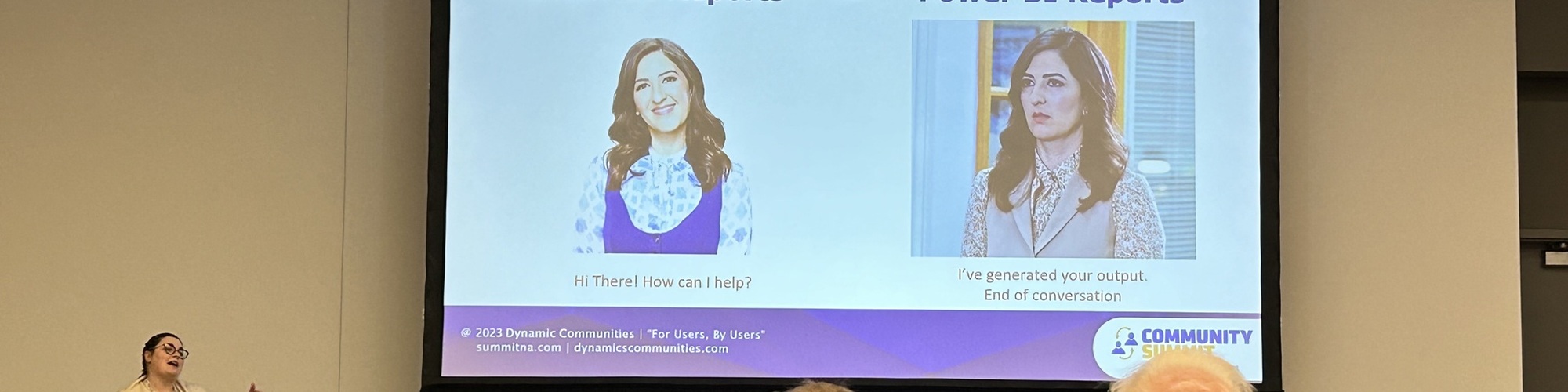
This session was first presented at Community Summit NA in collaboration with the inestimable Lauren Wooll.
DynamicsCon LIVE Sessionize Event
Community Summit NA
1. Choosing the Right Dynamics 365 F&O/AX Reporting Tool for the Job
Description: The right reporting tool can make a huge difference in development costs and user adoption, but knowing which one to use can be a challenge. During this session users will learn when to use standard Power BI reporting, paginated reports, Excel-based reporting, customized Dynamics 365 F&O reports, or a combination. We will dive into the wealth of out-of-the-box reporting Dynamics 365 F&O has, where to look, and what changes users can make without having to engage in any type of code changes.
Selected for: First Time at Summit Curated Agenda, Most Popular Sessions Curated Agenda
https://connect.summitna.com/8_0/sessions/session-details.cfm?scheduleid=408
2. Paginated Reports 101 for the Power BI Veteran (90-minute workshop)
Scenario: you’ve just completed a Power BI report, and it’s downright majestic! There’s just one tiny problem: it turns out your report users need a simple table that will print out well instead. Now what?
This hands-on session will go step-by-step in converting a Power BI analytical report into a Power BI paginated report that uses the same underlying Power BI Dataset. We’ll break down what each section of Power BI Report Builder contributes to your report and discuss how the underlying paginated report logic differs from a standard PBIX file.
Session attendees will have the opportunity to practice what they learn throughout this deep dive session with hands-on support and time for Q&A. At the end of this deep dive, attendees will leave with practice files that they can reference for practice and as a starter template for developing their own paginated reports.
https://connect.summitna.com/8_0/sessions/session-details.cfm?scheduleid=244
3. Paginated Reports 201 – Build a Better Report
You’ve connected to your data source and generated a table with parameters in Power BI Report builder, but the basic structure of your report leaves something to desire. How do you upgrade your functional but ho-hum report without breaking it?
In this hands-on session, users will learn how to tackle a mix of structural and formatting challenges that often plague paginated report developers, such as getting headers to repeat on each page, leveraging date pickers, and incorporating two datasets within the same table. Attendees will leave with links to the sample files and instructions they can reference in future when tackling their own reports.
https://connect.summitna.com/8_0/sessions/session-details.cfm?scheduleid=243
Power BI DC
Power BI paginated report tend to be thought of as the boring older sister of standard Power BI Reports. Still, when you need a report that can be reliably PDF-ed or printed out in a specific format, these boring but essential reports are simply the right tool for the job.
Join us for a special 1.5 hour in-person workshop on the evening of August 24th, where you'll be able to get some hands-on experience creating paginated reports from Power BI DC's co-organizer Lenore Flower. Attendees will leave the session with practice files and a firm understanding of when and how to leverage paginated reports.
Dynamics User Group Northeast Regional Meetup
You’ve connected to your data source and generated a table with parameters in Power BI Report builder, but the basic structure of your report leaves something to desire. How do you upgrade your functional but ho-hum report without breaking it? In this session, users will learn how to tackle a mix of structural and formatting challenges that often plague paginated report developers, such as getting headers to repeat on each page, leveraging date pickers, and incorporating two datasets within the same table. Attendees will leave with links to the sample files and instructions they can reference in future when tackling their own reports.
DynamicsCon Live
Session Presented: Power BI Paginated Reports 201: Build a Better Report
You’ve connected to your data source and generated a table with parameters in Power BI Report builder, but the basic structure of your report leaves something to desire. Now what?
In this session, users will learn how to tackle a mix of structural and formatting challenges that often plague paginated report developers, such as getting headers to repeat on each page, leveraging date pickers, and incorporating two datasets within the same table. Attendees will leave with links to the sample files and instructions they can reference in future when tackling their own reports.
Link to Presentation Slides: https://live.dynamicscon.com/wp-content/uploads/2023/06/Lenore-Flower-Power-BI-Paginated-Reports-201-Build-a-Better-Report.pdf
Please note that Sessionize is not responsible for the accuracy or validity of the data provided by speakers. If you suspect this profile to be fake or spam, please let us know.
Jump to top