
Stefan Koehler
Co-Founder and architect of praivate, your privacy-first RAG
Co-Founder und Architekt von praivate, dem datenschutzfreundlichen RAG
Belgrade, Serbia
Actions
Stefan’s work has touched fields that at first sight have little in common: music, large-scale open-source migrations, enterprise architecture, fine cuisine, organizational development, and AI. On closer inspection, they share recurring questions about structure, interaction, complexity, adaptation, and how individual parts form a functioning whole.
Across these contexts, his focus is less on individual technologies than on the relationships between components, people, processes, and institutions. His approach is shaped by systems thinking and Kanban: making work and dependencies visible, reducing unnecessary complexity, and enabling deliberate change. He is interested in how complex systems can remain understandable, maintainable, observable, and adaptable — and how technical architecture can support autonomy without losing sight of organizational reality.
He has contributed to initiatives including LiMux and the architectural groundwork for what later became openDesk. His technical work spans AI system architecture, corrective RAG, hybrid retrieval and reranking, observability and provenance, security, reproducible infrastructure, Infrastructure as Code, and deployment across environments from personal computers to data centers and cloud infrastructure. Today he brings these strands together in praivate, a privacy-focused AI platform built around free software, modularity, high engineering standards, reproducibility, and operational control.
Previous speaking engagements include LinuxCon Europe, FOSSASIA, SFSCon, CeBIT, and AI Tech Summit Belgrade. Forthcoming appearances include Big Data Week Bucharest, Kiss the Future Sarajevo, DeAI Summit Malta, and Commons AI Paris.
Stefans Arbeit berührte Bereiche berührt, die auf den ersten Blick wenig miteinander zu tun haben: Musik, aufsehenserregende Open-Source-Migrationen, Enterprise Architecture, gehobene Küche, Organisationsentwicklung und KI. Bei genauerem Hinsehen geht es dabei immer wieder um ähnliche Fragen: Struktur, Wechselwirkungen, Komplexität, Anpassungsfähigkeit und darum, wie einzelne Teile zu einem funktionierenden Ganzen werden.
Genau deshalb liegt sein Fokus weniger auf einzelnen Technologien als auf den Beziehungen zwischen Komponenten, Menschen, Prozessen und Institutionen. Stefans Ansatz ist geprägt von Systemdenken und Kanban: Arbeit und Abhängigkeiten sichtbar machen, Komplexität reduzieren und gewünschte Veränderung ermöglichen. Ihn interessiert, wie komplexe Systeme verständlich, wartbar, beobachtbar und anpassungsfähig bleiben können – und wie technische Architektur Autonomie unterstützen kann, ohne die organisatorische Realität aus dem Blick zu verlieren.
Er war an Initiativen wie LiMux und den architektonischen Vorarbeiten für das spätere openDesk beteiligt. Seine technische Arbeit umfasst KI-Systemarchitektur, Corrective RAG, hybrides Retrieval und Reranking, Observability und Provenienz, Sicherheit, reproduzierbare Infrastruktur, Infrastructure as Code sowie Deployments vom persönlichen Rechner bis hin zu Rechenzentrum und Cloud. Heute führt er diese Erfahrungen in praivate zusammen, einer privacy-orientierten KI-Plattform auf Basis freier Software, mit Fokus auf Modularität, hohe Engineering-Standards, Reproduzierbarkeit und operative Kontrolle.
Zu seinen bisherigen Vorträgen zählen unter anderem LinuxCon Europe, FOSSASIA, SFSCon, CeBIT und der AI Tech Summit Belgrade. Weitere Auftritte stehen bei Big Data Week Bucharest, Kiss the Future Sarajevo, DeAI Summit Malta und Commons AI Paris an.
Area of Expertise
Topics
FOST Paris Upcoming
My talk, 'Open Source Is Not Enough: What Makes an AI System Truly Open?' will be part of the 'Debunking Session: Building Actual Open AI Is Possible!' which will be great fun.
DeAI Summit Malta Upcoming
DeAI Summit brings together the people shaping AI’s next phase: founders, developers, researchers, enterprise leaders, investors, legal and compliance professionals, cybersecurity specialists and ecosystem builders.
kiss the future Sarajevo
The future doesn’t wait. join me on my talk "The Model Is Not The System" on the Research Stage at the Bosnian Cultural Center (BKC).
Big Data Week Bucharest 2026
The Model Is Not the System: Lessons from Building a Sovereign Corrective RAG Architecture
A practical look at building PrAIvate as a sovereign corrective RAG system. The talk shows why useful AI depends on much more than the model itself: hybrid retrieval, reranking, evaluation and correction, access control, reproducible infrastructure, and deployment independence. The core lesson is that sustainable AI requires an architecture designed for change, observability, and technological sovereignty.
AI Tech Summit 2026
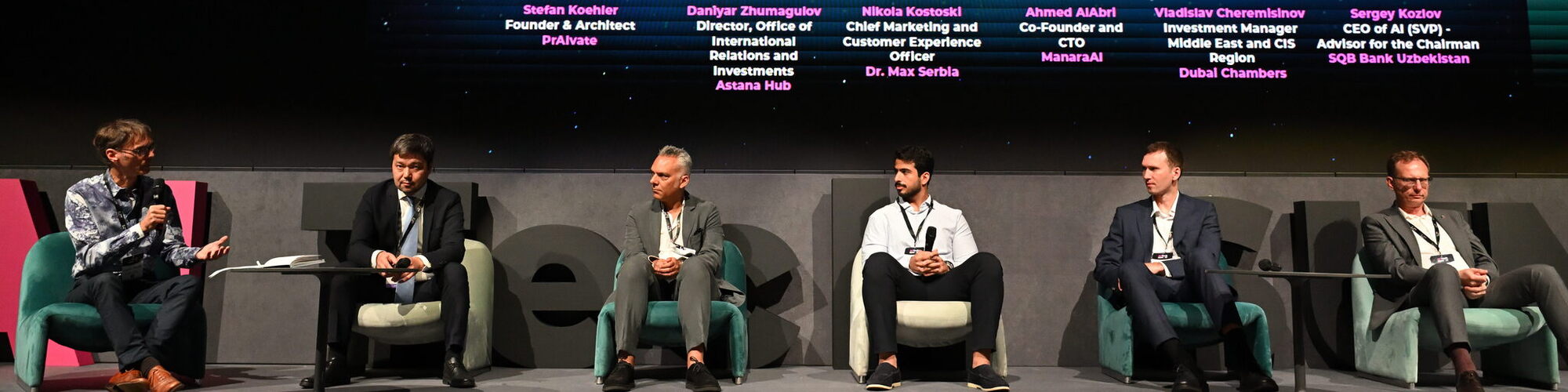
I hosted and moderated an international panel at AI Tech Summit Belgrade, bringing together senior leaders from Astana Hub, Dubai Chambers, banking, AI entrepreneurship, investment, and technology to discuss how emerging markets are turning AI innovation into real-world impact.
SFSCON
How Kanban concentric circles help you manage your work
Each enterprise, company or project has to tackle several challenges in organising work: On different levels different flavours of work appear; some people sit nearby while others are located in different parts around the world; some work items depend on each other.
In order to getting things done in a useful fashion tools are needed to make the value stream visible and to coordinate work. This is where the concept of Kanban concentric circles comes in handy. It helps you in setting up a structure that ensures a smooth flow from idea to impact along the whole value stream by giving all important
information to the people that need it at that time.
OpenTechSummit
LiMux-Projekt München
FOSSASIA 2015
The Power Of Free: How LiMux serves 15.000
The LiMux project has gained worldwide attention in 2003 when the City Of Munich decided to replace Windows with a linux--based client. Today more than 15.000 clients run LiMux. LiMux heavily relies on popular FOSS components like (K)Ubuntu, LibreOffice or Firefox but also adds some self-made magic ingredients. This talk will shed some light on the techniques used and how they work together.
LinuxCon Europe
LiMux And The FOSS Ecosystem
ПингВин-Фест (Pingvin-Fest)
State of FOSS in Germany - On the experience of Open-Source in Munich
Workshop on Promoting the Application and Development of Open Source Software
In December 2010, Stefan Koehler spoke at the Workshop on Promoting the Application and Development of Open Source Software in Hanoi, organized by Vietnam’s Ministry of Information and Communications. The event focused on advancing the use of free and open-source software in government and public administration, bringing together public-sector representatives, industry, associations, and the FOSS community.
FrOSCon
Revolution und Evolution – Freie Software im LiMuxprojekt
Please note that Sessionize is not responsible for the accuracy or validity of the data provided by speakers. If you suspect this profile to be fake or spam, please let us know.
Jump to top