
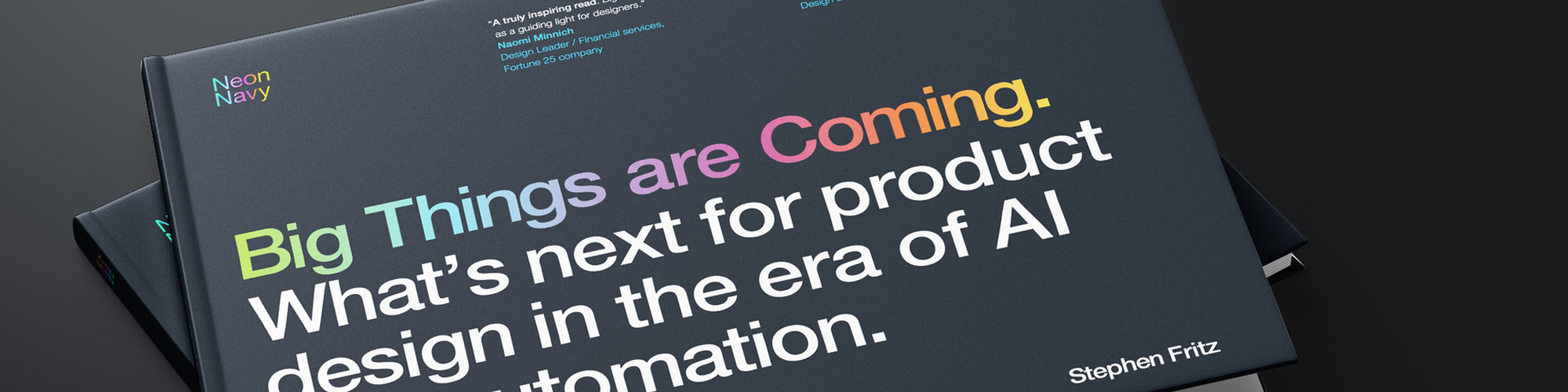

Stephen Fritz
Founder / CEO - Neon Navy
New City, New York, United States
Actions
An accomplished Product Design Leader with over 20 years of experience, Stephen has been leading companies through radical transformation throughout the digital age.
Stephen founded Neon Navy to help leaders guide their teams and organizations into the age of AI and automation.
Previously, Stephen led global teams at enterprise companies such as IBM, JPMorgan Chase, BT Global Services, Cognizant, and PepsiCo in their evolution to data-driven, human-centered, agile businesses at scale. While at IBM, he led the conception of IBM’s first full-stack component design system (now Carbon Design System), helping to usher in the age of product development with component design systems.
Steve began his career as leadership in one of the first global digital agencies working with businesses like Chase, Merrill Lynch, Siemens, and Valvoline establish their first online presence. Later he co-founded a digital agency named Olive that helped entertainment companies such as AMC Media (AMC, iFC, WE, Fuse), Viacom, Electra records and SONY shape their strategies to the emergence of digital downloads and streaming media.
Links
Area of Expertise
Topics
The AI Reset: No One Is Safe. Everything Is Up for Grabs.
For ten years, companies have optimized for efficiency. Costs are down, margins are up, and three foundational dimensions of every business have quietly hollowed out: experiences, organization, and methods. Forrester's CX Index now sits at its lowest level on record. Most leaders haven't connected those facts. They've created a blind spot, and AI is about to walk through it.
Today, nearly every company is treating AI as a capability — a tool to deploy, a productivity gain, a way to do more with less. Almost none are using it to actually transform their experiences, their organizations, or their methods. When that shifts, it will trigger a wave of growth, innovation, and competition unlike anything we've seen in a generation.
This talk lays out the blind spot most leaders aren't seeing, the cracks a decade of efficiency has created across all three dimensions, and the inflection point ahead — when AI stops being a tool for cutting costs and becomes the catalyst for reinventing experiences, organization, and methods. We'll cover how to recognize the moment, position for it, and act before someone in your market gets there first.
----
Session Goals
By the end of this session, attendees will be able to:
• Recognize the blind spot that a decade of efficiency has created across three foundational dimensions: experiences, organization, and methods.
• Distinguish between AI-as-capability and AI-as-catalyst, and understand why most current AI investments are aimed at cost reduction rather than the transformation that will actually define winners.
• Identify the leading signals that the customer-first AI shift has begun in their market, and what early movers are already doing across all three dimensions.
• Apply a framework for shifting posture from efficiency-first to growth-first — including the moves required across experiences, organization, and methods to make the transition stick.
• Understand why the reset levels the field for incumbents, challengers, and laggards alike, and what it means to be on the right side of it.
The New Experience Model: AI as UX
Most companies are still treating AI as a feature - a new chat interface, a smart suggestion, a productivity boost layered onto products built for a different era. Meanwhile, users are getting their first real taste of what comes next through agentic AI: experiences that are unified, personalized, and proactive…and indifferent to whose product or platform owns the data underneath. The gap between what users now expect and what companies are still shipping is where the next decade gets won and lost.
For decades, products have been built from an org-chart lens, not a customer-needs lens. Companies fragment experiences along their internal silos and ask users to do the integration work themselves. Agentic AI breaks that pattern. As agents mature, on the user's side and across every step of their journey, they stop respecting the boundaries between products, brands, and platforms. They pull content, services, and data from wherever it lives, integrating on the user's behalf. The brand stops controlling the experience. Agents do.
This talk walks through the three states of the new experience model — from today's fragmented experiences, to the unified brand experiences companies haven't yet built, to the integrated user experiences agentic AI is already previewing. We'll cover the principles that will define the new era — unified, personalized, proactive — and what it takes to design products for a world where your competition isn't another app. It's a network of agents across every step of a user's journey, including their own. And what we can see today is only the beginning.
Session Goals
By the end of this session, attendees will be able to:
• Recognize the expectation gap between what users now experience through agentic AI and what most companies still ship — and why closing it defines the next decade.
• Distinguish AI-as-feature from AI-as-experience-layer, and understand why most current AI investment is aimed at the wrong target — improving today's products rather than designing for what comes after them.
• Apply the three-state experience model — fragmented brand experiences, unified brand experiences, integrated user experiences — to evaluate where their product sits today and where it needs to go.
• Build toward the three principles - unified, personalized, proactive - that will define the new experience era and shape product decisions starting now.
• Position products for an agent-driven world, where experiences are shaped by a network of agents across every step of a user's journey — and recognize that what's visible today is only the start of the shift.
The Shape of Business for AI: The System-Led Organization
Conway's Law says any organization will design systems that mirror its own communication structure. For decades, that's been an annoying observation. In the AI era, it becomes a fatal one. It's not that we can't envision the experiences of tomorrow, it's that we can't envision how to build them in the organizations of today.
Most companies are attempting to layer AI on top of organizations built for a different era - fragmented by business unit, product line, and acquisition history. The internet era taught us where this leads: innovation stranded on islands, integration prohibitively expensive, customers falling through the gaps. Companies are now repeating those exact mistakes with AI - bolting it onto the same fragmented structure and accelerating the chaos rather than solving it. In a shape like that, no company can move at the speed innovation now requires.
The System-Led Organization is what comes after Conway's Law - a centralized, customer-aligned structure that learns from the internet era rather than repeating it. AI, data, applications, and product development live inside a unified system instead of scattered silos. This talk lays out what that structure looks like, the four big shifts required to build it (centralizing AI, applications and data, product development, and customer-aligned objectives), and the three principles it runs on — integration, data freedom, and customer alignment. We'll cover why most current AI initiatives are doomed by the structure they live inside, and what it takes to start building the shape of business that actually works for AI.
Session Goals
By the end of this session, attendees will be able to:
• Diagnose the structure problem — why even clear AI vision fails when the company underneath isn't built to deliver it, and how Conway's Law makes today's fragmented organizations a liability in the AI era.
• Recognize the internet-era pattern repeating with AI — how companies are bolting AI onto already-fragmented structures and accelerating the chaos rather than solving it.
• Understand the System-Led Organization as a centralized, customer-aligned structure where AI, data, applications, and product development live inside a unified system rather than scattered across silos.
• Apply the four big shifts required to build it — centralizing AI, applications and data, product development, and customer-aligned objectives — to evaluate where their company sits today.
• Build toward the three principles that hold the structure together — integration, data freedom, and customer alignment — and start the transition before the next wave of competitors does.
Stephen Fritz
Founder / CEO - Neon Navy
New City, New York, United States
Links
Actions
Please note that Sessionize is not responsible for the accuracy or validity of the data provided by speakers. If you suspect this profile to be fake or spam, please let us know.
Jump to top