
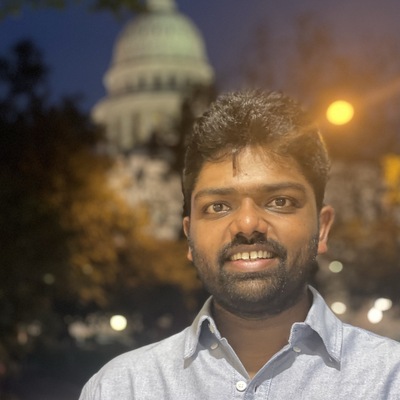
Tarun Reddy Nukala
Systems and AI Professional at Samsung Semiconductor | Researcher at UT Austin
Austin, Texas, United States
Actions
Tarun Reddy Nukala is a systems and AI professional at Samsung Semiconductor and a researcher at The University of Texas at Austin. His work and research interests span applied machine learning, trustworthy AI, computer vision, digital twins, and AI-enabled decision systems, with applications across semiconductor manufacturing, healthcare, and smart infrastructure. Tarun is also actively involved in IEEE standards, working groups, and AI policy initiatives, contributing to discussions and white papers on the responsible development and deployment of emerging technologies. His broader interests focus on bridging technical AI innovation with real-world engineering, governance, and societal impact, particularly in complex, safety- and reliability-sensitive environments.
From Digital Twins to Trusted Decision Loops: Engineering AI-Enabled Smart City Operations
Cities increasingly use 3D models, sensor-fed platforms, and scenario tools under the label “digital twin,” but those systems differ sharply in synchronization, predictive capability, operational authority, and evidence of public outcomes. The engineering question is therefore not whether a city owns a twin. It is whether a particular data–model chain is fit to inform—or execute—a particular decision.
This technical presentation introduces a vendor-neutral decision-loop reference pattern for AI-enabled urban operations: data → models → prediction → simulation → decision → action → feedback. The pattern is a practical synthesis, not a proposed new definition or certification scheme. It distinguishes a maintained city model, a monitored digital shadow, a synchronized twin, simulation-enabled decision support, and bounded closed-loop control.
The presentation maps concrete assurance controls to every stage: source identity, decision-relevant freshness, coverage and provenance; access and purpose restrictions; model verification, calibration, validation envelopes, uncertainty and sensitivity; AI drift and out-of-distribution monitoring; scenario credibility; traceable alternatives and approvals; secure actuation, interlocks and rollback; and comparison of predicted with observed outcomes. It also separates the roles of predictive AI, generative AI, optimization, physics-based and data-driven simulation, automated control, and accountable human authority.
Evidence from Helsinki’s 3D and Energy and Climate Atlas, the completed Athens DUET pilot, Virtual Singapore, Germany’s Connected Urban Twins, and Singapore’s Punggol Open Digital Platform shows a wide maturity range—from open semantic models and policy experiments to narrower operational integration. The cases also expose a critical evidence gap: documented capabilities are much more common than independently evaluated city outcomes.
Attendees will leave with a decision-fitness gate, a machine-readable “evidence envelope” for recommendations, and a consequence-based authority pattern. The goal is not to make every city twin autonomous; it is to make each supported decision traceable, challengeable, reversible where possible, and credible for its intended use.
Please note that Sessionize is not responsible for the accuracy or validity of the data provided by speakers. If you suspect this profile to be fake or spam, please let us know.
Jump to top