

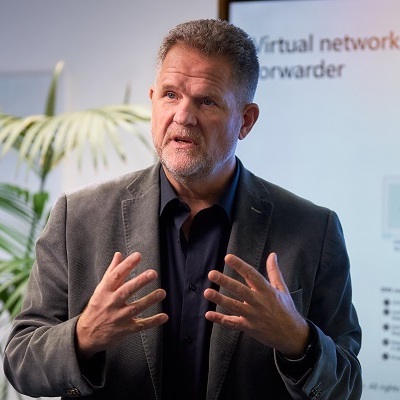
Thomas de Klerk
Learning Consultant
Bennekom, The Netherlands
Actions
Thomas de Klerk works as a learning consultant and trainer at Info Support, where he spends much of his time helping people make sense of complex technology — including AI.
His background is not purely technical. Early in his career he trained as a teacher at university level, later specialising in Human Resource Development. That combination still shapes how he looks at technology today: not just in terms of what it can do, but how people think, learn and make decisions around it.
His work now sits somewhere between training, facilitation and experimentation. He designs workshops, learning journeys and the occasional escape room to explore how people actually work with tools like AI in practice.
He uses AI himself, daily — which is exactly why he keeps questioning what it does to his own thinking.
Area of Expertise
Topics
Project Prometheus: AI Is Not Taking the Test. You Are.
For years, two experts have been arguing about the same question.
Not what AI can do.
What happens when people start trusting it.
Max Cornelisse believes most organizations move too slowly. They overanalyze, overgovern, and hesitate while others move ahead. In his view, AI is a force multiplier. The sooner you learn to work with it, the sooner you gain an advantage.
Dr. Sabine Charter believes the opposite. People are remarkably easy to influence, especially when information is presented with confidence, logic, and apparent certainty. As AI becomes more convincing, poor decisions become harder to recognize.
Neither managed to convince the other.
So they stopped debating.
They built Project Prometheus.
Today, participants enter that system.
Working in teams, they must gather evidence, connect seemingly unrelated information, make decisions under pressure, and compete for a place in the final round. Some conclusions will feel obvious. Some answers will seem too good to question. Some paths will appear far more convincing than they should.
Only two teams will reach the final stage.
There they will confront Prometheus itself.
And the question Max and Sabine never managed to answer:
When a system gives you an answer, how do you decide whether to trust it?
Project Prometheus is a large-scale interactive experience exploring trust, judgment, and decision-making in the age of AI. Participants do not learn these concepts from slides. They encounter them through their own choices, assumptions, and conclusions.
Because the greatest risk is not that a system occasionally gets things wrong.
It's that people stop noticing when it does.
No lecture.
No feature demos.
No spectators.
Just a room full of people making decisions.
And discovering how those decisions are really made.
If you're looking for a session where you can quietly catch up on email, this isn't it.
Project Prometheus is designed as a large-scale interactive session for conference audiences rather than a traditional talk.
While the abstract intentionally presents the experience through its narrative, the session explores a serious topic: how people evaluate, trust, challenge, and act upon information in the age of AI.
Participants work in teams and actively engage with evidence, assumptions, uncertainty, and decision-making under time pressure. The format is built around well-established concepts from cognitive psychology and human factors, including overconfidence, confirmation bias, automation bias, and the tendency to accept plausible answers without sufficient verification.
Rather than explaining these concepts through slides, participants experience them directly as part of the activity.
The session scales to conference-sized audiences and culminates in a live final round between the top-performing teams using physical puzzle devices. But the rest of the audience also remains active.
Conference attendees will leave with a memorable shared experience, practical insights into human decision-making around AI, and probably a few uncomfortable realizations about their own reasoning processes.
What Happens When Attacking Becomes Almost Free?
Imagine spending an entire day writing a carefully researched and well-argued document. Then someone takes a few seconds to generate a hundred objections, criticisms and counterarguments with AI.
Of course, you can use AI to respond. And the other person can use AI to attack your response. Before you know it, you're both producing enormous amounts of material that neither of you has the time to read properly.
I've seen this happen in competitive tendering. AI makes it remarkably easy to produce more text, more analysis and more criticism. But I'm not convinced that producing more actually gets us anywhere. At some point, we're simply creating work for each other.
That experience changed how I think about using AI. I've started treating it as an incredibly fast junior colleague. One that can read hundreds of pages, investigate unfamiliar subjects, ask useful questions and challenge my assumptions. But also one that needs guidance, doesn't know the reality of my client's business and can be confidently wrong.
Based on my experiences with actual tenders, I've developed a practical methodology for working this way. It's not rocket science (pun intended). Nor is it a clever collection of prompts. It's a fairly straightforward process: understand the tender requirements, talk to the people who know the business, gather evidence, identify what's missing, work out a strategy and only then start writing. And once there's a draft, have AI try to tear it apart.
The important part is knowing when to let AI do the work, when to challenge it and when to make the decisions yourself.
In this talk, I'll take you through an AI arms race that got rather out of hand, explain what I learned from it and show how I've translated those lessons into a practical way of working.
I don't think the future of knowledge work has to be a dark factory, with machines producing endless amounts of output and hardly any people left in the building.
I'm much more interested in what people can achieve with AI that they couldn't achieve without it.
AI Makes You Feel Smart. It’s a Trap.
This is not a talk about how AI works.
It’s about what it does to how you think.
We like to think the biggest risk of AI is that it sometimes gets things wrong.
But if you use it every day, you already know that’s not the real problem.
The real problem is that AI is very good at being just convincing enough.
Even when the input is incomplete, the output looks like something you can just move on with.
And that’s where it gets uncomfortable.
Because this isn’t just an AI problem.
Our brains work the same way.
We fill in the gaps. We smooth things over. We turn fragments into something that feels coherent, even when it isn’t.
In this session, I explore that pattern from a psychological point of view, using recognisable and personal examples to show how easily our judgement shifts when working with AI. Along the way, I connect those moments to the cognitive principles behind them.
We’ll look at what that means in practice.
Where you stop checking earlier than you think.
Where “good enough” quietly replaces “actually correct.”
And why the first reasonable answer is often exactly where things go wrong.
This is not an “AI is bad” talk. I use AI myself. Every day.
But once I started noticing this pattern, I also started changing how I use it.
Where I pause. What I double-check. And where I no longer trust the first good answer.
Expect this to be interactive.
You’ll recognise more of your own behaviour than you’re comfortable with.
Fair warning: this is not the session to quietly recover from an after‑lunch slump.
You’ll be involved.
Because the real shift is not only that AI can think with us.
It is that it quietly changes the point where we stop thinking for ourselves.
And if that moment feels familiar…
yeah.
It’s a trap.
Please note that Sessionize is not responsible for the accuracy or validity of the data provided by speakers. If you suspect this profile to be fake or spam, please let us know.
Jump to top