
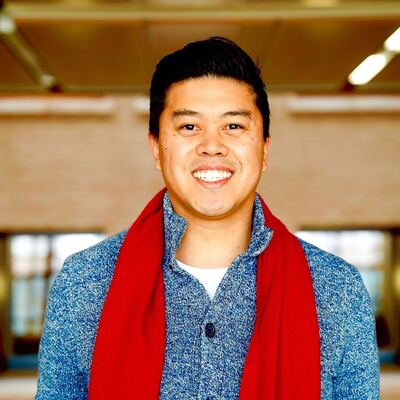
Tony DelaRosa
USAP Tayo Lab Co-Investigator at UW-Madison Center for Healthy Minds
Actions
Tony DelaRosa is the son of Pampangan & Caviteño Filipino immigrants and the father of two Filipinx-Cuban kids. Tony holds an M.Ed. from Harvard University and is now a PhD candidate at the University of Wisconsin-Madison Education Leadership & Policy Analysis department, where he researches how institutions, ethnic studies policies, and coalitions impact leadership practices. Tony is the author of the award-winning book "Teaching the Invisible Race: Embodying a Pro-Asian American Lens in Schools," published by Jossey-Bass. He co-investigates the USAP Tayo Lab at the Center for Healthy Minds at UW-Madison, where he researches the correlation between politics and the well-being of Filipina/x/o Americans. Before his research, he was a humanities teacher in Indianapolis and Boston, and an instructional coach in Miami-Dade between 2012 and 2022. His work has been featured in CNN, NPR, Harvard Education Magazine, NBC, KQED, the Hechinger Report and other publications. Learn more at TonyRosaSpeaks.com.
Links
Kapwa as Praxis: Community-Engaged Research Exploring Filipino American Politics and Well-Being
Abstract: In this roundtable, we showcase a multidisciplinary community-engaged research partnership with the nonprofit FilExcellence and Filipino American communities, offering perspectives from community organization, psychology, education, political science, history, and gender and women’s studies. Here, we discuss our experiences with initiating and sustaining community-based participatory research and create space to explore barriers and solutions to conducting community research with Asian/Pacific American communities. By way of illustration, each presenter will describe insights from the Usap Tayo national study, a mixed-methods investigation using Kuwentuhan as method and kapwa theory to explore the politics of wellbeing connected to Filipino Americans. Tony DelaRosa opens with a reflection on critical whiteness in Asian American scholarship and his auto-ethnographic notes from designing the research to leading focus groups. Next, Gabriella Sagun presents findings from our research on the theme of militarization. Cai Barias will explore the significance of place and memory within participants’ responses. Sarah Amplo will utilize a Pinayist framework to discuss participants’ definitions of success. Hadley Rahrig provides a perspective on future directions for health equity scholarship. Finally, Matthew Veland will lead a discussion on the Filipino value Kapwa as a guiding principle for equitable and multidisciplinary community-based research.
(*This session is the session I preference out of the two submissions)
Critical Whiteness Studies, Filipino American Politics, & Well-Being
This roundtable examines how whiteness influences Filipino/a/x American perspectives on politics and well-being. It builds on the national USAP Tayo study, conducted from October 2024 to August 2025 at the Center for Healthy Minds at UW–Madison. Bringing together scholars, practitioners, and community members, the roundtable considers how whiteness informs Filipino American political perspectives and the politics of well-being. That USAP Tayo data reveals how whiteness, inherited through familial and institutional experiences, shapes Filipino Americans’ views on well-being, success, and politics (Ahmed, 2007). Tony DelaRosa reflects on co-leading USAP Tayo and using Kapwa theory and Kwentuhan to facilitate focus groups. Gabriella Sagun discusses how militarization and well-being appear in the data. Cai Barias shares her perspective on memory and diaspora to investigate how participants relate to whiteness. Sarah Amplo utilizes a Pinayist framework to discuss participants’ definitions of success. Hadley Rahrig, a White identifying researcher, offers her perspective engaged in cross-ethnoracial research, while offering implications for power distribution through the lens of health equity research and mentorship of emerging critical Filipinx scholars. Finally, Matthew Veland, representing USAP Tayo’s community partner, offers his perspective on Kapwa, drawing on both his experiences and his application of it in the study. Alongside these narratives, audience members will be invited to share how whiteness has shaped their own views on politics, well-being, and the politics of well-being. Confronting whiteness in Filipina/x/o American politics and well-being opens broader conversations about decolonizing well-being more broadly.
AAAS Annual Conference 2026 Sessionize Event
Tony DelaRosa
USAP Tayo Lab Co-Investigator at UW-Madison Center for Healthy Minds
Links
Actions
Please note that Sessionize is not responsible for the accuracy or validity of the data provided by speakers. If you suspect this profile to be fake or spam, please let us know.
Jump to top