

Tricia Diamond
Director/Founder of Diamond PMO Solutions | Speaker (AI, Portfolio and Program Management, Professional Development, Heritage Management)
Directeur/Oprichter van Diamond PMO Solutions | Spreker (AI, Portfolio- en Programmamanagement, Professionele Ontwikkeling, Erfgoedbeheer)
Seattle, Washington, United States
Actions
Dr. Tricia Diamond is a portfolio and program management executive, aerospace engineer, and organizational strategist with more than two decades of leadership across the public sector, technology, and consulting in the United States and the Netherlands. She holds a PhD in Aerospace Engineering and professional aviation experience, alongside advanced credentials including the PfMP®, PMP®, PMI-ACP®, PMO-CP®, CPMAI, GPM-b®, CAL®, ITIL®, AWS-CCP, AWS-AIP, MCASE. As Director of ARPA Implementation for a major U.S. city, she built and led a PMO governing a $386M federal recovery portfolio with 100% regulatory compliance. She has spoken at ASPA and PMI conferences, previously served as VP of Professional Development for PMI Puget Sound, and is a Seattle Parks and Recreation Commissioner. She is the founder of Diamond PMO Solutions, an MWBE owned management consultancy specializing in portfolio governance, PMO design, and organizational strategy as well as PMI certification trainings. Her book, Second Line Leadership: How New Orleans Solved Coordination Without Controls, was published in September 2026.
Dr. Tricia Diamond is een uitvoerend leider op het gebied van portfolio- en programmamanagement, luchtvaartingenieur en organisatiestrateg met meer dan twee decennia aan leiderschapservaring in de publieke sector, technologie en adviesverlening in de Verenigde Staten en Nederland. Zij heeft een doctoraat in de luchtvaartechniek en professionele vliegervaring, naast geavanceerde certificeringen waaronder PMP®, PMI-ACP®, PMO-CP®, CPMAI, GPM-b®, CAL®, ITIL®, AWS-CCP, AWS-AIP en MCASE. Als directeur ARPA-implementatie voor een grote Amerikaanse stad heeft zij een PMO opgericht en geleid dat toezicht hield op een federaal herstelportfolio ter waarde van $386 miljoen, met 100% naleving van alle regelgeving. Zij heeft gesproken op ASPA- en PMI-conferenties, was eerder vicevoorzitter Professionele Ontwikkeling bij PMI Puget Sound en is commissaris bij Seattle Parks and Recreation. Zij is de oprichter van Diamond PMO Solutions, een door een vrouw en minderheid geleid managementadviesbureau gespecialiseerd in portfoliogovernance, PMO-ontwerp en organisatiestrategie, evenals PMI-certificeringstrainingen.
Links
Area of Expertise
Topics
Train the Trainer, Lead the Leader: Soft Skills That Make Technical Training Stick en
Technical accuracy earns a certification, but presence, adaptability, and communication are what make training transformational. Drawing on two decades of instructional leadership, service as VP of Professional Development for PMI Puget Sound, and experience training professionals across the United States and Europe, Dr. Tricia Diamond shares the facilitation, storytelling, and leadership techniques that separate good trainers from unforgettable ones. Attendees will learn to read a room, recover from technical failures gracefully, adapt delivery across cultures and languages, and build the confidence that turns learners into lifelong advocates.
The Hidden Cost of Intelligence: AI's Environmental and Equity Bill en
Agile organizations pride themselves on fast feedback loops, yet AI adoption decisions are routinely made with no feedback loop at all on their environmental and community cost. Every model an organization deploys draws on physical infrastructure: data centers, power generation, water, and land. Those costs concentrate somewhere, and too often they concentrate on communities with the least power to object. This session examines the documented case of data center expansion intersecting with under permitted power generation near a majority Black community, and asks what responsible adoption looks like when the true cost of intelligence is visible. Attendees will learn to separate verified findings from public narrative and apply a practical screening framework for evaluating AI vendor and infrastructure decisions against sustainability and equity standards before adoption, not after harm reaches families. This is responsible AI as an agile discipline: shortening the feedback loop between the decisions we make in sprint planning and the consequences they create in the physical world.
Governing AI Before It Governs You: A Practical Framework Trainers Can Teach en
AI adoption is outpacing AI governance across Africa and worldwide, and Microsoft Certified Trainers are on the front lines of closing that gap. This session delivers a practical, teachable governance framework covering policy design, data controls, risk management, and responsible deployment. Drawing on experience directing a $386M federally funded portfolio with 100% regulatory compliance, Dr. Tricia Diamond shows how trainers can embed governance thinking into every AI and Copilot course they deliver, positioning their learners to adopt AI safely, ethically, and confidently.
The Second Line: What a New Orleans Jazz Funeral Teaches About Building Recoverable AI Systems en
A New Orleans jazz funeral begins in grief and ends in celebration, moving from a structured procession into joyful, improvised motion without anyone directing it. Dr. Tricia Diamond grew up inside that tradition; her father is interred in the Musicians' Tomb at St. Louis Cemetery No. 1. She is also a PhD aerospace engineer trained in failure mode analysis who directed a $386 million AI-integrated federal portfolio through real production failures under continuous audit. Using the four-stage structure of the jazz funeral as a working model, she walks through real AI failure scenarios and the architectural decisions, failure propagation boundaries, graceful degradation paths, and human recovery interfaces, that determined whether each one became a catastrophe or a footnote.
Ten Things AI Labs Publish and Nobody Reads: What Every Education Leader Needs to Know Before Trust en
Every AI lab publishes research documenting the real limits of its own models, hallucination rates, contaminated benchmarks, and the gap between what a model claims to reason through and what it actually computes. Almost none of that research reaches the school and district leaders now approving AI tools for classrooms and administration. This session walks through ten specific, sourced findings from Anthropic, OpenAI, DeepMind, and peer reviewed research, then translates each into a concrete question education leaders should ask before trusting an AI tool with student data, grading, or instructional decisions. This is a literacy briefing, not a vendor pitch.
The Accountability Gap: Why AI Governance Fails Before the Breach Occurs en
The AI risk conversation in enterprise security is dominated by two categories of threat: external adversaries exploiting AI, and model-level failures such as bias, hallucination, and data leakage. Both are real. Neither is the governance failure that causes the most damage in high-stakes project, program and portfolio environments.
The most consequential AI risk in organizations today is internal and organizational: no human in the workflow has clear, documented, enforceable accountability for verifying what the AI produced before it became a decision. By the time the error surfaces, it has already propagated through compliance documentation, resource allocations, or regulatory filings. The breach did not come from outside. It was built into the process from the start.
Dr. Tricia Diamond draws on her experience directing a $386 million ARPA Implementation PMO, where AI-assisted tools were deployed in a federally audited environment with zero tolerance for undetected error, to present a practitioner's framework for closing the accountability gap before it becomes a liability. This session examines the specific organizational conditions under which AI errors compound undetected, the human-in-the-loop validation architecture that actually works under operational pressure, and the documentation and traceability practices thatmake AI-assisted decisions defensible when the regulator or the auditor arrives.
This is not a theoretical framework. It is a field account of AI governance built and operated under real federal scrutiny, with real consequences for failure, in an environment where the cost of an undetected error was measured in potential clawback of public funds and community harm.
Learning Objectives are
Identify three organizational conditions that allow AI errors to compound undetected in enterprise environments, and the governance interventions that interrupt each one before they become a security or compliance event.
Design human-in-the-loop validation checkpoints that function under operational pressure rather than creating the appearance of oversight while the process moves too fast for genuine verification.
Build the documentation and traceability architecture that makes AI-assisted decisions auditable, defensible, and correctable after the fact by satisfying both internal risk management requirements and external regulatory scrutiny.
When AI Gets It Wrong and Nobody Notices: Governance, Accountability, and the Cost of Unaccountable en
Conference Alignment
This session addresses the conference’s Ethical AI and Governance track with a case-study-grounded focus on bias, transparency, accountability, and the organisational conditions that allow AI errors to compound undetected in environments where the consequences are measured not in metrics but in community harm and regulatory exposure.
Problem Statement
Most AI governance discourse focuses on model-level risks: bias in training data, lack of explainability, regulatory non-compliance. These are real problems. However, the governance failures that cause the most damage in practice are not model failures — they are organisational failures. They happen when no human in the process has clear accountability for verifying AI outputs, when the speed of AI-assisted analysis creates institutional pressure to skip the validation step, and when the systems that should catch errors are themselves partially automated. In high-stakes environments — government programmes, healthcare systems, public infrastructure, financial services — these organisational governance gaps are not hypothetical. They are operational realities with measurable human costs.
Session Description
When a federal programme deploys AI-assisted tools to analyse eligibility, prioritise allocations, or generate compliance documentation, the AI does not bear the consequences if the output is wrong. The programme director does. The community does. The regulator does. The accountability gap between what AI produces and who answers for it is not a technical problem. It is a governance problem and it requires a governance solution.
Dr. Tricia Diamond draws on her experience directing a $386 million ARPA Implementation PMO where every allocation decision was subject to federal audit, every requirement was traceable to a community outcome, and the cost of an undetected error was measured in potential clawback of public funds to present a practitioner’s framework for AI governance in high-stakes programme environments. This session examines the specific conditions under which AI errors go undetected in organisational workflows, the governance structures that prevent them, and the accountability architecture that makes AI-assisted decision-making defensible under scrutiny.
This is not a theoretical session about responsible AI. It is a direct account of what governance looks like when the stakes are real, the scrutiny is constant, and the humans in the loop must be able to explain every decision to a federal auditor.
Key Takeaways
• The three organisational conditions that allow AI errors to compound undetected in high-stakes programme environments, and the governance structures that interrupt each one.
• How to design human-in-the-loop validation checkpoints that are genuinely effective rather than performative, including the accountability assignment that makes them function under operational pressure.
• A practical AI governance framework drawn from federal programme management practice that is transferable to any high-stakes delivery environment — healthcare, finance, government services, infrastructure.
• How to build the documentation and traceability practices that make AI-assisted decisions auditable, defensible, and correctable after the fact.
• Why the accountability gap between AI output and human responsibility is the most consequential and least addressed dimension of AI governance in organisations today, and what closing it actually requires.
How This Session Aligns With the Conference Theme
The conference’s Ethical AI and Governance track is explicitly seeking content on bias mitigation, regulatory frameworks, privacy, and transparent AI systems. This session contributes a practitioner-level case study perspective that is rare in AI governance discourse: not a policy researcher or a vendor, but a programme director who built and operated AI-assisted governance systems in a federally scrutinised environment and can speak directly to what worked, what failed, and what the accountability architecture actually needs to look like.
Intended Audience and Prerequisites
Advanced. Intended for senior leaders, programme directors, governance professionals, and policy practitioners who are responsible for AI adoption decisions in environments where errors carry regulatory, financial, or community consequences. Assumes basic familiarity with AI concepts and organisational governance frameworks.
When Your Product Fails, Who Pays? Accountability in High-Stakes Tech Delivery en nl
The product management community has developed sophisticated frameworks for discovery, delivery, and iteration. It has a much thinner vocabulary for what happens when a product fails in an environment where the users cannot simply churn, the organisation cannot simply pivot, and the consequences of a bad release are not a dip in engagement metrics but a disruption to someone’s housing, healthcare, or livelihood.
Technology is no longer confined to environments where failure is recoverable by default. Government services, healthcare platforms, financial systems, public infrastructure, and community programmes run on software built by product teams who often have no framework for reasoning about the accountability structure that surrounds their decisions. That gap is becoming increasingly consequential as technology moves deeper into the systems people depend on.
Dr. Tricia Diamond has built and led technology-enabled programme delivery in public sector environments where product decisions carry regulatory, legal, and community consequences. She offers product managers, developers, and technology leaders a direct, practical framework for thinking about accountability in high-stakes delivery contexts: what it means structurally, how it changes the product decisions you make, and how to build it into your team’s operating model without sacrificing the speed and adaptability that make product teams effective.
Key Takeaways for Attendees
• A clear framework for identifying when a product is operating in a high-stakes accountability context versus a standard commercial one, and why the distinction changes your entire approach to risk, requirements, and release decisions.
• How to structure product documentation, decision traceability, and stakeholder communication to withstand scrutiny from regulators, auditors, executives, and the public without turning your team into a compliance function.
• The product management anti-patterns that are harmless in low-stakes environments but catastrophic in high-consequence ones, including move-fast cultures, undocumented pivots, and stakeholder-light discovery.
• Practical techniques for building accountability into product team culture in a way that strengthens rather than slows delivery, drawn from real programme environments where the cost of unaccountable product decisions was measured in public harm.
• How product leaders can develop their own accountability fluency as a career differentiator in an industry that is increasingly being asked by governments, regulators, and the public to justify its decisions.
Why This Matters Now
Tech Fuse attendees are practitioners navigating an industry that is simultaneously gaining more power over people’s lives and facing more scrutiny than it ever has. This session does not moralize about that reality. It gives product and technology leaders the concrete tools to operate in it responsibly and confidently, from someone who has done it at scale in one of the most scrutinized spending programs in recent U.S. history.
Als uw product faalt, wie betaalt dan de prijs? Verantwoording bij techprojecten met hoge inzet en nl
De productmanagementgemeenschap heeft geavanceerde raamwerken ontwikkeld voor discovery, delivery en iteratie. Ze beschikt echter over een veel beperkter vocabulaire voor wat er gebeurt wanneer een product faalt in een omgeving waar gebruikers niet zomaar kunnen afhaken, de organisatie niet zomaar kan pivoteren, en de gevolgen van een slechte release geen daling in engagementcijfers zijn, maar een verstoring van iemands huisvesting, gezondheidszorg of levensonderhoud.
Technologie is niet langer beperkt tot omgevingen waarin falen standaard herstelbaar is. Overheidsdiensten, zorgplatforms, financiële systemen, publieke infrastructuur en gemeenschapsprogramma's draaien op software die is gebouwd door productteams die vaak geen raamwerk hebben om na te denken over de verantwoordingsstructuur rondom hun beslissingen. Die kloof krijgt steeds grotere gevolgen naarmate technologie dieper doordringt in de systemen waarvan mensen afhankelijk zijn.
Dr. Tricia Diamond heeft technologiegedreven programma's opgebouwd en geleid in de publieke sector, in omgevingen waar productbeslissingen regelgevende, juridische en maatschappelijke gevolgen hebben. Zij biedt productmanagers, ontwikkelaars en technologieleiders een direct en praktisch raamwerk om na te denken over verantwoording in delivery-contexten met hoge inzet: wat het structureel betekent, hoe het de productbeslissingen verandert die u neemt, en hoe u het in het operationele model van uw team verankert zonder in te leveren op de snelheid en wendbaarheid die productteams effectief maken.
Belangrijkste inzichten voor deelnemers
Een helder raamwerk om te herkennen wanneer een product zich in een verantwoordingscontext met hoge inzet bevindt in plaats van een standaard commerciële context, en waarom dat onderscheid uw volledige benadering van risico's, requirements en releasebeslissingen verandert.
Hoe u productdocumentatie, traceerbaarheid van beslissingen en communicatie met belanghebbenden zo inricht dat deze bestand zijn tegen toetsing door toezichthouders, auditors, bestuurders en het publiek, zonder dat uw team verandert in een compliance-afdeling.
De anti-patronen in productmanagement die onschuldig zijn in omgevingen met lage inzet maar catastrofaal in omgevingen met grote gevolgen, waaronder een cultuur van snel bewegen, ongedocumenteerde koerswijzigingen en discovery met te weinig betrokkenheid van belanghebbenden.
Praktische technieken om verantwoording zo in de cultuur van productteams te verankeren dat delivery erdoor wordt versterkt in plaats van vertraagd, ontleend aan echte programmaomgevingen waar de kosten van onverantwoorde productbeslissingen werden gemeten in publieke schade.
Hoe productleiders hun eigen vaardigheid in verantwoording kunnen ontwikkelen als onderscheidende factor in hun loopbaan, in een sector die door overheden, toezichthouders en het publiek steeds vaker wordt gevraagd haar beslissingen te rechtvaardigen.
Waarom dit nu belangrijk is
Deelnemers aan Tech Fuse zijn professionals in een sector die tegelijkertijd steeds meer invloed krijgt op het leven van mensen en onder meer toezicht staat dan ooit tevoren. Deze sessie moraliseert niet over die realiteit. Ze geeft product- en technologieleiders de concrete instrumenten om er verantwoord en met vertrouwen in te opereren, aangereikt door iemand die dit op grote schaal heeft gedaan in een van de meest kritisch gevolgde bestedingsprogramma's uit de recente Amerikaanse geschiedenis.
Build Stuff 2026 Lithuania Sessionize Event Upcoming
Agile Tour Montréal 2026 Sessionize Event Upcoming
Tech Fuse Des Moines 2026 Sessionize Event
MCT Africa Summit User group Sessionize Event
Tech Tactics in Education Fall 2026 Sessionize Event
AI Risk Summit & CISO Forum 2026 - Ritz-Carlton, Half Moon Bay Sessionize Event
PMI Agile 2026
PMI® Agile 2026 is the premier conference for agile practitioners and leaders. Running from July 26–28, 2026 at the Gaylord National Resort & Convention Center in National Harbor, MD (near Washington, DC), the event focuses on enterprise agility, AI integration, and the Manifesto for Enterprise Agility.
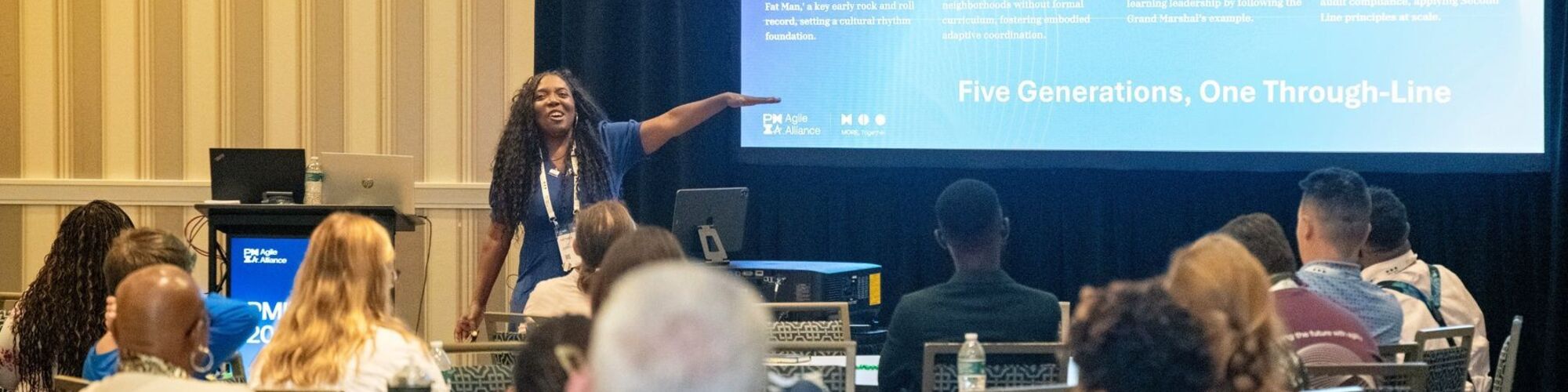
My session is "From Second Line to Agile: New Orleans Traditions as a Blueprint for Adaptive Leadership"
LEADING WITH EMPATHY, DELIVERING WITH PURPOSE Project & Analysis Management Summit
The PAM Summit, hosted by PMI Poland, conference is two days full of workshops and lectures led by leaders in their fields. The event program focuses on the synergies between project management and business analysis and the benefits that can be achieved through them. It is aimed at practitioners and anyone interested in developing these areas
I served on a panel discussing AI's impact on project management and presented a lecture on Portfolio Level Business Analysis
AI in The New Era Sessionize Event
Tricia Diamond
Director/Founder of Diamond PMO Solutions | Speaker (AI, Portfolio and Program Management, Professional Development, Heritage Management)
Seattle, Washington, United States
Links
Actions
Please note that Sessionize is not responsible for the accuracy or validity of the data provided by speakers. If you suspect this profile to be fake or spam, please let us know.
Jump to top