

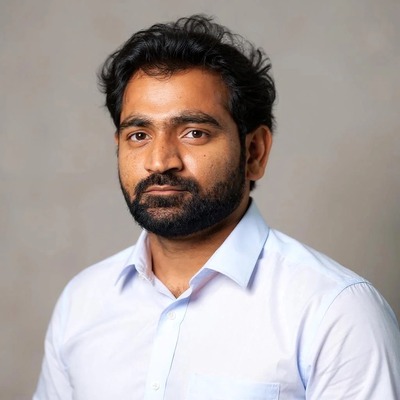
Vinay Chowdary Duvvada
California State University, East Bay
Kirkland, Washington, United States
Actions
Vinay Chowdary Duvvada is a highly experienced software engineer with over 11 years of expertise in the design, development, testing, and support of enterprise applications. His career spans multiple industries, including e-commerce, insurance, automotive, ticketing, and cloud services. He currently works as a Staff Software Engineer at ServiceNow in Kirkland, WA, where he focuses on automation workflows for infrastructure services, key management systems, load balancer upgrades, and database versioning to support ServiceNow's SaaS ecosystem.
Before ServiceNow, Vinay was a Software Engineer at Microsoft, where he developed a distributed architecture system for Windows package release testing framework on Azure. His work included building real-time event-processing pipelines and implementing disaster recovery strategies through infrastructure as code.
Vinay has also held Software Development Engineer roles at Live Nation Entertainment, StubHub (via Anchor InfoTech), and Nordstrom.com (via Infosys). In these roles, he developed microservices-based APIs, integration layers, and analytics platforms using modern technologies such as Scala, Akka, Spring Boot, AWS Lambda, Redis, and Spark. His projects supported ticketing platforms, customer purchase profiling, and enterprise integration systems.
He has a strong command of Java, Scala, JavaScript, C#, SQL/PLSQL, and has worked extensively with tools and platforms such as Kubernetes, Docker, Azure Service Fabric, Jenkins, Helm, Splunk, Grafana, and Mule ESB.
Vinay earned a Master of Science in Computer Science from California State University, East Bay, and a Bachelor of Technology in Computer Science from JNTU, Hyderabad. He also completed a certification in MongoDB for Java Developers in September 2016 and briefly worked as a Teaching Associate and Graduate Assistant at CSU East Bay.
Links
Area of Expertise
Topics
Predictive and Self-Healing BCDR in Hybrid Cloud: Automating Resilience with AI and Policy-as-Code
Hybrid cloud architectures have transformed enterprise IT, but they have also introduced significant complexity in ensuring Business Continuity and Disaster Recovery (BCDR). As organizations increasingly distribute workloads across on-premises, public, and private clouds, traditional recovery strategies can no longer keep pace with the operational demands of dynamic infrastructures. This session explores how automation, Infrastructure-as-Code (IaC), and Policy-as-Code are redefining resilience planning, helping enterprises build more intelligent and adaptive recovery frameworks.
By replacing manual recovery processes that often involve over a hundred steps, organizations can dramatically accelerate recovery and improve reliability. Real-world case studies show enterprises reducing recovery time by up to 67%, increasing first-attempt success rates by 54%, and minimizing recovery time variation by 73% through codified automation. The session examines four key architectural models driving this transformation: geo-redundant active-active deployments that enable sub-30-second failovers, cloud-to-on-premises failback strategies now adopted by 78% of enterprises, cross-cloud orchestration that delivers 37% faster recovery stabilization, and immutable infrastructure that enhances consistency and reliability by 83%.
Participants will also gain insight into the integration of native BCDR capabilities across leading providers—Azure, AWS, and Google Cloud—including their respective strengths such as Azure’s orchestrated runbooks and AWS’s block-level replication. The discussion also addresses one of the most pressing challenges in the field: the 67% of enterprises that report difficulty achieving seamless interoperability between cross-provider APIs.
Looking ahead, the session explores the future of AI-driven predictive recovery and self-healing architectures, where machine learning models anticipate system disruptions before they occur, and automated remediation workflows dynamically reconfigure protection policies in real time. Attendees will leave with actionable insights and proven design patterns for building resilient, future-ready BCDR systems in hybrid cloud environments transforming continuity from a reactive process into a proactive, intelligent discipline.
Thank you for your participation!
If you missed the session, you can watch the recording here:
https://www.linkedin.com/events/theazureandaishow7414332753422249984/theater/
Building Resilient Automation for the Cloud-Native Enterprise
In an era where critical business operations depend entirely on cloud-native platforms, resilience is no longer an afterthought—it is foundational. This presentation outlines a comprehensive blueprint for architecting automation systems that are robust, fault-tolerant, and built to scale reliably across diverse cloud environments.
Key Discussion Areas
Domain-Driven Fault Isolation: Discover how structuring services around clear domain boundaries limits blast radiuses, prevents cascading failures, and isolates issues at the service level.
Orchestration & Self-Healing: Learn how platforms like Google Kubernetes Engine (GKE) and Microsoft Service Fabric leverage automated pod recovery, liveness and readiness probes, and horizontal autoscaling to maintain high availability under peak load.
Advanced Traffic Management: Explore how service meshes such as Istio and Linkerd standardize resilience via intelligent traffic routing, mutual TLS, and dynamic circuit breaking across microservices.
Codified Infrastructure: Understand how Infrastructure-as-Code (IaC) eliminates configuration drift and ensures deterministic, repeatable, and audit-compliant deployments.
Proactive Validation with Chaos Engineering: See how intentionally injecting controlled failures into staging and production surfaces hidden architectural weaknesses before outages occur.
Future-Proofing with Multi-Cloud & AIOps: Conclude with forward-looking strategies that use provider-agnostic design patterns and machine learning-driven anomaly detection to dynamically self-heal systems.
Who Should Attend
Whether you operate large-scale distributed enterprise systems or are architecting your organization’s next-generation cloud foundation, this session provides practical design patterns and actionable frameworks to keep your platforms dependable, adaptive, and prepared for the unexpected.
Thank you for your participation!
If you missed the session, you can watch the recording here:
https://www.linkedin.com/events/7526017973321576449/
Beyond the Model: Building the Gateway Infrastructure for Enterprise AI
Adopting Generative AI and LLM agents at enterprise scale introduces architectural bottlenecks that sit well below the model layer. As organizations transition from isolated proofs of concept to multi-tenant production systems, they face strict requirements around routing control, credential isolation, protocol standardization, and unified observability. Infrastructure teams often struggle to manage traffic across heterogeneous services without compromising enterprise governance or developer velocity.
Drawing directly from real-world engineering experience automating the AI gateway, this talk deconstructs the foundational control plane needed to power modern AI ecosystems. We examine how to design unified proxy gateways that seamlessly interface with core AI services, including Model Context Protocol (MCP) integrations, dynamic AI gateways, build agents, and next-generation inference endpoints. Attendees will walk through automated configuration workflows, policy enforcement, centralized traffic inspection, and fault-tolerant service discovery across distributed environments.
The session also addresses operational challenges, such as handling token rate limits, mitigating vendor lock-in through abstraction layers, maintaining end-to-end security compliance, and isolating failure domains during upstream outages. Platform architects and infrastructure engineers will leave with an actionable architectural blueprint for orchestrating reliable, automated, and secure enterprise AI gateways that scale alongside accelerating AI adoption.
Platform Engineering as a Value Driver: Quantifying Reliability, Velocity, and Cost Optimization
Engineering teams frequently struggle to justify major platform overhauls and technical debt reduction when initiatives are framed solely in technical jargon rather than strategic business outcomes. True platform engineering goes beyond writing CI/CD pipelines or provisioning Kubernetes clusters; it is a discipline centered on systematically reducing operational friction, protecting revenue streams, and accelerating feature velocity across the entire software development lifecycle.
Synthesizing over a decade of staff-level engineering leadership across ServiceNow, Microsoft, Live Nation, and Nordstrom, this session provides engineering leaders and senior technologists with a strategic framework for aligning platform automation with measurable business value. We examine concrete case studies: how caching layers and distributed stream processing slashed e-commerce latency by 80% while boosting transaction volume by 40%, how automated pre-release validation cut manual QA efforts by 83%, and how centralized infrastructure automation safeguards multi-tenant SaaS availability.
The talk outlines concrete methodologies for defining key platform metrics, measuring developer cognitive load, calculating return on investment (ROI) for automated recovery mechanisms, and communicating complex technical trade-offs to non-technical stakeholders. Participants will leave with practical guidance on turning internal platform teams from perceived cost centers into core business enablers that drive measurable organizational agility.
Vinay Chowdary Duvvada
California State University, East Bay
Kirkland, Washington, United States
Links
Actions
Please note that Sessionize is not responsible for the accuracy or validity of the data provided by speakers. If you suspect this profile to be fake or spam, please let us know.
Jump to top