
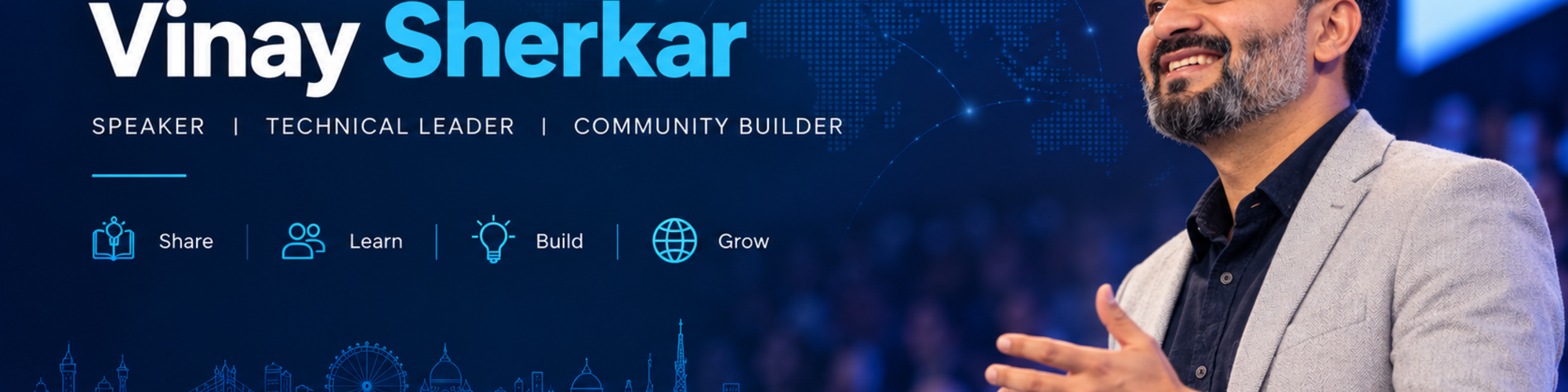

Vinay Sherkar
Senior Storage Platform Engineer, Bloomberg
Philadelphia, Pennsylvania, United States
Actions
Vinay Sherkar is a Senior Storage Platform Engineer at Bloomberg with 15+ years of experience in enterprise storage, distributed systems, Linux, cloud and infrastructure automation. His interests include resilient platforms and systems, AI infrastructure, observability and safe autonomous operations.
Links
Area of Expertise
Topics
When AI Agents Touch Production: Building Automation That Knows When to Stop
Giving an AI agent access to production infrastructure is easy to demonstrate. Making sure it doesn't turn a small issue into a major outage is a much harder engineering problem.
Imagine an agent detects rising storage latency and decides to fix it. It identifies a possible bottleneck, selects a remediation action, and executes it. But what happens if the diagnosis is incomplete, the system is already under pressure, or the proposed fix makes things worse?
In traditional infrastructure operations, we have learned to be careful with automation. We use health checks, change windows, canary deployments, access controls, rollback procedures, and human approvals. Agentic AI doesn't eliminate the need for these safeguards. It makes them even more important.
In this session, I'll explore how established infrastructure engineering practices can help us build safer agent-driven operations. Using a hypothetical storage incident and a reference architecture based on Python, Ansible, monitoring systems, and policy-controlled tool access, I'll walk through how an agent could move from observation to recommendation and eventually to a controlled action.
We'll look at how to:
- Separate what an agent can observe from what it is allowed to change.
- Use health checks, policies, and approval gates before taking action.
- Prevent repeated or conflicting remediation attempts.
- Recognize when automation should stop, escalate, or require a human decision.
- Design actions that are observable, auditable, and reversible wherever possible.
This isn't about replacing infrastructure engineers with AI agents. It's about applying the lessons we've learned from running complex production systems to a new generation of automation.
Attendees will leave with a practical design pattern they can adapt when connecting AI agents to enterprise tools, infrastructure APIs, and operational workflows.
The Infrastructure Beneath Agentic AI: Storage, Context, and the Cost of Every Decision
We spend a lot of time talking about how intelligent AI agents are becoming. But there is another side to the story that doesn't get nearly as much attention: the infrastructure they depend on.
Every time an AI agent retrieves information, searches a knowledge base, calls a tool, or makes another decision, something has to happen behind the scenes. Data must be available, storage must respond, networks must carry requests, and systems must deliver the right context at the right time.
What happens when the data is stale? When storage latency increases? When an agent makes repeated tool calls that create unexpected infrastructure load? Or when the underlying system becomes unavailable halfway through a workflow?
These are familiar problems for infrastructure engineers, but they take on new importance as organizations move from simple AI assistants to autonomous, multi-step agents.
Drawing on more than 15 years of experience with enterprise storage, distributed systems, Linux, and infrastructure automation, I'll explore the infrastructure challenges behind agentic AI and how we can design for them.
Using a hypothetical enterprise knowledge-retrieval workflow, I'll walk through a reference architecture showing how agents interact with storage, retrieval services, APIs, and operational infrastructure.
We'll examine:
- How context retrieval depends on data availability, freshness, and storage performance.
- Why traditional infrastructure metrics don't always explain poor agent performance.
- How repeated tool calls, retries, and parallel agent workloads can amplify latency and infrastructure demand.
- Where caching, observability, request limits, and failure handling fit into the architecture.
- How to think about reliability across the entire agent workflow, rather than treating each component independently.
The Platform Beneath AI: Building Infrastructure That Can Sense, Decide and Recover
AI performance depends on far more than GPUs. In this talk, Vinay Sherkar explores the platform beneath AI: compute, memory, storage, networking, observability and automation working as one resilient system. Drawing on 15+ years of infrastructure experience, he shows how telemetry, IaC and policy-driven control loops can detect degradation, contain failures and enable safe recovery. The talk examines the progression from monitoring and scripted automation toward bounded autonomous operations—where infrastructure can act at machine speed while remaining observable, reversible, auditable and under human control.
Beyond the Algorithm: Teaching Future Healthcare Leaders to Trust AI Responsibly
What happens when an AI system gives a confident but incorrect answer, relies on incomplete data, or becomes unavailable during a critical task? How do we teach future healthcare professionals to respond? This interactive workshop introduces a practical approach to teaching AI failure before it causes harm. Through hypothetical healthcare scenarios, participants will learn to identify warning signs, assess risks, build human oversight into decisions, and develop classroom exercises that strengthen critical thinking and responsible AI use.
Teaching AI Failure Before It Happens: A Practical Framework for Healthcare Education
What happens when an AI system gives a confident but incorrect answer, relies on incomplete data, or becomes unavailable during a critical task? How do we teach future healthcare professionals to respond? This interactive workshop introduces a practical approach to teaching AI failure before it causes harm. Through hypothetical healthcare scenarios, participants will learn to identify warning signs, assess risks, build human oversight into decisions, and develop classroom exercises that strengthen critical thinking and responsible AI use.
Automating Storage Infrastructure Without Automating the Outage
Storage automation gets harder when one platform becomes many. In this talk, Vinay Sherkar draws on hands-on experience across traditional enterprise and distributed storage to show how Python, Ansible and APIs can create a consistent automation layer across heterogeneous infrastructure. He explores idempotency, configuration drift, canary changes, health gates, observability, failure containment and rollback—and why safe automation must know when to stop before a small mistake becomes a fleet-wide outage.
Vinay Sherkar
Senior Storage Platform Engineer, Bloomberg
Philadelphia, Pennsylvania, United States
Links
Actions
Please note that Sessionize is not responsible for the accuracy or validity of the data provided by speakers. If you suspect this profile to be fake or spam, please let us know.
Jump to top