
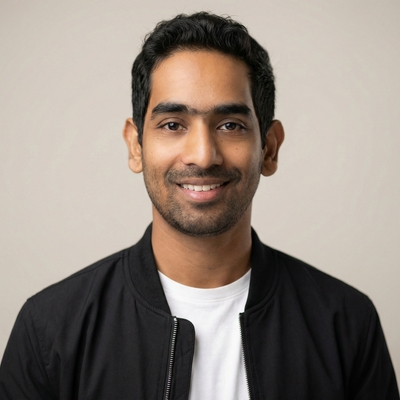
Viswanathan Ranganathan
Senior Engineer
San Francisco, California, United States
Actions
Viswanathan (Vish) Ranganathan is a Senior Engineer at Netflix, where he owns the deployment platform that governs whether engineering teams across Streaming, Ads, and Gaming can ship software during the company's highest-stakes moments — major live broadcasts, holiday peaks, and anything else where a bad release would be front-page news. He sets the technical direction for that platform and answers for it directly to senior leadership.
Before Netflix, he led the real-time analytics platform powering Twilio's messaging infrastructure, a system critical to the business and depended on by customers well beyond the tech industry. He then moved to Atlassian, where he built developer-platform tooling that turned third-party service integration from a multi-day process into an afternoon's work.
He holds a Master's in Computer Science from the University of Houston, is a Fellow of the British Computer Society, and a Senior Member of IEEE. He reviews for leading venues in machine learning and systems, including NeurIPS, ICML, ACL, ACM SIGIR, and ICLR. He is a founding member and chapter officer of the ACM Irving Professional Chapter and also serves as Program Chair for the Fremont ACM Professional Chapter, where his work has drawn coverage from outside media.
Badges
Area of Expertise
Topics
Versioned Datasets - Rethinking local in-memory caches
In the world of distributed computing, your data is often served through API requests. There may be several systems depending on a single dataset. For datasets that are relatively small (in the order of a few GBs), one way to have faster data access is by using a local in-memory cache. Because the dataset is relatively small, using distributed systems such as Redis/EVCache might be overkill, and the risk of adding a new integration outweighs the reward of faster data access. This is where the services opt for an in-memory local cache.
The JVM ecosystem, in particular, features several highly efficient caching libraries, including Ehcache, Caffeine, and Guava cache, among others. However, there are challenges with maintaining a local in-memory cache. Traditional approaches force uncomfortable trade-offs: cold starts, individual key invalidation, TTLs causing cache stampedes; full reloads causing memory spikes, GC pauses, and service disruptions; and incremental updates require complex change-tracking infrastructure. For gigabyte-scale datasets accessed millions of times per second, these approaches break down—yet this is precisely where in-memory caching matters most.
This talk introduces a different paradigm: treating datasets as versioned, immutable snapshots with delta-based distribution—essentially applying Git's model to in-memory data. We'll explore Hollow, an open-source library by Netflix that implements this pattern, enabling applications to efficiently distribute and update multi-gigabyte datasets with minimal memory overhead, zero downtime, and no GC pressure. Through real-world examples, you'll learn when versioned dataset distribution makes sense, how it works under the hood, and how to apply this emerging pattern to solve persistent caching challenges in your own systems—regardless of whether you're running microservices, monoliths, or anything in between.
Target audience: Backend engineers, Technical leaders, Software Architects
First public delivery: Fremont ACM Chapter
Session duration: 25 mins
Slide deck: https://vichu.github.io/hollowdemo
From Gatekeepers to Groundwork — Rethinking Human Oversight in Deployment Pipelines
Every deployment pipeline has one. The button. The approval gate. The moment where an engineer pauses, skims a diff, and clicks approve — not because they've evaluated anything specific, but because that's how it's always been done. It's the monkey ladder of modern software delivery, and most teams don't even know they're climbing it.
This talk challenges the assumption that manual deployment gates are a form of caution. In most cases, they are a form of theater — a reflex dressed up as oversight. But the answer isn't to blindly automate your way to production either. The answer is to make human intervention something that has to be earned by the system, not assumed by default.
Drawing from real architectural patterns, this session introduces a deployment trust model built around three tiers — Manual, Assisted, and Autonomous — and the data-driven system that determines where any given service belongs at any given moment. You'll see how deployment health signals, test stability trends, pipeline frequency, and changeset risk annotations can be combined into a maturity score that tells your pipeline orchestrator whether to call a human or just ship.
The goal isn't to remove humans from the equation. It's to make their involvement exceptional — reserved for the moments when the data genuinely calls for it, rather than every time a merge lands on main.
If your team has reached continuous delivery but stalled on the last mile to continuous deployment, this talk is your on-ramp.
Cache me if you can: Decentralize your Distributed Caches with Hollow
Distributed caches are often used for scenarios that don't actually require them. For massive datasets (100's of GB's or more), distributed caches make sense—the data simply won't fit in a single node's memory. However, distributed caches tend to be overkill when working with smaller data sets (100s of MBs to 10s of GBs) that do fit in memory. Additionally, using traditional In-Memory caching libraries creates additional operational challenges, such as cache stampedes during TTL expiration, memory spikes during reloads, and long cold-start times that directly affect deployment velocity.
This talk proposes an alternate, unconventional view: What if we could decentralize our cache while centralizing its preparation? We'll discuss how dataset distribution using Hollow (an open-source project by Netflix) enables applications to serve data from local memory with microsecond access latency while staying perfectly synchronized via delta-based updates.
We'll cover:
- Design trade-offs that make this pattern ideal for GB-scale, read-heavy workloads.
- Delta-based updates that optimize cache reloads/refreshes.
- Zero-downtime updates applied in milliseconds without memory spikes.
Netflix's Quiet Period: The Race Day Rule That Protects Holidays, Live Sports & Cloud meltdowns
As the golden race day rule goes, do nothing new on race day. In other words, don't change what's already working. At Netflix, we follow this same principle through Quiet Period, our automated strategy for protecting production during the moments that matter most.
When live sports events capture enormous global audiences, when holiday viewership breaks all records, and when your cloud provider experiences a meltdown that sends half the internet into chaos—that is precisely when Netflix enacts its Quiet Period. This isn't merely a deployment freeze; it's a form of intelligent governance that poses one essential question: Is this truly the right moment to push something new into production?
In this session, we aim to take you inside Netflix's battle-tested playbook for high-stakes moments. You'll discover how we built systems that automatically protect production across multiple scenarios—from planned holiday peaks to emergency cloud outages. We'll explore the architecture that governs deployments across Streaming, Ads, and Gaming, and how we removed the "trust me, this is critical" problem that plagues every engineering organization under pressure.
You'll learn about our evolution from a manual policy to an intelligent adaptive system that knows when you're racing and refuses to let you experiment.
Every organization has race days. The question is: do you know when yours are, and are you disciplined enough to follow the rule?
Earning the Right to Deploy: Netflix's Approach to Deployment Safety at Scale
At some point, all organizations will hit a similar point. A high-risk time frame exists for each org when a single poor deployment can lead to disaster (holiday peak periods, new product launch times, etc.) In many cases, the first response to such situations is to call for a complete deployment lockdown. Freeze everything. Just wait until things are safer. Unfortunately, such freezes cause problems of their own: emergency patches get blocked, panic releases occur prior to the lockdown, engineers begin treating safety gateways like bureaucratic hurdles they need to find ways around.
We posed the question differently. How can we set up our systems so deployments automatically pause at the correct time, and how can we make bypassing eligibility a team-earned privilege rather than simply available to all? This talk is a technical dive into Quiet Period Automatic Protection, the system Netflix developed to replace raw trigger suppression with intelligent, stage-level deployment safety. We will go over how we moved from 'stop the pipeline' to 'pause the right stage at the right time with surgical accuracy'. The presentational topics include how the system determines production impact without requiring manual setup, how it dynamically adds protection to already running deployments, how it will handle multiple-region deployments that may last hours, and how every override is treated as an auditable learning opportunity rather than just a liability.
This architectural shift transforms the mechanism of safety. By mandating a justification for every override, we convert raw bypasses into high-fidelity, auditable learning signals. Monitoring these patterns allows the system to act as a barometer for organizational strain, surfacing latent risks before they manifest as outages. Furthermore, we linked bypass eligibility to proven deployment health metrics, ensuring high-velocity teams maintain autonomy while others remain shielded. This "safety by default, freedom by merit" philosophy was battle-tested during our 2025 peak holiday window. I will detail our findings from this high-pressure period, examining where our logic proved resilient and where we recalibrated, demonstrating why designing for dynamic adaptation is superior to static lockdowns.
Target audience: Backend engineers, Technical leaders, Software Architects
Session duration: 25 mins
YouTube link: https://www.youtube.com/live/OGwFg4nZ_P4
WeAreDevelopers World Congress 2026 - North America Sessionize Event
Open Source Summit + Embedded Linux Conference North America 2026 Sessionize Event
DeveloperWeek 2026 Sessionize Event
ACM Fremont Chapter
An engaging session hosted by the ACM Chapter, where industry experts and researchers explore the latest breakthroughs shaping the future of technology. This event will cover cutting-edge advancements in AI, quantum computing, blockchain, cloud-native systems, and next-generation computing architectures. Participants will gain insights into real-world applications, career opportunities, and the impact of emerging technologies on businesses and society.
Please note that Sessionize is not responsible for the accuracy or validity of the data provided by speakers. If you suspect this profile to be fake or spam, please let us know.
Jump to top