
Waskar Paulino
Software Engineer building AI products | Founder, PhilaCon Valley | Former Startup CTO | Technical.ly 2025 RealLIST Innovator
Philadelphia, Pennsylvania, United States
Actions
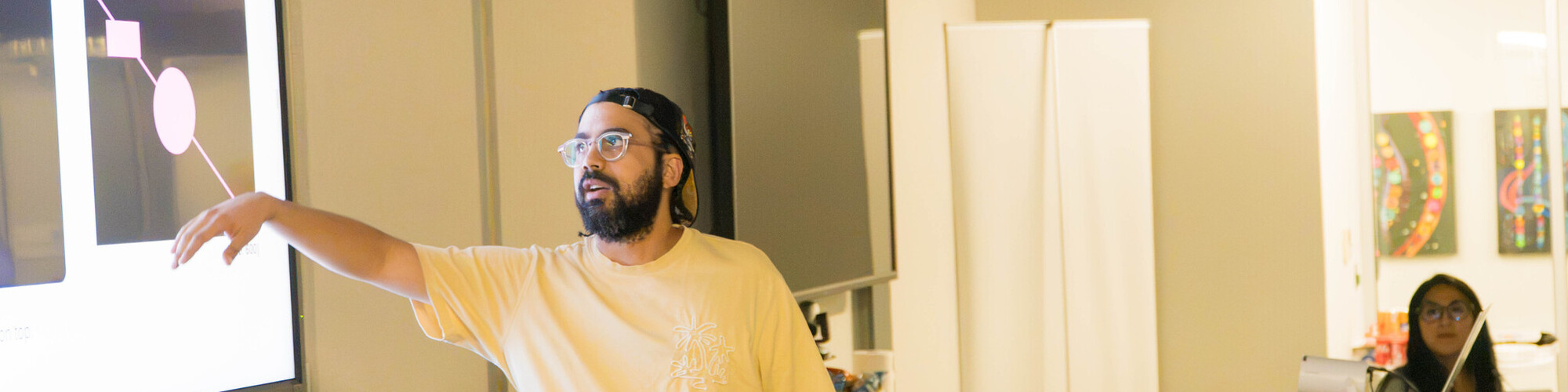
Waskar Paulino is a software engineer who builds AI products, and a Technical.ly 2025 RealLIST Innovator. He is the founder of PhilaCon Valley, a Philadelphia tech community for people who build. Its PATCH series of hands-on labs puts designers, engineers, and artists in one room to make things, from NFC hardware to projection mapping.
He is a former startup CTO. Before that, he spent seven years at Apple as a Genius and trainer. He started his career teaching Spanish and music to young people in Philadelphia. He is a first-generation AfroLatinx technologist who explains technology the same way to a boardroom or a beginner.
He speaks on AI in production, AI-assisted building, creative coding, and community-led growth. At the AI Community Conference at Microsoft in New York, he presented "From Pixels to Meaning: Building an AI Content Pipeline That Actually Works." He has also spoken at Philly JS Club, OwlHacks at Temple University, FamCon, and The Moonlighters' Club Showcase. He has been a panelist at Technical.ly's Builders Conference during Philly Tech Week, at Per Scholas Philadelphia, and on AI infrastructure with Unisys in Allentown.
Coming up: he leads the PhilaCon Valley creative-tech activation at Founders Alley Philadelphia in October 2026. In December 2026 he co-hosts The AI Confessional at The AI Summit New York.
Area of Expertise
Topics
Make Sound Visible: Audio-Reactive Visuals in the Browser
Music is already data. Every beat, every bass hit, and every quiet moment is a number your browser can read.
I'm a DJ and a software engineer, and I build visuals that move with sound in real time, using JavaScript, the Web Audio API, and Meyda for audio analysis. In this 20-minute session, I'll play music, show the visuals respond live, and open the code, so you see how little it takes: read the audio, pick a feature, and map it to something you can see.
I've given this as a talk at Philly JS Club and as a live build at FamCon. Everyone leaves with a link to a running open-source visualizer they can fork.
Any Wall Is a Screen: Projection Mapping From a Browser Tab
You don't need a headset or a game engine to change a room. You need a browser tab, a projector, and a surface.
On September 30, 2026, PhilaCon Valley put five projectors, five mapped surfaces, and about twenty people in one room in Philadelphia. Many came from design, and some had never written code. Each person wrote p5.js in the browser, saw it land on a real object that same night, and left with the files on their own laptop.
In 20 minutes, I'll show the starter template we used and map a sketch onto a physical surface live on camera. I'll also share what broke, and the design choices that took a beginner from zero to a projected piece in one evening.
The Wrong Number: What Happens When a CTO Guesses Confidently
I told my team our AI pipeline processed images in batches of 50. The real number was 5. They built a sprint plan around my wrong answer, and nobody questioned it, because I said it with confidence.
This talk is about technical leaders who optimize for sounding certain instead of being accurate. I'll share the moments where my unverified claims shaped real product decisions. I'll show the codebase audit I ran that same day to fact-check myself, and the pre-meeting system I now use before every architecture discussion.
You leave with:
- A way to calibrate technical confidence at an early-stage startup
- A pre-meeting checklist you can use Monday morning
- Permission to say "let me verify that," and proof that it builds more trust than having every answer
For first-time CTOs, tech leads, and anyone who has ever guessed a number in a meeting.
Adaptable to 5, 15, 20, 30, or 45-minute slots. Drawn from my time as CTO of an AI-powered creative workspace. Target audience: engineering leaders, startup founders, and tech leads.
Code as a Canvas: What DJing Taught Me About Building Software
Long before my years as a startup CTO, I was a DJ. Before that, I played lead guitar in a band and burned CDs for my friends. Before that, I was a kid drawing on everything.
This talk is about what happens when you stop treating your creative life and your engineering career as separate things. I'll walk through five skills from the DJ booth that shaped how I build software. Reading a room is user research. Mixing live is production debugging. Knowing when the crowd is done with a track is feature deprecation.
Optional live demo: a Pioneer DDJ-REV1 driving real-time visuals built in JavaScript. This is the same audio-visual work I presented at Philly JS Club and FamCon.
For anyone who has felt their non-technical passions don't belong on a resume.
Adaptable to 5, 15, 20, 30, 45, or 90-minute (workshop) formats. Includes an optional live DJ hardware demo with a Pioneer DDJ-REV1. Related audio-visual work presented at Philly JS Club (September 2025) and FamCon (September 2026). Target audience: developers, creative technologists, and anyone with a non-traditional path into tech.
From Pixels to Meaning: Building an AI Content Pipeline That Actually Works
Every AI demo looks magical. Then you ship it, and your image analysis returns "this is a photo" for 30% of uploads. Your embedding model invents categories that don't exist. Your users' searches return confidently wrong results.
When I was CTO of an AI startup, I built a content pipeline for a creative workspace used by design teams. It analyzed images, generated semantic embeddings, and powered natural-language search across visual libraries. It used Gemini for vision and embeddings, Claude for conversation, and a custom orchestration layer on Convex.
This talk covers what broke, what we fixed, and four lessons from shipping it:
- Why every AI response gets validated against a strict schema before it touches the database, and the production incident that taught us that
- Adaptive batching sized to real throughput limits, not the number you assumed
- A priority queue that keeps interactive features fast while background analysis runs behind
- Why retrieval with reciprocal rank fusion beat pure vector search for creative content
Real code, real failure modes, and real before-and-after search results. You leave with patterns you can use Monday morning.
Delivered at the AI Community Conference - New York (Microsoft, 11 Times Square), June 26, 2026. Adaptable to 20, 30, or 45 minutes. Target audience: engineers and technical leads who ship AI features to real users.
The Deli Line Problem: Building an AI Pipeline That Doesn't Fall Over
When your image analysis, search embeddings, and chat assistant all share one queue, you have a deli line problem. The customer who wants one slice waits behind the catering order.
When I was CTO of an AI startup, I built a multi-provider AI pipeline on Convex. It used priority queuing, circuit breakers, and adaptive batching. The same real-time architecture served a web app (TanStack Start) and a mobile app (React Native) with shared business logic.
I'll walk through the design, the failures that shaped it, and how to tell which of your AI jobs belong at the front of the line.
Adaptable to 20, 30, or 45 minutes. Target audience: full-stack and backend engineers adding several AI features to one product. Companion talk to "From Pixels to Meaning," delivered at the AI Community Conference - New York, June 2026.
When Your AI Becomes a Teammate: Fitting Agentic AI Into a Small Team's Flow
Six months into building an AI-powered creative workspace, my four-person team added an AI agent. It analyzed uploads, pulled client and contact profiles out of conversations, and scored feedback sentiment. On paper, it removed cognitive load. In practice, it created new load we did not plan for.
This is the honest story of that integration. The agent surfaced information nobody asked for. We had to build trust boundaries before we improved accuracy. Then we found the interaction model that worked: the AI as a teammate with a defined "team API," not a magic oracle.
If you plan to add agentic AI to your team, you get the real tradeoffs, not the vendor pitch.
Adaptable to 20, 30, or 45 minutes. Drawn from my time as CTO of an AI startup. Target audience: engineering managers, tech leads, and small product teams adding AI agents to their workflow.
Feeling Fast vs. Being Fast: Building With AI Without Losing the Plot
Experienced developers predicted AI would make them 24% faster. Afterward, they believed it had made them about 20% faster. When METR measured the work in 2025, they were 19% slower.
I have felt that gap in my own work. This session teaches the four moves I use to close it: spec before prompt, small slices that you run every time, feed the model the real error and not your memory of it, and keep the human twenty percent human. Each move is demonstrated live, not explained on slides.
In workshop format, everyone leaves with a working change in their own project and a one-page card of the flow. It is tool-agnostic, with no installs, and works with Claude Code, Cursor, Copilot, or a browser chat window. The goal is not to go faster. The goal is to still be able to explain every function you shipped.
First delivered as a workshop at OwlHacks '26, Temple University, September 2026. Runs as a 30-45 minute talk or a 60-minute hands-on workshop. Attendees need a laptop with their own project; nothing to install. Target audience: students, early-career developers, and teams adopting AI coding tools.
The AI Confessional: What People Won't Admit They Don't Understand
Everyone at work is supposed to "get" AI by now. Most people don't, and they won't say so in a meeting.
The AI Confessional is an interactive session. Attendees post, anonymously, what they don't actually understand about AI in their jobs. I then translate the top questions into plain English, live, in a few minutes each. I learned to do that as an Apple Genius, explaining technology to anyone who walks up to the bar.
It works for 20 people or 200, and it runs 30 to 60 minutes.
Interactive format. Debuts as a Partner-Led Meetup at The AI Summit New York (Javits Center), December 9, 2026. Needs a way for attendees to submit anonymous questions (a physical board or a QR-code form). Works in a lounge, breakout room, or main stage. Target audience: non-technical professionals, managers, and anyone expected to "use AI" at work.
STEAM, Not STEM: Taste Is the Last Scarce Thing
You don't break into tech by learning to code. You break in by having taste, and then reaching for whatever tool serves it.
AI cut the cost of a first version to almost zero. That did not make taste less valuable. It made taste the only scarce thing left. I'm living proof of that path: a former music teacher and Apple trainer, a DJ turned software engineer, and a former startup CTO.
The session opens with sound, not slides. Then the room directs me as I build an audio-reactive visualizer live, with AI. Everyone leaves with a running visualizer that responds to their own music, and the code to keep changing it.
First delivered at FamCon '26 (FamFrequency Productions), Philadelphia, September 2026. 45-50 minutes. Needs a screen with HDMI and room speakers for the audio. Attendees need only a phone or laptop with a browser. Target audience: creatives, musicians, career changers, and anyone told they are "not technical."
Build It in the Room: Designing Tech Events Where People Make Things
Most tech events are people watching other people talk. PhilaCon Valley's PATCH labs work the other way: designers, engineers, and artists build something together in one evening. They have built sound-reactive visuals, NFC hardware, and projection mapping, and everyone takes the files home.
I'll share the design rules behind the series: the takeaway is proof, not a souvenir. The north star is one feeling: "I did not know people could do this." I'll also share the honest numbers on why people RSVP and don't come, and what we changed.
For community organizers, DevRel teams, and anyone who runs events and wants people to come back.
Based on the three PATCH labs PhilaCon Valley ran in Philadelphia in 2026, including real turnout data (one lab drew 72 RSVPs and about 24 attendees). Adaptable to 20, 30, or 45 minutes, or a 60-minute working session for organizers. Target audience: community organizers, DevRel and developer-community teams, and event producers.
You Don't Have to Leave Your Identity at the Door: Founder-Led Marketing
"When I walk into rooms, I don't have to leave my identity at the door. It's because I created that expectation through the marketing of my voice."
I'm an engineer, a founder, a DJ, and a first-generation AfroLatinx technologist, and I stopped running separate online and offline versions of myself. This talk shows how one honest public voice became my most useful founder tool. It brought speaking invitations, partners, and a community that knows who it is joining. It covers what to post, what to leave out, and how to start with one true sentence.
Grew out of the "Founder-Led Marketing" panel at Technical.ly's Builders Conference during Philly Tech Week, May 2026. Adaptable to 20 or 30 minutes, or as a panel contribution. Target audience: founders, early-stage operators, and technologists building a public presence.
Coding Rave with SarahPStudio + Waskar Paulino
Use your phone, tablet, handheld, or anything else that connects to the internet to code live visuals to live music. Bonus points if it has a microphone.
Waskar Paulino DJs live while SarahPStudio shows you how to create your own music-reactive visuals. We start with a short, beginner-friendly tutorial using an app Sarah built with HydraJS, then turn the room loose to experiment, remix, and play along.
By the end, everyone can contribute their visuals to the Coding Rave, creating a collaborative projection shaped by the music and the people in the room. Share what you make with each other and on social media, or just enjoy making something strange, colorful, and alive.
No coding experience required. Bring a device and curiosity.
Co-presented with Sarah Peony (SarahPStudio), software engineer, streamer, and creative coder. Sarah teaches the visuals with her HydraJS app; Waskar DJs live. Submitted to Super MAGFest 2027 (National Harbor, MD). Needs a projector, a sound system, DJ table space, and Wi-Fi for attendees' devices. Works for all ages and all experience levels.
AI Community Conference - New York Sessionize Event
Please note that Sessionize is not responsible for the accuracy or validity of the data provided by speakers. If you suspect this profile to be fake or spam, please let us know.
Jump to top