

William Janssen
CTO & Head of Engineering | Author of a book on the EU Cyber Resilience Act | Building the operational side of CRA compliance | Ex-Red Hat & Founder
The Hague, The Netherlands
Actions
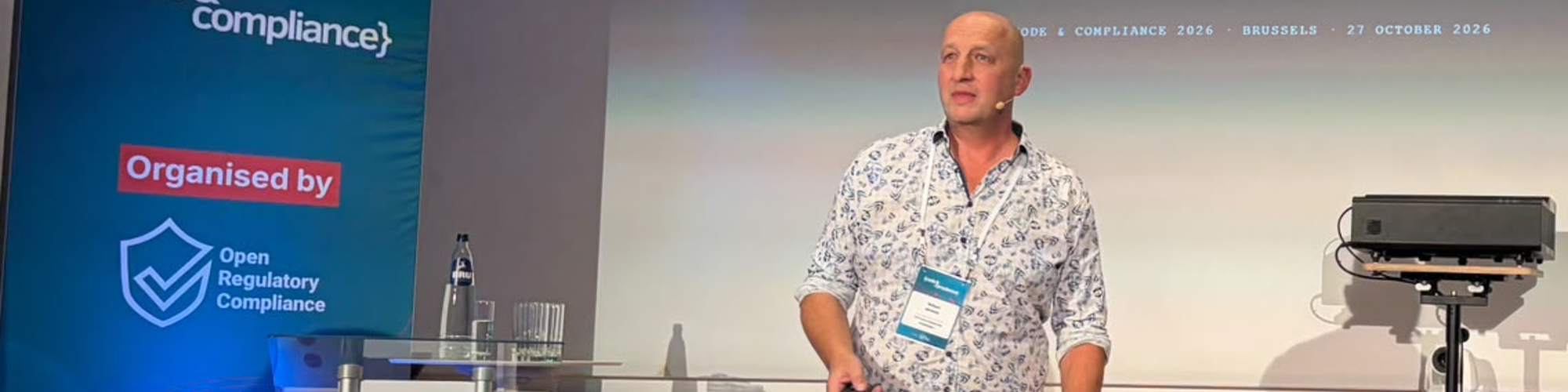
William Janssen is founder, CTO & Head of Engineering at TrustEngine. He has spent his career on the supplier side of software: he founded and ran companies that built patient portals for healthcare and a platform-as-a-service, and worked at Red Hat. He has seen what shipped software costs to support over its lifetime. He is the author of Einde van het MVP-tijdperk, a Dutch-language book on the EU Cyber Resilience Act, and speaks on the regulation at events including the Linux Foundation Member European Forum in Prague and Code & Compliance in Brussels. He also writes about it, most recently in IAM 360 magazine.
Badges

Area of Expertise
Topics
Transparency Upstream, Evidence Downstream: SBOMs, AI Code and the CRA
Given at Code & Compliance 2026, Brussels, 27 October 2026.
One fictional manufacturer, one real vulnerability, and today’s law. Maria spends a Log4Shell day under the EU Cyber Resilience Act, and her record is built from upstream signals: advisories, package URLs, SBOMs and VEX.
The talk shows why SBOMs taken from source, build, shipped artefact and running fleet give four different answers, and how a PHP interpreter that came with a base image can be in everything you shipped and in nothing you declared, as the October 2026 PHP flaws showed. It covers when the 24-hour reporting clock actually starts, why the same component version can lead to different verdicts, and what VEX cannot record: confidence in the verdict. It asks what a support period means when seven-year-old firmware has to be rebuilt, and what to keep when AI writes the code: the result, the toolchain and the reasoning, not the prompt. It closes with who signs, the manufacturer and not the maintainer, and with the second reader of the record: product liability under the revised Product Liability Directive.
What the Cyber Resilience Act gives CISOs, and what still belongs in the contract
Most talks on the EU Cyber Resilience Act (CRA) are about manufacturers. This one is for the buyer.
Since 11 September 2026, manufacturers selling products with digital elements on the EU market must send an early warning within 24 hours of becoming aware of an actively exploited vulnerability in their product. This also applies to products placed on the market before that date, and manufacturers must inform affected users. Products placed on the market from 11 December 2027 must also meet security requirements. Their manufacturers must tell buyers at the point of sale how long they will receive security updates, and provide those updates free of charge during that period, unless a business buyer agrees otherwise for a tailor-made product.
Some things you used to negotiate are now law. Others are not, and that is where buyers often get it wrong. Many assume suppliers must hand over a full SBOM. They do not: manufacturers must keep one, but sharing it with users is optional. Many also assume the new legislation creates a right for businesses to recover their own losses from suppliers. It does not. Liability between buyer and supplier remains primarily a matter of contract and national law.
I work with manufacturers on their CRA obligations, and this session ends with a one-page checklist: what the law now gives you, when each obligation applies, and what you still need to put in the contract.
Attendees will learn:
Which supplier duties give you new security information, and from when.
Which common supplier demands, from SBOMs to liability, still belong in the contract.
How to feed manufacturer notifications and support-period dates into your own vulnerability and lifecycle processes.
Transparency Upstream, Evidence Downstream: Manufacturers and Open Source under the CRA
The Cyber Resilience Act settled the legal side of the open source relationship: product responsibility stays with the manufacturer, stewards carry a light-touch regime, maintainers shielded from manufacturer-grade duties. The operational side is far less settled. Manufacturers must consume and interpret upstream security signals, but what that takes is rarely described from the manufacturer's seat.
This session walks that seat in concrete terms. From 11 September 2026, a manufacturer has 24 hours from awareness of active exploitation to file an early warning. Awareness at that speed is only dependable when machine-readable upstream signals (SBOMs, VEX, provenance, project health) are continuously correlated against what was actually shipped, per product, per configuration, with the record written as it happens, not assembled afterwards.
It also covers the return path: contributions rather than contracts, funding rather than warranties, and a defence of the transparency-versus-assurance boundary that keeps the voluntary model sustainable.
Presented three and a half weeks after the reporting duty goes live, it closes with first field observations from September.
CISO Forum Virtual Summit 2026 Sessionize Event
William Janssen
CTO & Head of Engineering | Author of a book on the EU Cyber Resilience Act | Building the operational side of CRA compliance | Ex-Red Hat & Founder
The Hague, The Netherlands
Actions
Please note that Sessionize is not responsible for the accuracy or validity of the data provided by speakers. If you suspect this profile to be fake or spam, please let us know.
Jump to top