
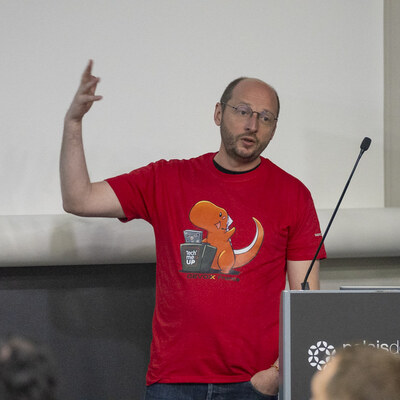
Matthieu Vincent
Platform engineering CTO / Tech'Advocate
Vichy, France
Actions
✍️ All my references are available @ https://me.yodamad.fr
🎤 Speaker since 2022 @ Devoxx FR, @SnowCamp, multiple DevFest, Innersource summit, ...
🌋 Co-founder of Volcamp @Clermont-Fd : https://volcamp.io
🦊 Gitlab hero | 🤖 R2Devops ambassador
Links
Area of Expertise
Topics
Kyverno: Keep control on your clusters
Controlling your clusters is a real challenge and governance is becoming key.
With multiple teams deploying resources, manual checks quickly become the bottleneck, and misconfigurations—like privileged containers or missing resource limits—inevitably slip through. , but you don't want to learn a complex new language to get it.
In this session, let's discover how Kyverno can help you keep control over your cluster with a Policy-as-Code approach.
With Kyverno: automatically fix configurations, generate required resources on the fly, and clean up the cluster "noise."
We'll explain and illustrate with live demos the different kinds of policies provided by Kyverno and how it will help you manage your clusters
📜 Don't like to write doc ? You don't know Zensical then !
Writing documentation, most of us don't like this : it's boring, most of time ugly, in short we don't do it...
Fun fact : I like this even if I'm definitely not a good designer so probably very few people read it 😅 But one day, everything changed when I discovered Zensical (formerly mkdocs) !
Zensical with its large set of plugins and extensions make it super easy to build readable, structured & pretty documentation
Come and discover these features, which I hope like me, will bring back the joy and wish of writing documentation.
In this presentation, I'll show how to start from scratch and initialize a cool tech website, efficient and who make your friends want to read again
🏴☠️ Fun with (Feature) Flags
In this talk, we invite you to discover the concept of Feature Flags ✨ in the Java ecosystem.
This deployment pattern is widely used, particularly on large public-facing websites, to test new functionalities "in production," deploy several concurrent versions of application features without the need for a full redeployment, and consequently, to observe end-user behavior.
By the end of this talk, you'll be just like Sheldon, wanting to have "fun with (feature) flags"!
Docker Compose: Rediscovered
In this session, let's rediscover Docker Compose.
We will move past the basics and explore the useful features introduced in the last versions that turn Compose from a simple runner into a sophisticated development orchestrator.
Some samples features that we'll discover and illustrate with live demos:
* Using "include" and "extend"s to modularize your configurations and keep your project DRY.
* How to manage environment-specific services (like debugging tools or heavy cron jobs) without cluttering your production-ready files with "profile"
* How to use "develop" and "watch" to eliminate manual container rebuilds and achieve true hot-reloading.
In this session, let's rethink our way to use Docker compose and make it even more efficient.
AI-powered Platform Engineering : A good idea ?
Since 2018, we have been developing our Platform Engineering program (formerly known as DevSecOps platform) and now have 11,000 users who rely on it every day.
With the rise of AI, we had to integrate these new tools and patterns into the platform to effectively (and securely) support teams in their adoption and skill development — all while maintaining a smooth “Developer Experience” that fits seamlessly into the existing ecosystem.
In this talk, we’ll share a return of experience (REX) on the journey of this platform — which, like Rome, wasn’t built in a day — and how we supercharged it with AI-driven initiatives to cover a wide range of use cases (from classic code generation to more operational needs like test coverage or code review). And to prove it’s real, we’ll showcase live demos of the different tools we’ve implemented.
By the end of this session, you’ll walk away with ideas to bring similar initiatives to life in your own organization 😉
ArgoCD vs Flux: Who will be the Lord of GitOps?
With GitOps becoming a standard in platform engineering, the parallel is easy with Lord of the Rings: a tool to rule them all.
But, who will be the Lord? In the CNCF landscape, 2 solutions seems to take the lead: ArgoCD & Flux.
Join Paul (ArgoCD fan) & Matthieu (Flux fan), and let's discover their common points and differences and thus know which should become the Lord of GitOps.
After a quick reminder about GitOps, "App for Apps" pattern, we'll deep dive into a comparison of both tools, of course illustrated with demos.
And, finally, we'll share with you which one is the Lord of GitOps (or not 😉), or at least, some clues to understand which are the contexts to use either one or the other 😊
Don't like yaml ? Pulumi to the rescue !
In this presentation, I'll show how to setup a Kubernetes cluster and some samples deployments without a line of yaml but only code (Golang mostly). This is where Pulumi make the trick: no yaml, only code to help "classic" developers onboards infrastructure management.
Workstation-as-Code with Mise: Killing "It Works on My Machine"
That's weird, it works on my machine." We’ve all heard at least, one time, this phrase. While Infrastructure as Code has revolutionized how we manage our infrastructures, our local development environments often remain fragile snowflakes with outdated READMEs that nobody reads.
Let’s explore the Workstation-as-Code approach using Mise. Far more than a simple version manager, Mise is the ultimate Swiss Army knife for developers and platform engineers. Key capabilities include:
* Runtime Management: Declaratively manage and lock versions of Java, Python, Terraform... across your entire team.
* Environment Management: Replace direnv to seamlessly inject environment variables, secrets, and cloud contexts right when you need them.
* Task Running: Say goodbye to cryptic Makefile syntax and fragmented shell scripts with a modern task orchestrator
In this talk, we will explore how Mise shrinks a painful three-day onboarding process down to a single `mise install` and the AsCode approach to easily share everything accros a team.
We’ll demonstrate how to standardize toolchains across an entire engineering organization, eliminate configuration drift between local dev and CI/CD, and why Mise is rapidly becoming the must-have tool for Developer Experience (DevEx) and Platform Engineering.
From Beginner to Intermediate (no prior Mise experience required; basic familiarity with CLI tools, environment variables, and CI/CD pipelines is helpful).
Key Takeaways: Attendees will leave with samples of configurations covering several use cases: to unify runtime versions, environment variables, and task automation across local machines and CI runners—eliminating the gap between local development and production pipelines.
Zero-Friction Workshops with EasyLab: Getting 30 Attendees Running in Under 5 Minutes
Running a hands-on workshop seems easy—right up until 30 attendees show up with 30 different laptop configurations. Suddenly, disaster strikes: your carefully crafted session turns into a one-on-one troubleshooting marathon.
After experiencing this pain on my own too many times 😅, I decided to tackle the problem head-on by building EasyLab, an open-source project born from a simple expectation: instructors should focus on delivering great content, not fighting fragile local environments. By automating ephemeral cloud workspaces, EasyLab brings Infrastructure-as-Code reliability to live training and hands-on labs.
In this session, we’ll build a complete workshop setup from scratch. We will walk through:
* Automated Lifecycle Management: Provisioning underlying cloud infrastructure, defining reusable workshop templates, granting instant attendee access, and automating post-session teardown to avoid surprise cloud bills.
* The Instructor Experience: Using admin controls to broadcast notifications, monitor progress, and jump in to unblock struggling participants in real time.
* The Attendee Experience: Spinning up a pre-configured browser workspace in seconds, following the lab smoothly, and submitting feedback seamlessly.
Our goal is simple: move from "It doesn't work on my machine" to "Everyone is coding in under 5 minutes!"
Technical Level: All Levels / Beginner-to-Intermediate (no prior EasyLab knowledge required; basic familiarity with containers, cloud infrastructure, or running technical workshops is helpful).
Key Takeaways: Attendees will learn how to eliminate setup drift for live trainings using an open-source self-hosted/cloud-native tool, leaving with a repeatable workflow for provisioning, managing, and tearing down isolated lab environments cleanly.
BreizhCamp 2026 Sessionize Event
DevFest Toulouse 2024 Sessionize Event
BreizhCamp 2023 Sessionize Event
Matthieu Vincent
Platform engineering CTO / Tech'Advocate
Vichy, France
Links
Actions
Please note that Sessionize is not responsible for the accuracy or validity of the data provided by speakers. If you suspect this profile to be fake or spam, please let us know.
Jump to top